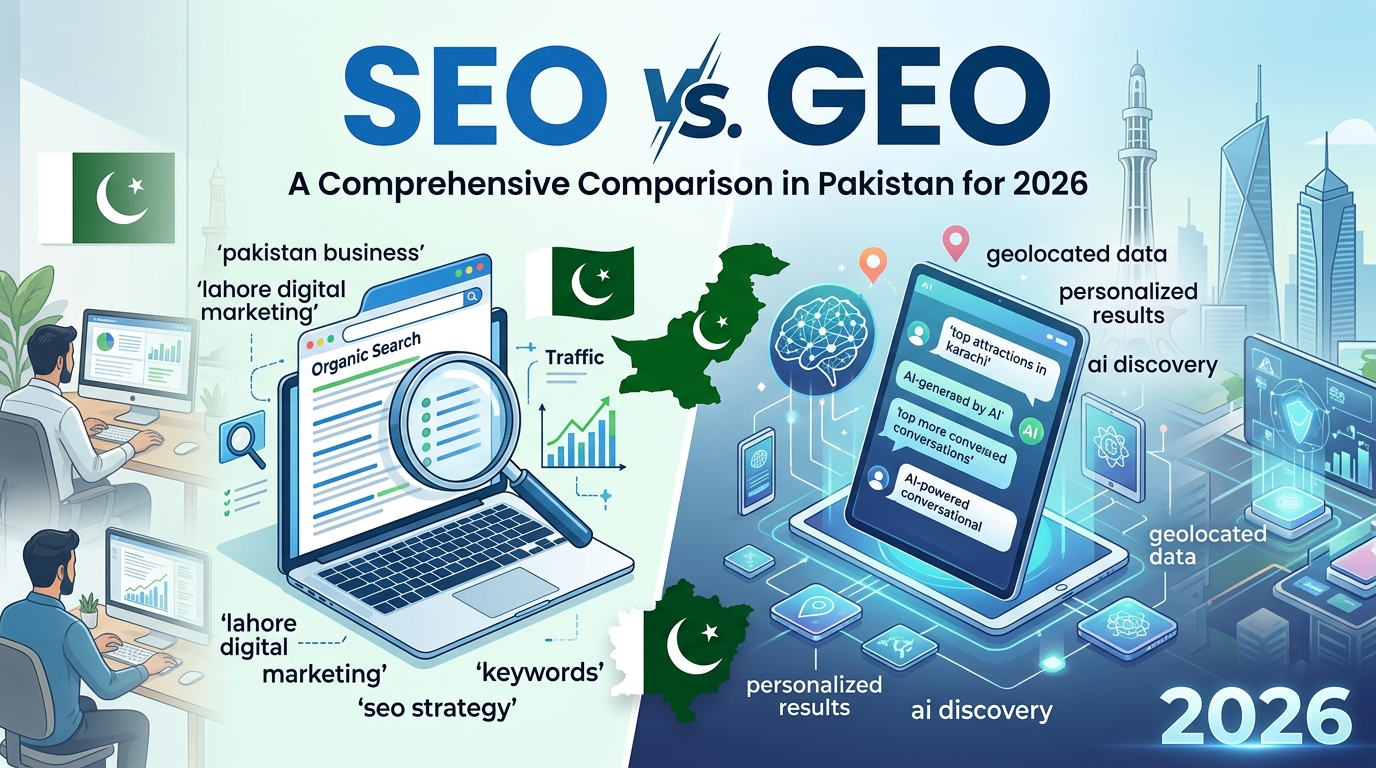
SEO vs GEO in Pakistan (2026): What Businesses Need to Know About AI Search
Search is changing in 2026. People still use Google to find products, services, businesses, and information. At the same time, they can receive AI-generated answers that summarize information from multiple sources.
For example, Google AI Overviews and AI Mode bring this shift into Google Search. Meanwhile, AI answer and search platforms such as ChatGPT and Perplexity provide other forms of AI-assisted discovery. Google’s current guidance makes an important point: SEO remains foundational for its generative AI search features.
This has led to growing interest in Generative Engine Optimization (GEO). For businesses in Pakistan, however, GEO should not be treated as a replacement for SEO or as a secret Google ranking system. It is better understood as an industry term for work intended to improve visibility, representation, or citations within AI-generated search and answer experiences.
What Is SEO?
Search Engine Optimization (SEO) is the practice of improving a website so search engines can discover, understand, and evaluate its pages for relevant searches.
For a Pakistani business, SEO may involve several connected areas:
- On-page SEO: One Page SEO includes Clear page titles, headings, useful content, internal links, and relevant terminology.
- Technical SEO: Technical SEO includes Crawlability, indexing, mobile accessibility, performance, and a sound site structure.
- Local SEO: Accurate business information, Google Business Profile data, local relevance, and location-based searches.
- Off-page signals: Relevant references and links that help establish reputation and authority.
For AI search, these fundamentals still matter. Google says its generative AI features use information retrieved from its Search index. In addition, a page must be indexed and eligible to appear in normal Google Search to be eligible for supporting links in AI Overviews or AI Mode. Even then, meeting the requirements does not guarantee crawling, indexing, or inclusion.
What Is GEO?
GEO, or Generative Engine Optimization, is an industry term rather than an official Google ranking system. It is commonly used to describe efforts aimed at improving how a business, website, product, or piece of content may be surfaced, represented, or cited in AI-generated answers.
The terminology can vary across the SEO industry. However, Google says that, from its perspective, optimizing for generative AI search is still part of optimizing the search experience and therefore remains SEO.
That distinction matters because there is no universal GEO checklist that guarantees an AI citation. Tactics presented online as special AI-ranking requirements should be treated carefully unless they are supported by evidence or official documentation.
For example, a Pakistani business might publish a detailed guide answering:
“What should a small business in Lahore consider when comparing SEO services?”
An AI search system may use information from several sources to construct an answer. A clear and trustworthy page can therefore be useful as source material, but publication alone does not guarantee that the page will be selected or cited.
SEO vs GEO: What Is the Difference?
The simplest distinction is the type of search experience being considered.
| Area | SEO | GEO |
|---|---|---|
| Main goal | Improve visibility in search engines | Improve visibility or representation in AI-generated answers |
| Primary environment | Traditional search results and search features | Generative AI and AI-assisted search experiences |
| Common outcomes | Rankings, impressions, clicks, conversions | Mentions, citations, references, and broader AI visibility |
| Content emphasis | Relevance, usefulness, search intent, and quality | Clear information, context, usefulness, authority, and source quality |
| Technical foundation | Crawlability, indexing, accessibility, site structure | The same underlying SEO foundations for Google Search |
| Measurement | Search Console, rankings, traffic, conversions | AI visibility signals plus search, referral, brand, and conversion data |
Therefore, the two are not opposing strategies. A well-built page can support traditional search visibility while also providing useful source material for AI-assisted discovery.
How AI Search Changes the Search Journey
In traditional search, the journey often follows a simple path:
Query → Search results → Website → Answer
By contrast, AI-assisted search can work differently:
Question → Related searches → Multiple sources → Synthesized answer → Supporting links
Google explains that its generative AI systems can use retrieval-augmented generation (RAG) and query fan-out. Query fan-out means the system can issue multiple related searches to explore different parts of a complex question before producing a response.
As a result, a business page does not need to match only one exact keyword. Instead, it needs to provide useful information within the wider context of the topic.
That is why clear explanations, useful examples, relevant entities, and accurate supporting information can remain valuable beyond a single keyword ranking.
Why AI Search Matters for Pakistani Businesses
AI search is not just a future concept for Pakistani businesses. Google’s current availability documentation lists Pakistan for AI Overviews and AI Mode. However, feature availability, language support, and user eligibility can change over time.
The opportunity becomes especially relevant when customers ask detailed questions rather than short keyword queries.
For example, someone may search:
“SEO company in Lahore”
But an AI-assisted query could be:
“What should I look for when comparing SEO companies in Lahore for a small business?”
The second query requires more than a location and service phrase. A useful answer may depend on expertise, pricing factors, services, experience, evidence, and business context.
Pakistan also has a diverse search environment. Depending on the audience, queries may be written in English, Urdu, Roman Urdu, or a mixture of languages. Therefore, businesses should focus on understanding the questions their customers actually ask rather than producing separate pages for every possible wording.
How SEO and GEO Work Together
Instead, the practical approach is usually to build one strong content and search foundation rather than creating two disconnected systems.
1. Make Important Pages Crawlable and Indexable
First, AI visibility cannot compensate for a page that search engines cannot properly access or index. For that reason, technical accessibility and sound site architecture remain fundamental.
2. Answer the Main Question Clearly
Next, state the main answer early and organize supporting information logically. Clear headings and concise explanations help users understand the page. They also make its subject easier for search systems to interpret.
3. Build Useful, Original Content
Likewise, Google’s guidance emphasizes unique, valuable, people-first content rather than material created primarily to manipulate search systems.
Original research, genuine expertise, useful examples, first-hand knowledge where appropriate, and information that adds value beyond common summaries can make a page more useful.
4. Add Context Around Important Entities and Topics
Explain what a business does, which products or services it provides, where it operates, and how related concepts connect. This gives both people and search systems a clearer understanding of the subject.
5. Keep Information Accurate and Current
Meanwhile, outdated information can reduce usefulness and trust. Review important pages periodically, especially pages containing prices, service details, business information, regulations, statistics, or other facts that can change.
6. Use Structured Data Where It Makes Sense
Structured data can help Google understand eligible content types and can support relevant search features. However, structured data is not a special GEO requirement and does not guarantee AI citations. Therefore, use it where it genuinely fits the content rather than treating it as an AI-search shortcut.
Importantly, Google’s current generative AI guidance says there is no special schema.org markup required for appearing in its AI search features.
7. Avoid Unproven GEO Hacks
Google’s current guidance also warns against several popular assumptions, including the idea that websites must create special AI files, break content into tiny chunks, rewrite everything specifically for AI, or pursue artificial mentions simply to influence generative search.
Instead, for Google Search, the more durable approach is to follow established SEO practices and create genuinely useful content.
What Does This Mean for Local Businesses in Pakistan?
For local businesses, strong local search foundations still matter. A business serving Lahore, Karachi, Islamabad, or another city should make its location, services, contact details, and other important business information clear and consistent.
Google also advises businesses to keep their Business Profile information up to date as part of its guidance for generative AI search.
Consider searches such as:
- SEO services in Lahore
- dentist in Karachi
- software company in Islamabad
- restaurant near me
- wedding photographer in Faisalabad
These searches have strong local intent. Therefore, GEO should not replace local SEO. Useful local information can instead become part of a broader search presence that serves both conventional and AI-assisted discovery.
Should Small Businesses in Pakistan Invest in GEO?
Small businesses should not start by buying into a collection of GEO tricks. Nor should they treat GEO as a separate ranking system.
A stronger starting point is to build a reliable search foundation:
- Make important pages accessible and indexable.
- Create useful content around genuine customer questions.
- Explain products and services clearly.
- Build topical depth within the business’s area of expertise.
- Keep business information accurate and current.
- Earn legitimate references and links from relevant sources.
- Monitor search visibility, traffic, brand demand, and conversions.
As a result, these actions support conventional SEO and can also help a business provide useful source material for AI-assisted search experiences.
Common SEO vs GEO Misconceptions
“GEO Will Replace SEO”
First, there is no good reason to treat GEO as a replacement for SEO. Google’s current guidance explicitly says that SEO best practices remain relevant because its generative AI search features are built on core Search systems.
“There Is Special GEO Schema”
Second, there is no special schema.org markup required for Google generative AI search. Structured data can still be useful for normal Search features when implemented correctly. However, it is not a guaranteed AI visibility mechanism.
“You Need to Write Differently for AI”
Third, Google says you do not need to rewrite content in a special way just for generative AI search. Its systems can understand synonyms and broader meanings. Therefore, chasing every keyword variation is not necessary.
“More Mentions Automatically Mean More AI Visibility”
Not necessarily. Google warns against pursuing inauthentic mentions. Instead, high-quality, relevant information and legitimate references are more defensible than attempts to manufacture citations.
“AI Search Makes Website Clicks Irrelevant”
AI experiences can change how users discover information. Nevertheless, clicks, organic traffic, engagement, leads, and conversions remain important business outcomes. AI visibility should therefore be evaluated as part of the wider customer journey.
How Should Businesses Measure AI Search Visibility?
However, AI visibility is harder to summarize with one universal metric than traditional rankings.
Google has introduced a Generative AI performance report in Search Console for monitoring performance in its generative AI search features. Businesses can also use analytics, referral data, branded-search trends, conversion tracking, and carefully documented manual checks to understand how their visibility changes.
The important point is not to invent a single “GEO score” and treat it as a ranking guarantee. Because AI responses can vary by query, context, user, location, and system, measurement should focus on patterns rather than isolated observations.
Which Should a Pakistani Business Focus on First?
For most businesses, SEO should come first. That priority gives the website a durable foundation for both conventional search and AI-assisted discovery.
That means establishing the technical and content foundations that make a website accessible, useful, relevant, and trustworthy. Once those foundations are strong, businesses can make the same content more useful for AI-assisted discovery by improving clarity, depth, context, originality, and factual accuracy.
Ultimately, this is more sustainable than creating a completely separate GEO program based on unproven shortcuts.
The Practical Takeaway for 2026
Overall, SEO and GEO are best understood as overlapping approaches to a changing search environment.
SEO is the established discipline for improving visibility in search. GEO is an industry term for efforts focused on visibility within generative AI and answer experiences. For Google, those generative experiences are still rooted in SEO and core Search systems.
For Pakistani businesses, the practical response is straightforward. Build technically sound websites, publish helpful and original information, answer real customer questions, maintain accurate business details, strengthen relevant topical authority, and avoid AI-search hacks that are not supported by evidence.
Ultimately, the goal is not to write for a machine instead of a person. It is to create information that is clear enough for people to use and trustworthy enough to deserve visibility wherever modern search takes place.
Frequently Asked Questions About SEO vs GEO
SEO is the established practice of improving a website's visibility in search engines. GEO is an industry term commonly used for efforts focused on visibility, representation, or citations in generative AI and AI-assisted search experiences. The two overlap, and strong SEO fundamentals can support both.
No. GEO is not a replacement for SEO. For Google, AI Overviews and AI Mode still rely on core Search systems and established SEO foundations. Businesses should therefore continue investing in crawlability, indexing, useful content, relevance, and trust while adapting to changes in how people search.
Yes. AI-assisted search is part of the changing search environment, and Pakistani businesses can prepare by publishing clear, accurate, original information that answers genuine customer questions. However, the importance and availability of specific AI features can vary by country, language, account, and time.
No special GEO schema guarantees inclusion in Google's AI search features. Structured data can help search engines understand eligible content when it is used correctly, but it should support the content rather than serve as an AI-search shortcut.
Usually, no. A better approach is to build useful content that satisfies people, follows sound SEO practices, and provides clear context. You can then improve its clarity, structure, originality, and factual accuracy without creating a completely separate GEO content system.
Start with the basics: make important pages accessible and indexable, answer real customer questions, explain products or services clearly, keep business information current, build relevant authority, and earn legitimate references. These actions support conventional SEO while also creating useful source material for AI-assisted discovery.
Yes. Google has introduced Search Console reporting for visibility from generative AI features, although the new reporting is being rolled out gradually. Businesses can also combine Search Console, analytics, referral data, branded-search trends, conversions, and documented AI-search checks to monitor changes over time
