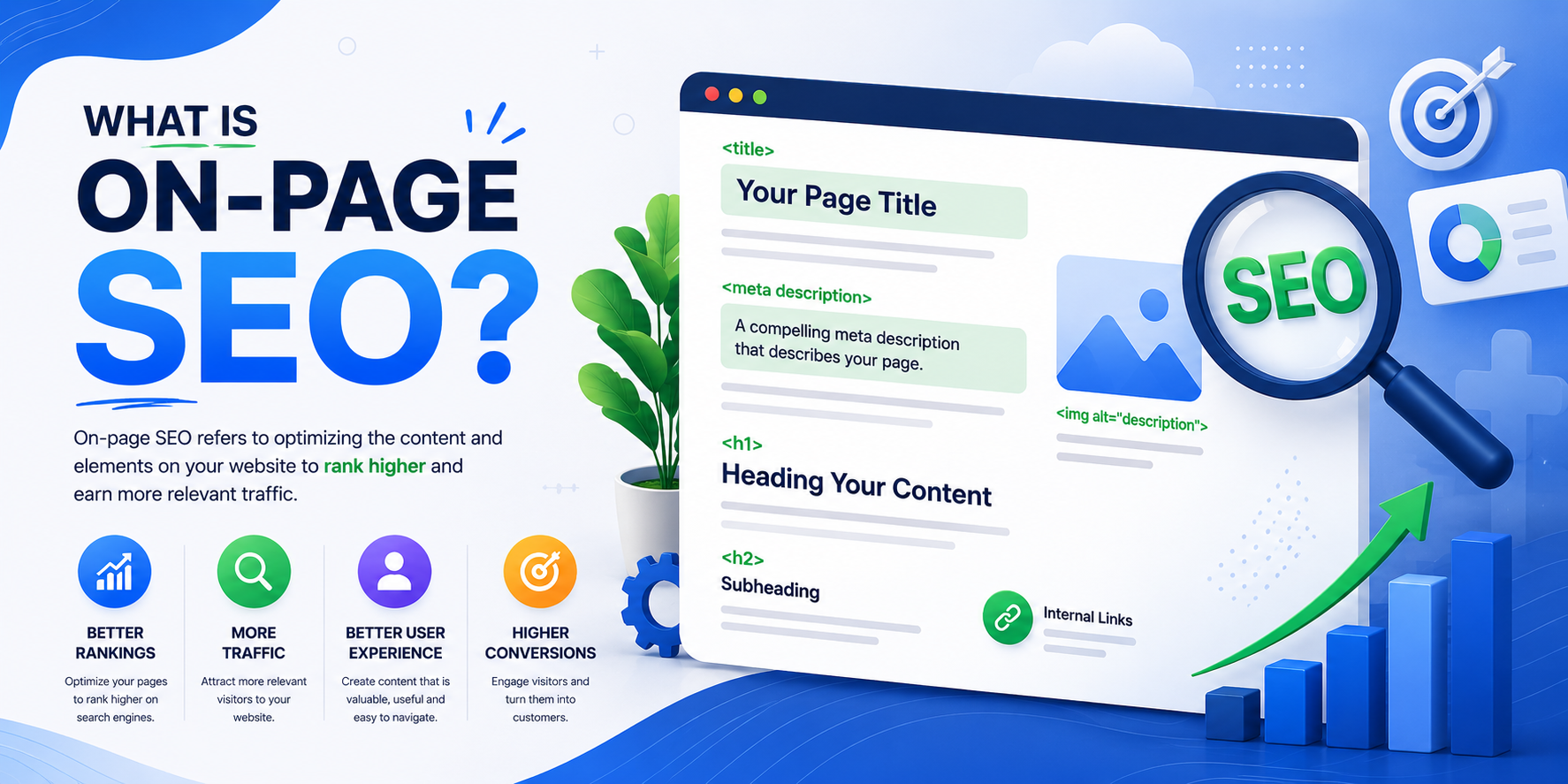
What Is On-Page SEO?
-
nimda
- June 12, 2026
How Search Engines Evaluate On-Page SEO
Introduction
On-page SEO is the process of optimizing the content and elements of an individual webpage so that search engines can better understand it and users can more easily find the information they need.
Every page on a website sends signals that help search engines determine its topic, relevance, and usefulness. On-page SEO involves improving those signals through content, headings, title tags, meta descriptions, URLs, internal links, images, and overall page structure.
Unlike factors that occur outside a website, on-page SEO focuses entirely on elements that website owners can directly control. When implemented correctly, it helps search engines understand the purpose of a page while creating a better experience for visitors.
As search engines become increasingly sophisticated, modern on-page SEO is no longer about inserting keywords into content. It is about creating clear, relevant, well-structured pages that fully satisfy user intent.
Understanding On-Page SEO
On-page SEO refers to the optimization of individual web pages to improve their visibility, relevance, and usability in search results.
Its primary goal is to help search engines answer questions such as:
- What is this page about?
- Which search queries is it relevant for?
- How comprehensive is the information?
- Does the content satisfy user intent?
- How does this page relate to other content on the website?
By providing clear answers to these questions, a webpage becomes easier for search engines to interpret and more likely to appear for relevant searches.
Why On-Page SEO Matters
Search engines aim to provide users with the most relevant and useful content available.
Even high-quality information can struggle to rank if a page lacks structure, clarity, or topical relevance. On-page SEO helps bridge the gap between content creation and search visibility.
Effective on-page optimization can:
- Improve organic visibility
- Increase search relevance
- Enhance user experience
- Improve content discoverability
- Strengthen topical authority
- Increase engagement
- Support long-term search performance
Without proper optimization, search engines may have difficulty understanding the purpose and value of a page.
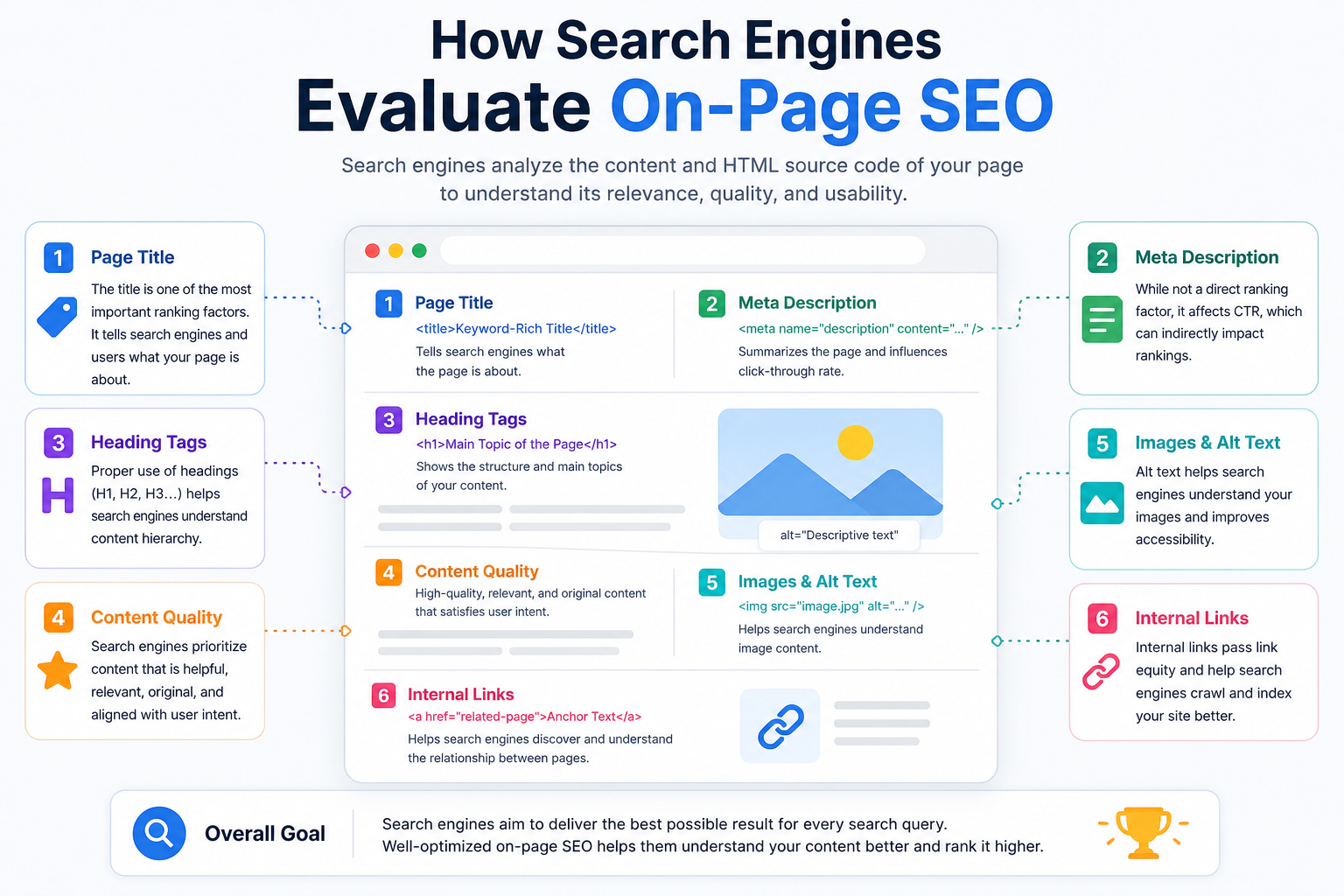
Search engines analyze numerous signals to understand a webpage and determine whether it deserves visibility for specific searches.
Content Relevance
The content itself remains one of the strongest signals.
Search engines evaluate:
- Topic coverage
- Information quality
- Relevance to search intent
- Content freshness
- Semantic relationships
Pages that thoroughly address a topic are generally easier to understand and classify.
Headings and Content Structure
Headings help create a logical hierarchy.
A well-structured page allows search engines to identify:
- Main topics
- Supporting sections
- Relationships between concepts
This structure improves content comprehension and user navigation.
Metadata
Elements such as title tags and meta descriptions provide additional context about a page’s subject matter.
Although not all metadata directly influences rankings, it helps search engines and users understand page relevance.
Internal Links
Internal links help search engines discover related content and understand the relationships between topics across a website.
They also help establish content hierarchy and topical clusters.
User Experience Signals
Search engines increasingly prioritize content that provides a positive user experience.
Factors such as readability, organization, and content usefulness contribute to overall page quality.
Core Elements of On-Page SEO
Title Tags
The title tag is one of the strongest on-page SEO signals.
It appears as the clickable headline in search results and helps communicate the page’s topic.
A strong title tag should:
- Clearly describe the content
- Include the primary topic naturally
- Remain concise
- Encourage clicks
Example:
What Is On-Page SEO? A Complete Guide to Page Optimization
Meta Descriptions
Meta descriptions summarize a page’s content for users in search results.
While they are not considered direct ranking factors, they can influence click-through rates.
Effective meta descriptions:
- Match page content
- Address user intent
- Provide a concise summary
- Encourage engagement
Headings
Headings organize content into a logical structure.
A typical hierarchy includes:
- H1 for the main topic
- H2 for major sections
- H3 for supporting subsections
Proper heading usage improves both readability and search engine understanding.
URL Structure
URLs should clearly reflect page content.
Example:
example.com/on-page-seo
Well-structured URLs are:
- Descriptive
- Concise
- Easy to read
- Relevant to the topic
Content
Content forms the foundation of on-page SEO.
High-quality content should:
- Answer user questions
- Demonstrate expertise
- Cover the topic thoroughly
- Remain accurate and current
- Align with search intent
Content should prioritize usefulness over keyword repetition.
Images
Images contribute to both user experience and content comprehension.
Image optimization includes:
- Descriptive file names
- Relevant alt text
- Appropriate file formats
- Compression for faster loading
Optimized images help search engines understand visual content while improving usability.
Internal Links
Internal links connect related pages throughout a website.
They help users discover additional information while helping search engines understand content relationships.
For example, a page about on-page SEO may naturally connect to topics such as:
- Keyword research
- Search intent
- Website indexing
- Technical SEO
- Content optimization
Rather than repeating those concepts extensively, internal links allow deeper exploration elsewhere within the content ecosystem.
On-Page SEO and Semantic Search
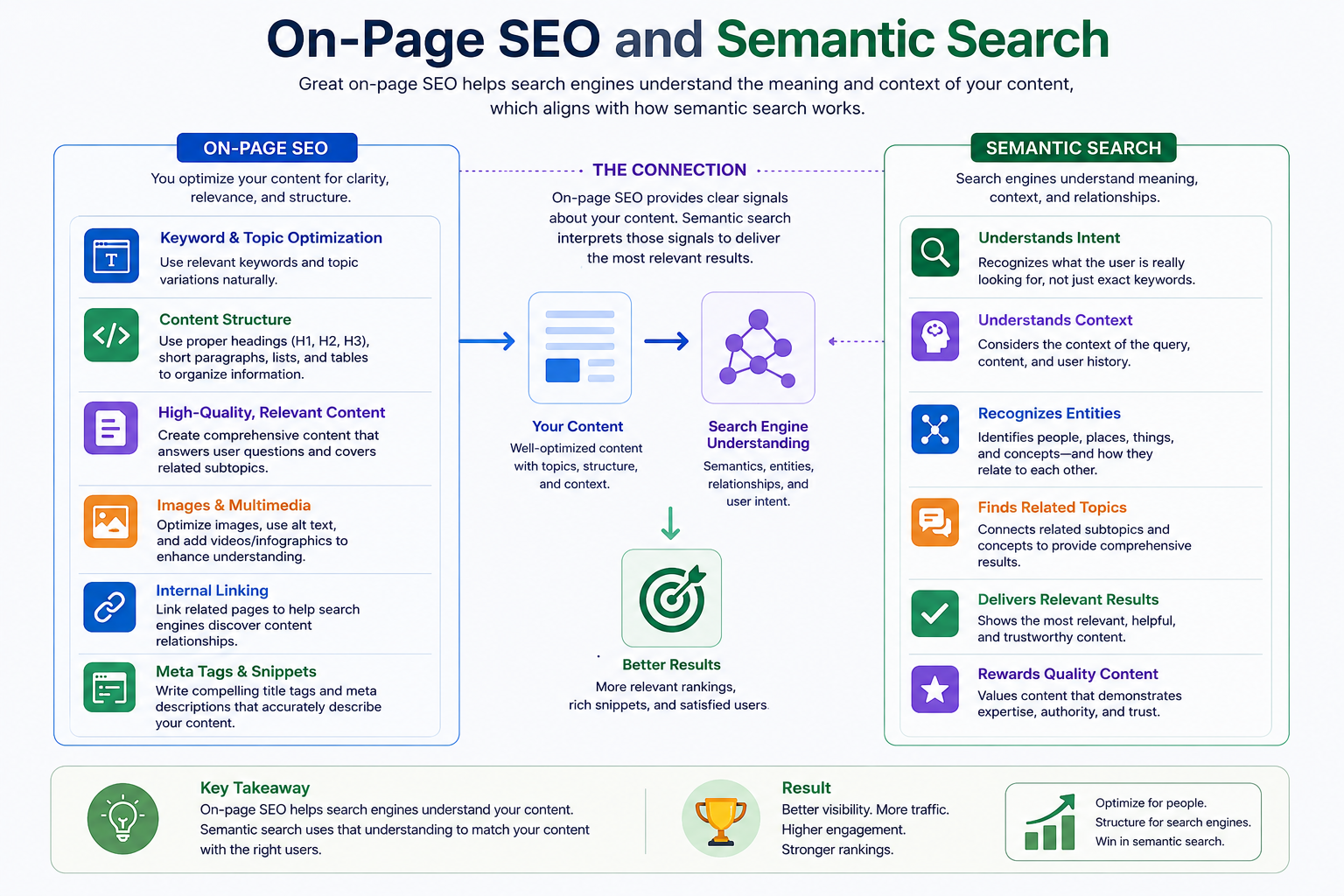
Modern search engines do not rely solely on exact-match keywords.
Instead, they use semantic understanding to determine how concepts relate to one another.
This means search engines evaluate:
- Topic relevance
- Context
- Related entities
- Concept relationships
- User intent
For example, a page discussing on-page SEO may naturally include terms such as:
- Content optimization
- Metadata
- Search intent
- Internal linking
- User experience
- Page relevance
These related concepts help search engines understand the overall topic more accurately.
As a result, modern on-page SEO focuses on topic completeness rather than keyword repetition.
Content Optimization in Modern On-Page SEO
Content optimization has evolved significantly.
Today, successful content focuses on satisfying users rather than achieving a specific keyword density.
Topic Coverage
The content should address the subject comprehensively.
Users should be able to find answers without needing to visit multiple pages for basic information.
Entity Usage
Relevant concepts and entities should appear naturally throughout the content.
This helps reinforce topical relevance.
Readability
Content should be easy to scan and understand.
Short paragraphs, logical headings, and clear language improve usability.
Information Architecture
Information should be presented in a logical sequence.
Well-organized content helps both users and search engines understand the page.
How Expertise and Trust Influence On-Page SEO
Search engines aim to surface reliable information.
Although rankings are influenced by many factors, pages that demonstrate expertise and trustworthiness often provide better user experiences.
Helpful content generally exhibits:
- Accuracy
- Clarity
- Topical depth
- Credible information
- User-focused intent
The goal is not simply to rank but to provide information that users can trust and understand.
Example of an Optimized On-Page SEO Structure
Consider a page targeting the topic:
What Is On-Page SEO?
URL
example.com/what-is-on-page-seo
Title Tag
What Is On-Page SEO? Complete Guide for Beginners
Meta Description
Learn what on-page SEO is, why it matters, and how page optimization helps search engines understand content.
H1
What Is On-Page SEO?
H2 Structure
- Understanding On-Page SEO
- Why On-Page SEO Matters
- Core Elements of On-Page SEO
- On-Page SEO and Semantic Search
- Common On-Page SEO Mistakes
- Frequently Asked Questions
This structure creates clear topical organization for both users and search engines.
Common On-Page SEO Mistakes
Keyword Stuffing
Excessive keyword repetition can reduce readability and create a poor user experience.
Thin Content
Pages with limited information often struggle to compete against more comprehensive resources.
Poor Heading Structure
Disorganized headings make content harder to understand.
Duplicate Content
Similar pages can create confusion regarding which page should rank.
Weak Internal Linking
Disconnected content reduces discoverability and topical relationships.
Misaligned Search Intent
Content that fails to satisfy user expectations often performs poorly regardless of optimization.
Common On-Page SEO Myths
More Keywords Mean Better Rankings
Modern search engines prioritize relevance and usefulness rather than keyword frequency.
Longer Content Always Wins
Content length alone does not determine rankings. Quality and intent satisfaction matter more.
Meta Descriptions Directly Improve Rankings
Meta descriptions can improve click-through rates but are not direct ranking factors.
Exact-Match Keywords Are Required Everywhere
Search engines understand variations, synonyms, and related concepts.
Frequently Asked Questions About On-Page SEO
What is the difference between on-page and off-page SEO?
On-page SEO focuses on elements within a webpage, while off-page SEO involves external signals that influence authority and visibility.
Is on-page SEO still important?
Yes. It remains one of the most fundamental aspects of helping search engines understand content.
How often should on-page SEO be updated?
Pages should be reviewed periodically to ensure information remains accurate, relevant, and aligned with user intent.
Does keyword density matter?
Modern SEO focuses more on relevance and topic coverage than specific keyword percentages.
What is the most important on-page SEO factor?
There is no single factor. High-quality content, search intent alignment, clear structure, and strong user experience work together to support performance.
Final Thoughts
On-page SEO is the practice of optimizing webpage elements to improve relevance, clarity, and usability for both search engines and users.
While title tags, headings, URLs, images, and internal links all play important roles, modern on-page SEO extends beyond individual elements. It involves creating content that is well-structured, comprehensive, semantically relevant, and aligned with user intent.
Ultimately, successful on-page SEO is about communication. The clearer a page communicates its purpose, value, and relevance, the easier it becomes for search engines to understand and for users to benefit from its content. This combination of clarity, usability, and topical depth forms the foundation of long-term organic search success.

5 Comments
[…] On Page SEO: Every important page should make its subject obvious to visitors and search engines alike — through descriptive title tags, a clear main heading, logical H2/H3 structure, and useful link text. Page elements should describe the actual content, not be engineered primarily to manipulate rankings. […]
[…] […]
[…] SEO: One Page SEO includes Clear page titles, headings, useful content, internal links, and relevant […]
[…] on-page optimization […]
[…] example, an SEO agency might start with seed terms like “keyword research,” “on-page SEO,” or “local SEO,” then expand from […]