-
nimda
- June 11, 2026
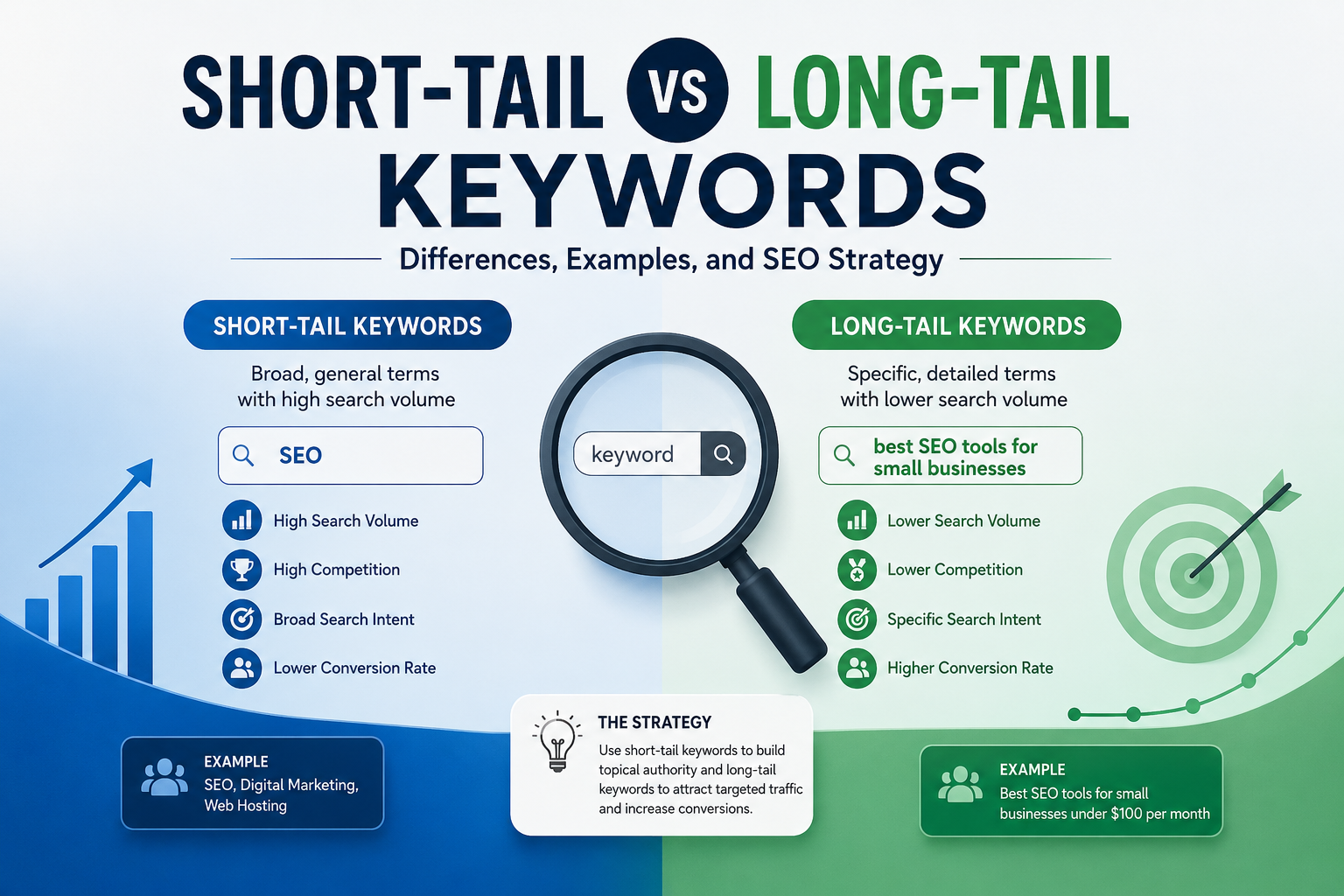
Short-Tail vs Long-Tail Keywords: Differences, Examples, and SEO Strategy
Keyword research is not just about finding popular search terms. It is about understanding how specific or broad a query is, what the user is trying to accomplish, and how difficult it will be to compete for that search.
One of the most important distinctions in SEO is the difference between short-tail keywords and long-tail keywords. These two keyword types play different roles in content strategy, topical authority building, and search visibility.
Understanding when and how to use each type can help websites attract more relevant traffic and create content that better matches user intent.
What Are Short-Tail Keywords?
Short-tail keywords are broad search terms that usually contain one to three words.
Examples
SEO
Digital marketing
Web hosting
Running shoes
Fitness
These keywords cover general topics and often attract large audiences. Because they are broad, search engines may have difficulty determining exactly what the user wants.
Example
A search for SEO could mean someone wants a definition, a tutorial, tools, industry news, or services.
Common Characteristics
High search volume
Broad search intent
Strong competition
Wide audience reach
Lower conversion rates compared with more specific searches
What Are Long-Tail Keywords?
Long-tail keywords are more specific search queries that usually contain three or more words.
Examples
How to perform keyword research for SEO
Best running shoes for flat feet
What is technical SEO
How to improve website crawlability
Affordable web hosting for small businesses
These queries reveal a clearer user intent. Someone searching for best running shoes for flat feet has a much more specific need than someone searching for running shoes.
Common Characteristics
Lower search volume per keyword
More specific search intent
Lower competition
Higher conversion potential
Stronger topical relevance
Why Are They Called Long-Tail Keywords?
The term long-tail comes from the Long Tail Theory, which describes how demand is distributed across many niche searches.
A small number of broad keywords receive extremely high search volume. However, a very large number of specific queries each receive smaller amounts of traffic. When combined, those specific searches often represent a significant share of total search demand.

This means that while a keyword like SEO may attract massive search volume, thousands of more specific searches such as how to improve SEO for a local business website collectively create a large opportunity for targeted traffic.
Head, Mid-Tail, and Long-Tail Keywords
Keyword specificity exists on a spectrum, not just in two categories.
| Category | Example |
|---|---|
| Head Term | SEO |
| Mid-Tail Keyword | SEO tools |
| Long-Tail Keyword | Best SEO tools for small businesses |
| Highly Specific Long-Tail | Best SEO tools for small businesses under $100 per month |
As the keyword becomes more specific, search volume usually decreases while intent clarity increases.
Short-Tail vs Long-Tail Keywords: Key Differences
| Factor | Short-Tail Keywords | Long-Tail Keywords |
|---|---|---|
| Length | 1–3 words | 3+ words |
| Search Volume | Usually high | Usually lower |
| Competition | High | Lower |
| Search Intent Clarity | Broad | Specific |
| Ranking Difficulty | Harder | Easier |
| Conversion Potential | Lower | Higher |
| User Specificity | General | Targeted |
| Content Focus | Broad topics | Narrow topics |

How Search Intent Changes with Keyword Length
Consider these searches:
SEO
Broad intent
SEO tools
More focused
Best SEO tools for beginners
Specific intent
Best free SEO tools for beginners in 2026
Highly specific intent
Each step provides more context about what the user expects. Search engines can use that additional context to deliver more relevant results.
The Relationship Between Specificity and Competition
Broad keywords attract many competing websites because they appeal to large audiences.
Examples of highly competitive short-tail keywords
SEO
Marketing
Hosting
Fitness
Long-tail keywords narrow the field.
Examples of more targeted long-tail keywords
How to fix indexing issues in Google Search
SEO audit checklist for beginners
Difference between crawling and indexing
Fewer pages are optimized for these exact searches, which can create opportunities for newer websites to gain visibility.
Real-World Keyword Expansion Example
Imagine a website focused on SEO education.
Broad Topic
SEO
Short-Tail Keyword
SEO
Mid-Tail Keyword
SEO audit
Long-Tail Keyword
SEO audit checklist for small businesses
Very Specific Long-Tail Keyword
SEO audit checklist for small business websites with under 50 pages
This progression shows how specificity increases while audience size generally decreases.
How Long-Tail Keywords Support Topical Authority
Topical authority is built by demonstrating expertise across many related subtopics.
Long-tail keywords naturally support this process because they allow websites to create focused content that answers specific questions.
For example, a site building authority around keyword research might publish articles such as:
What Is Keyword Research?
How to Find Keyword Opportunities
Search Intent and Keyword Selection
Keyword Difficulty Explained
Short-Tail vs Long-Tail Keywords
Each article targets a distinct aspect of the broader topic while contributing to overall topical depth.
Advantages of Short-Tail Keywords
Broad Topic Coverage
They help define the primary subject area of a website or content cluster.
Brand Visibility
Ranking for broad terms can expose content to large audiences.
Topic Relevance Signals
Search engines use these terms to understand the general theme of a page or website.
Content Categorization
Short-tail keywords often serve as parent topics that connect multiple supporting articles.
Advantages of Long-Tail Keywords
Easier Ranking Opportunities
Lower competition often makes it easier for websites to gain visibility.
Better User Intent Matching
Specific searches make it easier to create content that satisfies user needs.
Higher Engagement
Visitors arriving through long-tail searches are often more interested in the topic.
Stronger Content Relevance
Content can focus on solving a particular problem or answering a specific question.
Long-Tail Keywords and Modern Search Behavior
Search behavior has become increasingly conversational.
People often use natural-language queries, especially when searching by voice.
Examples
| Shorter Search | Conversational Long-Tail Search |
|---|---|
| What is SEO | What is SEO and how does it work |
| SEO benefits | How does SEO help websites rank higher |
This trend has increased the importance of long-tail content that directly answers specific questions.

Common Myths About Long-Tail Keywords
Myth 1: Long-tail keywords have no traffic
Many long-tail keywords receive meaningful search volume, and thousands of long-tail rankings can collectively drive substantial traffic.
Myth 2: Short-tail keywords are always better
Short-tail keywords can be valuable, but their competition often makes them difficult to rank for.
Myth 3: Every long keyword is a long-tail keyword
A keyword is considered long-tail because of its specificity and search-demand characteristics, not simply because it contains many words.
When Should You Target Short-Tail Keywords?
Short-tail keywords are useful when:
Defining a core topic
Creating pillar content
Building broad topical relevance
Establishing content categories
Supporting overall subject authority
When Should You Target Long-Tail Keywords?
Long-tail keywords are especially useful when:
Answering specific questions
Creating educational content
Targeting niche topics
Addressing user problems
Expanding topic coverage
Should You Choose Short-Tail or Long-Tail Keywords?
The answer is usually both.
A balanced SEO strategy often uses short-tail keywords to establish broad topic relevance and long-tail keywords to provide depth and satisfy specific user needs.
Short-tail keywords help search engines understand the main subject of a website, while long-tail keywords help capture targeted traffic and demonstrate expertise across related subtopics.
Common Mistakes to Avoid
Targeting keywords without understanding user intent
Choosing keywords based only on search volume
Ignoring topical relevance
Creating multiple pages targeting the same keyword
Stuffing keywords unnaturally into content
Focusing on traffic while neglecting user needs
Final Thoughts
Short-tail and long-tail keywords serve different purposes within SEO, but both are important.
Short-tail keywords establish broad topical relevance and define major subject areas. Long-tail keywords provide specificity, address detailed user needs, and support deeper topical coverage.
As search engines increasingly prioritize relevance and intent satisfaction, successful content strategies rely on a combination of both. Understanding how these keyword types differ allows you to create content that is easier to understand, more useful to readers, and better aligned with how people search online.

3 Comments
[…] keyword research involves matching product, category, brand, and attribute terms to the right page type. Search […]
[…] Keywords are important because they help search engines and users understand what a page is about. However, SEO is not simply a matter of repeating a target keyword throughout an article. […]
[…] SEO Guides 01 What Is SEO? Learn the fundamentals of search engine optimization. Read Guide → 02 Short-Tail vs Long-Tail Keywords Understand search specificity and conversational queries. Read … 03 Internal Linking Explained See how internal links connect related pages and guide users. Read […]