-
nimda
- June 6, 2026
Every day, billions of searches happen across the internet. People type questions, look for products, read news, find services, and explore ideas. Behind every one of those searches, there is a system deciding which results appear at the top — and which ones stay buried on page five.
That system is built around SEO.
SEO, or Search Engine Optimization, is the practice of improving a website so that it appears prominently in search engine results pages (SERPs) for relevant queries. It is one of the most foundational disciplines in digital marketing, and understanding it is essential for anyone building a meaningful presence online.
This guide covers what SEO is, how it works, why it matters, and the core concepts that define it. Whether you are entirely new to the topic or looking to deepen your foundational understanding, this article will give you a thorough, accurate picture of SEO as a knowledge discipline.
1. Defining SEO: What It Actually Means
The term “Search Engine Optimization” is often misunderstood. Many people think it refers only to keywords, or to getting backlinks, or to some kind of technical trickery that fools Google. None of those definitions are accurate on their own.
At its core, SEO is about relevance and authority. Search engines want to deliver the most relevant, trustworthy, and useful result for every query. SEO is the process of making your website match that standard.
More precisely, SEO involves:
- Understanding what users are searching for and why
- Creating content that satisfies those search queries
- Ensuring search engines can properly access and understand your content
- Building credibility and trust so search engines rank your content highly
SEO is not a single tactic. It is a system of interconnected practices that work together to improve a website’s visibility in organic (non-paid) search results. The word “organic” is important — SEO deals with earned rankings, not paid placements.
Paid search (often called PPC or pay-per-click) is a separate discipline entirely. While both appear on search results pages, SEO governs the unpaid listings that appear based on relevance and authority.

2. How Search Engines Work: The Foundation of SEO
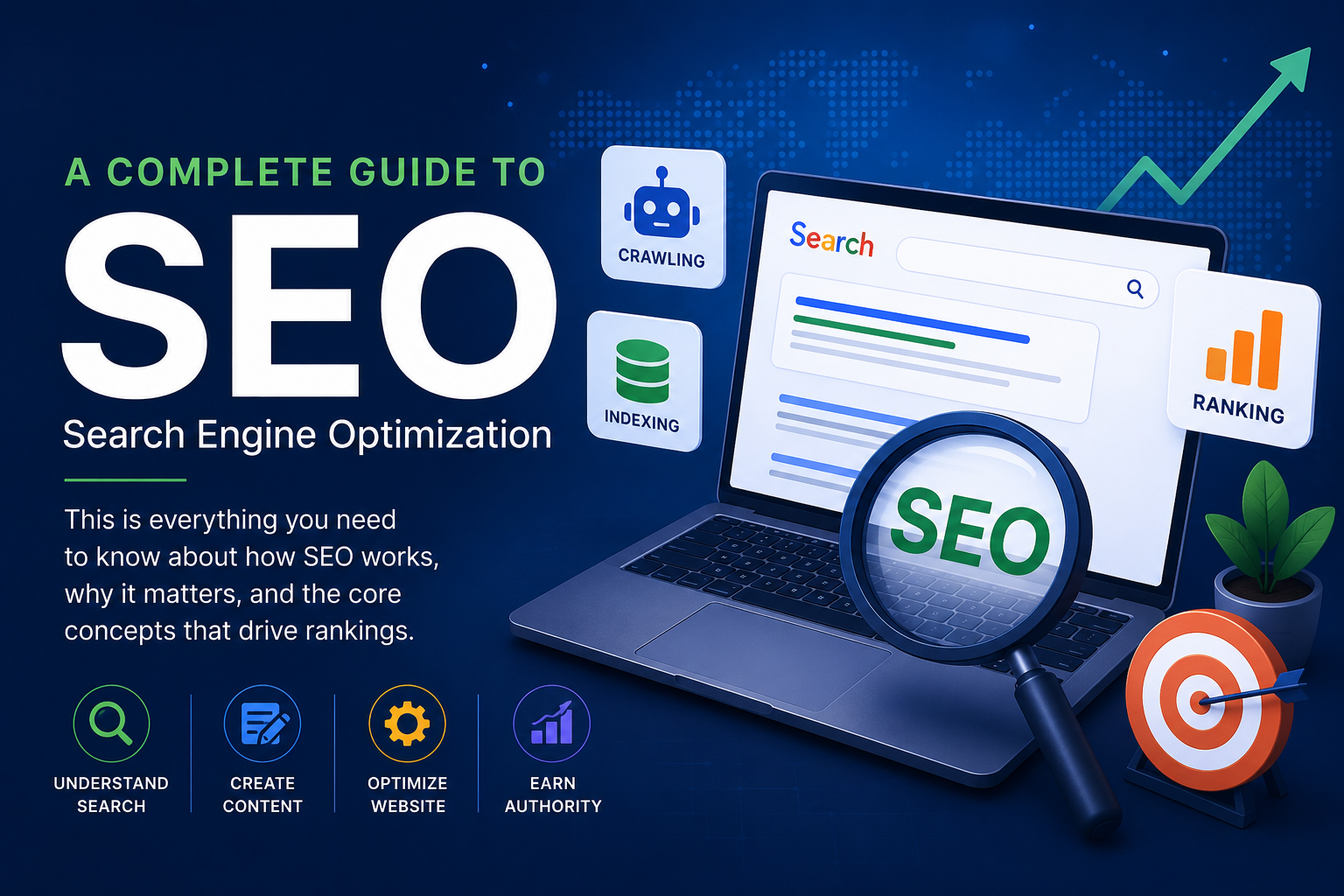
To understand SEO, you first need to understand what search engines actually do. The process is more complex than most people realize, but it can be broken into three major stages: crawling, indexing, and ranking.
Crawling
Search engines use automated programs called crawlers (also known as spiders or bots) to discover and visit web pages. Googlebot is Google’s primary crawler. These bots move across the web by following links from one page to another.
When a crawler visits a page, it reads the content, notes the links on the page, and adds those links to a queue to visit later. This is how search engines discover new pages — through the network of links connecting the web.
For your pages to appear in search results, search engine bots must first be able to crawl them. Pages that are blocked by robots.txt files, hidden behind login walls, or linked from nowhere are often invisible to search engines.
Indexing
After crawling a page, the search engine processes and stores information about it in a massive database called the index. The index is essentially a structured library of all the content search engines have discovered and analyzed.
Being indexed does not guarantee ranking. It means the page is eligible to appear in search results. The search engine now knows the page exists, understands what it is about, and can potentially serve it to users.
Pages can fail to be indexed for several reasons: thin or duplicate content, poor technical structure, or signals that the page provides low value. Understanding the indexing process is a key part of technical SEO.
Ranking
Ranking is the final stage — and the most visible one. When a user submits a search query, the search engine scans its index and selects the most relevant, authoritative results to display. These results are ranked in a specific order based on hundreds of signals.
The exact ranking algorithm is proprietary and constantly evolving. However, the core principles are well understood: content relevance, content quality, page authority, user experience signals, and technical accessibility all play significant roles.
The goal of SEO is to influence these ranking signals in your favor — not by gaming the system, but by genuinely meeting the standards that search engines have established to serve users well.

3. The Core Components of SEO
SEO is typically discussed through several distinct but interconnected components. Each one addresses a different dimension of how search engines evaluate and rank content.
On-Page SEO
On-page SEO refers to everything you do directly on a webpage to make it more relevant and valuable to both search engines and users. It is the most directly controllable aspect of SEO.
Key elements of on-page SEO include:
- Title tags: The HTML element that defines the title of a page, appearing in browser tabs and as the clickable headline in search results.
- Meta descriptions: Short summaries of page content that appear below the title in search results. While not a direct ranking factor, they influence click-through rates significantly.
- Heading structure: The use of H1, H2, and H3 tags to organize content logically and signal content hierarchy to search engines.
- Keyword usage: Placing relevant search terms naturally throughout the content, particularly in headings, introductions, and throughout the body text.
- Content depth: Covering a topic thoroughly enough to fully satisfy the user’s search intent.
- Internal linking: Connecting related pages on your site to help users and search engines navigate your content ecosystem.
- Image optimization: Using descriptive file names and alt text for images so search engines can understand visual content.
On-page SEO is not about stuffing keywords into every sentence. It is about structured, clear, relevant writing that demonstrates expertise on a specific topic.
Technical SEO
Technical SEO focuses on the infrastructure of a website — the behind-the-scenes elements that affect how search engines access, crawl, and interpret your content. Even the best-written content can fail to rank if technical barriers prevent search engines from properly accessing it.
Core areas of technical SEO include:
- Site speed: How quickly pages load on both desktop and mobile devices. Slow pages lead to higher bounce rates and lower rankings.
- Mobile-friendliness: Whether a website works well on small screens. Google uses mobile-first indexing, meaning the mobile version of a site is the primary version evaluated for ranking.
- Crawlability: Whether search engine bots can access your pages without being blocked by robots.txt rules or other barriers.
- Site architecture: How pages are organized and linked together. A logical, flat structure helps crawlers discover all your content efficiently.
- Structured data (schema markup): Additional code that helps search engines understand specific types of content, such as reviews, events, recipes, or FAQs.
- HTTPS: Secure connections are a confirmed ranking signal. Websites using HTTP instead of HTTPS are at a disadvantage.
- Core Web Vitals: Google’s set of metrics measuring real-world user experience, including loading speed, visual stability, and interactivity.
Technical SEO issues often go unnoticed by website owners because they are invisible to casual visitors. However, they can have a major impact on rankings, and diagnosing them requires either SEO tools or a trained eye.
Off-Page SEO
Off-page SEO encompasses the actions taken outside your own website that influence your rankings. The most prominent off-page signal is backlinks — links from other websites pointing to yours.
Search engines treat backlinks as votes of confidence. When a reputable website links to your content, it signals that your content is valuable and trustworthy. The more high-quality backlinks your pages earn, the more authority they accumulate.
Not all backlinks are equal. A link from a high-authority, relevant website carries far more weight than a link from a low-quality or unrelated site. In fact, toxic or spammy backlinks can actually harm your rankings.
Beyond backlinks, off-page SEO includes:
- Brand mentions: References to your brand online, even without a direct link, contribute to your overall authority signals.
- Social signals: While not direct ranking factors, strong social presence can amplify content reach and indirectly generate backlinks.
- Digital PR: Earning coverage in reputable publications creates high-quality backlinks and brand authority simultaneously.
Content SEO
Content is the medium through which all other SEO signals are expressed. Without strong content, neither technical excellence nor backlink building can produce sustainable rankings.
Content SEO involves creating and optimizing content specifically for search. This includes:
- Keyword research: Identifying the specific phrases and questions your target audience searches for, and understanding the intent behind those searches.
- Content creation: Writing, recording, or designing content that directly addresses the identified search intent with depth, clarity, and expertise.
- Content organization: Structuring content around topic clusters — groups of related pages that collectively build authority on a broad subject area.
- Content freshness: Keeping existing content updated so it remains accurate and relevant, which can protect and improve rankings over time.
Effective content SEO is not about producing the maximum amount of content. It is about producing the right content — the pieces that genuinely satisfy what people are searching for.
4. Search Intent: The Central Concept of Modern SEO
If there is one concept that defines contemporary SEO thinking, it is search intent — the underlying reason behind a search query.
Every time someone types a query into a search engine, they have a goal. Sometimes that goal is to learn something. Sometimes it is to find a specific website. Sometimes it is to purchase something. The content that best matches that goal is the content that ranks.
Search intent is typically categorized into four types:
Informational Intent
The user wants to learn or understand something. Queries like “what is SEO,” “how does the immune system work,” or “why does bread rise” all reflect informational intent. The appropriate response is educational content — articles, guides, explanations.
Navigational Intent
The user wants to reach a specific website or page. Queries like “Google Analytics login” or “Amazon customer service” reflect navigational intent. The user already knows where they want to go — they are just using search as a shortcut.
Commercial Intent
The user is researching options before making a decision. Queries like “best SEO tools,” “WordPress vs Wix comparison,” or “top email marketing platforms” reflect commercial intent. The user is in evaluation mode.
Transactional Intent
The user is ready to take an action — usually a purchase. Queries like “buy running shoes online” or “hire SEO consultant” reflect transactional intent. The appropriate response is a product page, service page, or conversion-focused content.
Understanding search intent is critical because Google has become extremely good at detecting it. If you create a blog post targeting a transactional keyword, or a sales page targeting an informational keyword, your rankings will suffer. The format and focus of your content must align with what the searcher actually wants.
5. Keywords in SEO: Beyond Simple Phrases
Keywords are the terms and phrases people type into search engines. Keyword research — the process of identifying which keywords to target — is one of the most fundamental skills in SEO.
However, the role of keywords in SEO has evolved significantly over the past decade. Early SEO relied heavily on exact keyword matching: using a specific phrase repeatedly throughout a page to signal relevance. Modern search engines are far more sophisticated.
Keyword Types
Keywords are commonly classified by length and specificity:
- Short-tail keywords: Broad, high-volume terms like “SEO” or “web design.” They attract large audiences but are highly competitive and often unclear in intent.
- Long-tail keywords: More specific phrases like “how to improve website crawlability” or “SEO for new blogs.” They attract smaller but more targeted audiences and are often easier to rank for.
- Question-based keywords: Queries phrased as questions, like “what is a meta description” or “why does my website not rank.” These often align perfectly with informational intent.
Semantic Keywords and Topical Coverage
Modern SEO goes beyond individual keywords and focuses on semantic relevance — the network of related concepts and entities around a topic. Search engines do not just look for keyword matches; they look for topical authority.
A page covering a topic with depth — addressing related subtopics, answering common questions, using relevant terminology — signals greater expertise than a page that simply repeats one keyword frequently.
This is why SEO practitioners talk about topic clusters: groups of interlinked content pieces that collectively cover a subject comprehensively. A main pillar page covers the broad topic, while supporting cluster pages address specific subtopics in detail.
Keyword Cannibalization
One of the most common SEO mistakes is keyword cannibalization — when multiple pages on the same website target the same keyword or topic. This creates internal competition, splitting ranking signals between pages and confusing search engines about which page should rank.
Avoiding cannibalization requires a clear content architecture where each page owns a distinct topic or intent. Addressing this issue is part of building a healthy, well-organized site structure.

6. How Google Evaluates Content Quality
Google’s approach to content quality is guided by a framework called E-E-A-T, which stands for Experience, Expertise, Authoritativeness, and Trustworthiness. While these qualities are not direct algorithmic ranking factors in a simple checkbox sense, they guide what high-quality content looks like — and Google’s systems are increasingly able to detect their presence or absence.
Experience
Does the content reflect genuine first-hand experience with the topic? For a product review, was the product actually used? For a travel guide, did the author visit the place? For a health guide, was it written by someone who has dealt with the condition? Experience adds authenticity and credibility.
Expertise
Does the creator have deep knowledge of the subject? Content written by recognized experts in a field carries more weight than content produced by generalists. In YMYL (Your Money or Your Life) topics — those affecting health, finance, or safety — expertise is especially critical.
Authoritativeness
Is the creator, content, or website recognized as a trusted source in the field? Authority is built over time through consistent, high-quality content production, backlinks from other authoritative sources, and positive brand signals.
Trustworthiness
Is the content honest, accurate, and transparent? Does the site clearly identify who is behind it? Are claims supported by evidence? Trust is the foundation on which all other E-E-A-T signals rest.
Creating content that embodies these qualities is the sustainable path to strong SEO performance. Shortcuts and manipulative tactics may produce short-term gains but rarely withstand Google’s ongoing algorithm refinements.
7. The Role of Backlinks in SEO Authority
Backlinks remain one of the most powerful ranking signals in SEO. When a credible external website links to your content, it transfers some of its authority to you — a process often described through the concept of link equity or “link juice.”
This principle stems from the original PageRank algorithm developed by Google’s founders, which treated links as citations in academic literature: the more reputable sources that cite your work, the more credible your work must be.
What Makes a High-Quality Backlink?
Not all backlinks carry equal value. The factors that determine a backlink’s quality include:
- Domain Authority: Links from highly trusted, well-established websites carry more weight than links from new or low-authority sites.
- Relevance: A link from a website in the same or a closely related industry is more valuable than a link from an unrelated site.
- Editorial context: A link naturally placed within relevant content carries more value than a link in a sidebar, footer, or unrelated list.
- Anchor text: The clickable text of the link provides context about the linked page’s content. Descriptive, relevant anchor text strengthens the relevance signal.
Earning vs. Building Backlinks
There is an important distinction between earning backlinks and artificially building them. Earning backlinks involves creating content so valuable that other sites voluntarily link to it. Building backlinks involves proactive outreach, guest posting, digital PR, and link partnership strategies.
What SEO practitioners must avoid is buying links, participating in link schemes, or using black-hat tactics that violate search engine guidelines. Google actively penalizes manipulative link building, and such penalties can be devastating for rankings.
8. User Experience and SEO: An Inseparable Relationship
A common misconception is that SEO and user experience (UX) are separate concerns — SEO for search engines, UX for humans. In reality, they have become deeply intertwined.
Google’s mission is to organize the world’s information and make it universally accessible and useful. Serving users poorly defeats that mission. As a result, Google has increasingly incorporated user experience signals into its ranking systems.
Core Web Vitals
In 2021, Google introduced Core Web Vitals as official ranking signals. These metrics measure real-world user experience on three dimensions:
- Largest Contentful Paint (LCP): How quickly the main content of a page loads. A good LCP score is under 2.5 seconds.
- Cumulative Layout Shift (CLS): How stable the page is as it loads. Pages that jump around as elements load create a poor experience and receive lower scores.
- Interaction to Next Paint (INP): How quickly the page responds to user interactions like clicks and taps.
Bounce Rate and Dwell Time
While Google has been careful not to confirm bounce rate as a direct ranking factor, behavioral signals matter. If users consistently click on your page and immediately return to the search results (a behavior sometimes called “pogo-sticking”), it signals that your content did not satisfy the query.
Dwell time — how long a user spends on your page before returning to search — provides an indirect signal of content quality. Pages that hold user attention tend to perform better over time.
Mobile Experience
Since Google switched to mobile-first indexing, the mobile version of your site is the primary basis for evaluation. A website that looks excellent on desktop but poorly on mobile is at a significant ranking disadvantage.
Responsive design — the practice of building websites that adapt seamlessly to any screen size — has become a baseline requirement for competitive SEO.
9. Local SEO vs. Ecommerce SEO vs. International SEO: A High-Level Overview
SEO is not a one-size-fits-all discipline. Different types of websites require different approaches based on their goals, audience, and structure.
Local SEO
Local SEO focuses on helping businesses appear in searches with geographic intent — queries like “plumber near me” or “coffee shop in downtown Chicago.” It involves optimizing a Google Business Profile, building local citations, earning reviews, and creating locally relevant content. Local SEO is a distinct discipline with its own set of tools and strategies.
Ecommerce SEO
Ecommerce SEO addresses the unique challenges of optimizing large online stores — often with thousands of product pages, faceted navigation, duplicate content from filters, and complex site architecture. Category page optimization, product schema markup, and managing crawl budget are central concerns in ecommerce SEO.
International SEO
International SEO helps websites appear correctly in multiple languages and geographic markets. Using hreflang tags to signal language and regional targeting, managing duplicate content across translated versions, and building authority in specific markets are key challenges in this space.
Each of these specializations builds on the same core SEO principles but applies them to a specific context. Understanding the fundamentals of SEO is the prerequisite to succeeding in any of these areas.
10. White Hat, Grey Hat, and Black Hat SEO
SEO practices are broadly categorized by their alignment with search engine guidelines.
White Hat SEO
White hat SEO refers to practices that align fully with search engine guidelines and focus on providing genuine value to users. This includes creating high-quality content, earning backlinks through legitimate means, and optimizing user experience. White hat SEO is sustainable and produces durable results.
Black Hat SEO
Black hat SEO refers to manipulative tactics designed to game ranking algorithms rather than genuinely satisfy users. Examples include keyword stuffing, cloaking (showing different content to search engines vs. users), buying links, and creating doorway pages. These tactics can produce short-term results but almost always lead to penalties or deindexation when detected.
Grey Hat SEO
Grey hat SEO occupies the ambiguous space between white and black hat practices. These tactics are not explicitly prohibited but may skirt the edges of guidelines. Private blog networks (PBNs) operated carefully, aggressive anchor text strategies, and certain content automation practices fall into this category. The risks are lower than black hat SEO but not negligible.
For anyone building a serious, long-term online presence, white hat SEO is the only approach that makes sense. The short-term gains from manipulative tactics are rarely worth the risk of penalties that can take months or years to recover from.
11. How Google Algorithm Updates Affect SEO
Google makes thousands of changes to its algorithm every year. Most are minor and go unnoticed. But periodically, Google releases major algorithm updates that reshape the SEO landscape.
Understanding the history of major updates helps explain how modern SEO thinking evolved.
Panda
Launched in 2011, Panda targeted low-quality content — thin pages, content farms, and sites with excessive duplicate content. It fundamentally established that content quality was a ranking factor, not just keyword relevance.
Penguin
Launched in 2012, Penguin targeted manipulative link-building practices — paid links, exact-match anchor text spam, and link networks. It established that backlink quality mattered as much as backlink quantity.
Hummingbird
Launched in 2013, Hummingbird represented a fundamental shift toward semantic search — understanding the meaning behind queries rather than just matching keywords. It laid the groundwork for conversational and intent-based search.
RankBrain
Introduced in 2015, RankBrain brought machine learning into the ranking process for the first time. It helps Google understand queries it has never seen before by interpreting them in context. RankBrain was reportedly the third most important ranking signal at the time of its introduction.
BERT
Launched in 2019, BERT (Bidirectional Encoder Representations from Transformers) dramatically improved Google’s ability to understand natural language. It processes words in full context rather than in isolation, enabling much better interpretation of complex, nuanced queries.
Helpful Content Update
Beginning in 2022, the Helpful Content Update series specifically targeted content created primarily to rank in search rather than to genuinely help users. It introduced a site-wide signal that penalizes sites where a significant portion of content is deemed unhelpful — even if individual pages are well-optimized.
Each of these updates moved SEO further in the direction of quality, relevance, and genuine user value. The practitioners who kept pace with these changes — focusing on users rather than algorithms — consistently fared better than those chasing shortcuts.
12. SEO Tools: The Practitioner’s Toolkit
SEO would be nearly impossible to practice effectively without specialized tools. These platforms provide data that is not available through observation alone: search volumes, ranking positions, backlink profiles, technical issues, and competitor insights.
Understanding what these tools do — even if you do not use them all — provides a clearer picture of how professional SEO is practiced.
Keyword Research Tools
Platforms like Ahrefs, SEMrush, Moz, and Google Keyword Planner allow you to discover what people search for, how often, and how competitive those terms are. They help you identify opportunities where you can realistically rank and understand what content to create.
Technical SEO Tools
Crawlers like Screaming Frog and Sitebulb simulate how search engine bots see your website, identifying issues like broken links, duplicate content, missing meta tags, and crawlability problems. Google Search Console — a free tool provided directly by Google — shows how Googlebot sees your site, which pages are indexed, and what queries are driving traffic.
Rank Tracking Tools
Tracking tools monitor where your pages rank for specific keywords over time. This data helps you measure the impact of SEO changes and spot ranking fluctuations that may require investigation.
Backlink Analysis Tools
Backlink analysis tools like Ahrefs and Majestic map the link profiles of websites — your own and competitors’. They help you understand where authority is coming from, identify link-building opportunities, and detect potentially toxic backlinks.
Site Speed and Performance Tools
Tools like Google PageSpeed Insights and GTmetrix measure load speed and provide actionable recommendations for improvement. Given the role of Core Web Vitals in rankings, these tools have become essential.
13. Measuring SEO Success: Key Metrics and What They Mean
SEO generates data — a lot of it. But not all metrics are equally meaningful. Focusing on the right indicators helps you understand whether your SEO efforts are actually working.
Organic Traffic
Organic traffic — visitors arriving via non-paid search engine results — is the most direct measure of SEO performance. Growth in organic traffic indicates that more of your pages are ranking and being clicked.
Keyword Rankings
Where your pages appear for target keywords tells you how well your content is performing against competitors. Moving from position 12 to position 4 for an important keyword can dramatically increase traffic even if total keyword count stays the same.
Click-Through Rate (CTR)
CTR measures the percentage of people who see your page in search results and actually click on it. A low CTR may indicate that your title tag and meta description need improvement — even if your ranking is strong.
Impressions
Impressions count how many times your pages appear in search results, regardless of whether they are clicked. High impressions with low CTR identifies optimization opportunities. Low impressions indicate ranking or indexing problems.
Domain Authority / Domain Rating
Third-party metrics like Moz’s Domain Authority and Ahrefs’ Domain Rating provide an overall estimate of a website’s backlink strength. While not Google metrics, they are useful for comparing site authority and tracking link-building progress.
Conversions from Organic Traffic
Ultimately, SEO value must connect to business outcomes. Tracking how much organic traffic converts — into leads, sales, subscriptions, or other goals — shows whether your SEO is attracting the right audience.
14. Common SEO Misconceptions Clarified
SEO is surrounded by persistent myths that mislead practitioners, especially those new to the field. Addressing these misconceptions is part of building solid foundational knowledge.
“SEO is a one-time task”
SEO is an ongoing process, not a project with a start and end date. Rankings fluctuate as competitors optimize, algorithms update, and content ages. Maintaining and improving rankings requires consistent attention.
“More keywords means better rankings”
Keyword stuffing — the practice of overloading content with keywords — actively harms rankings. Search engines are sophisticated enough to recognize it as a quality signal failure. Natural, contextual keyword use is what works.
“Buying ads improves organic rankings”
Running paid ads on Google has no impact on organic rankings. Google maintains a strict separation between paid and organic search systems. Ads can complement SEO strategy, but they do not directly influence it.
“All backlinks are equally valuable”
Backlink quality matters enormously. A single link from a highly authoritative, relevant website can outweigh dozens of links from low-quality sources. Volume without quality is ineffective — and potentially harmful.
“SEO results are immediate”
SEO typically takes months to show meaningful results. New websites may take six to twelve months before organic traffic begins to build substantially. This is normal and expected — it reflects how search engines gradually build confidence in new sources.
“You can fully outsmart Google”
This belief underlies most black hat SEO strategies, and it is consistently proven wrong. Google employs thousands of engineers and has access to enormous behavioral data. Tactics that appear to exploit gaps in the algorithm are typically detected and addressed — often in ways that permanently harm the sites using them.
15. The Future of SEO: Directions and Developments
SEO is not static. The way people search and the way search engines respond to those searches continue to evolve. Several trends are shaping where SEO is heading.
AI-Generated Search Experiences
Search engines are increasingly incorporating AI into their results. Google’s Search Generative Experience (and similar features in other engines) generates direct answers from AI, sometimes reducing the need for users to click through to individual websites. SEO must adapt to this changing landscape by focusing even more on being the authoritative source that AI systems cite and draw from.
Voice and Conversational Search
As voice assistants become more integrated into daily life, more searches take on a conversational, question-based format. Optimizing for natural language and featured snippets becomes increasingly important in capturing this traffic.
Entity-Based SEO
Search engines are moving from understanding documents to understanding entities — real-world objects, concepts, and their relationships. This shift makes structured data, knowledge graph optimization, and topical authority building more important than ever.
Search Beyond Google
While Google dominates global search, other discovery surfaces matter too. YouTube is one of the world’s largest search engines. Social platforms like TikTok and Instagram are increasingly used as search tools, especially by younger demographics. A comprehensive digital visibility strategy extends SEO principles to these platforms as well.
Final Thoughts: Why Understanding SEO Matters
SEO is one of the most powerful and enduring forces in digital marketing. It is the mechanism by which websites earn sustainable, long-term visibility — without a perpetual advertising budget.
But SEO is also one of the most misunderstood disciplines. Many businesses treat it as a mysterious black box, hoping that a few tactical changes will suddenly catapult them to the top of Google. That is not how it works.
SEO works when you understand it deeply — when you know why search engines behave the way they do, what signals they rely on, and how to build a website that genuinely deserves to rank well. Every component of SEO, from technical infrastructure to content quality to backlink authority, is connected to a simple underlying principle: serve users exceptionally well.
This guide has covered the foundational concepts of SEO: what it is, how search engines work, the core components of on-page, off-page, and technical SEO, the centrality of search intent, the role of content quality and E-E-A-T, the history of algorithm evolution, and where SEO is headed.
The topics referenced here — technical SEO, keyword cannibalization, local SEO, ecommerce SEO, search intent analysis, and others — each represent deep areas of knowledge in their own right. Building expertise in SEO means going deeper into each of these areas, understanding how they interact, and applying that understanding consistently over time.
That process starts with a solid foundation — and that is exactly what this guide has aimed to provide.
─────────────────────────────────────────────────────────────
Published by 101sols.com | SEO Knowledge Authority Series

1 Comment
[…] SEO Guides 01 What Is SEO? Learn the fundamentals of search engine optimization. Read Guide → 02 Short-Tail vs Long-Tail Keywords Understand search specificity and conversational queries. Read […]