SEO for startups is the process of improving a startup's website and online presence to earn relevant organic search visibility, traffic, and potential customers. It applies the same core principles as SEO for any business, but with a different set of constraints: no brand recognition, limited budget, and often no existing website traffic to build from.
That's why SEO for startups means prioritizing high-impact work over broad, resource-heavy campaigns.
This article explains what makes SEO different for startups, which fundamentals matter most in the early stage, and how to avoid the mistakes that waste a founder's limited time and budget.
Paid advertising can bring in traffic quickly, but that traffic disappears the moment the budget runs out. SEO works differently. Once a page starts ranking, it can keep bringing in visitors for months or years without ongoing ad spend.
For a startup, this matters for two reasons. First, most startups don't have large marketing budgets to sustain long-term paid campaigns. Second, organic search builds a long-term asset — a website that earns trust and visibility over time — rather than a channel that stops the day spending stops.
The tradeoff is speed. SEO rarely produces results overnight. A startup pursuing SEO needs to treat it as a long-term investment, not a quick fix.
Before doing any SEO work, it helps to be clear on what success actually looks like. "Get more traffic" isn't specific enough to guide decisions. For a startup, useful SEO goals typically include:
- Increasing visibility for relevant, non-branded searches
- Attracting qualified organic traffic, not just volume
- Building topical authority in a specific niche
- Generating organic leads or signups
- Reducing long-term dependence on paid acquisition
These goals shape everything that follows — which keywords to prioritize, which pages to build first, and how to measure progress.
An established company usually already has some domain authority, existing content, and a base level of search visibility. The work is often about refining and expanding what's there.
A startup usually starts from zero. There's little to no backlink profile, no historical rankings, and often a brand-new domain. This changes the priorities:
- Foundation before expansion. A startup needs technical basics and core pages in place before investing heavily in large-scale content production.
- Focus over breadth. With limited resources, a startup can't compete for every keyword. Targeting a narrower set of realistic, relevant keywords produces better results than spreading effort thin.
- Patience with realistic timelines. New domains typically take longer to rank, since search engines have no history to draw on yet.
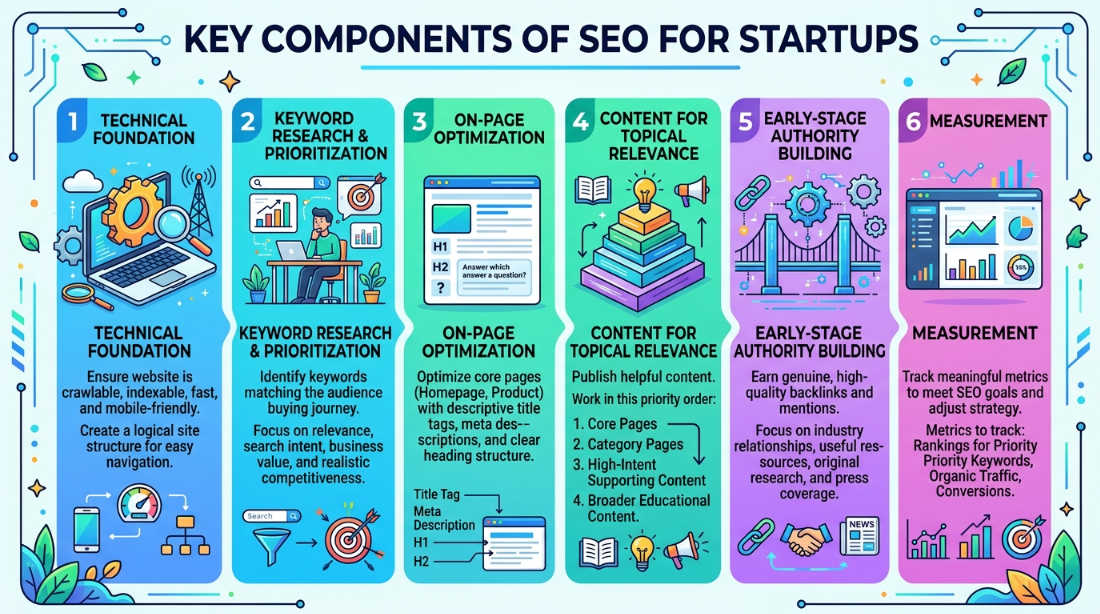
Before content or link building, a startup's website needs to be technically sound: crawlable, indexable, mobile-friendly, and reasonably fast. Search engines can't rank a page they can't properly access or read. Getting this right early prevents problems from compounding as the site grows.
A logical site structure matters too. Important pages should be easy to reach through clear navigation and internal links, so search engines — and visitors — can find them without digging.
Startups benefit from targeting keywords that match where their audience actually is in the buying journey, rather than chasing high-volume terms that are difficult to rank for with a new domain.
Low competition alone isn't a good enough reason to target a keyword — it also needs to be relevant to the business. A keyword that's easy to rank for but brings in the wrong audience isn't worth the effort. A better approach is to prioritize keywords based on a combination of factors: relevance to the business, search intent, business value, realistic competitiveness, and the resources needed to create a page that can actually compete for it.
Matching each keyword to the right search intent also matters — a page built for informational searches won't perform well if the keyword is actually driven by people ready to buy, and vice versa.
Each core page — homepage, product or service pages, key landing pages — should be optimized around a clear topic: a descriptive title tag, a meta description that reflects the page's purpose, logical heading structure, and content that directly answers what the visitor is looking for. This is foundational work that supports everything built on top of it.
Publishing helpful, relevant content signals to search engines — and to visitors — what the business is about. For a startup, this often means starting with the questions its target audience is already asking, rather than trying to cover every possible topic at once.
A common mistake is publishing a large volume of general educational content before the pages that actually drive the business are in place. A more effective order looks like this:
- Core product or service pages — the pages that directly support the business
- Important category or solution pages — pages that group related offerings or use cases
- High-intent supporting content — content that answers specific questions close to a decision
- Broader educational content — content that builds topical authority over time
Working through this order helps a startup's limited content resources go toward what matters most first.
Backlinks and mentions from other credible websites still matter for a new domain, but they should be earned through genuine relevance rather than volume for its own sake. The focus should be on legitimate industry relationships, useful resources, original research, and relevant press coverage — situations where a link is naturally editorially appropriate, not links picked up just to increase a count.
Tracking a small set of meaningful metrics — rankings for priority keywords, organic traffic, and conversions from organic visitors — shows whether the SEO goals set earlier are actually being met, and where to adjust.
- Prioritize ruthlessly. With limited time and budget, focus on the pages and keywords that will have the most impact first.
- Fix technical issues early. A technically broken site undermines every other SEO effort.
- Build a small number of strong pages before a large number of weak ones. A few well-optimized, genuinely useful pages outperform many thin ones.
- Track a few meaningful metrics. Rankings, organic traffic, and conversions from organic visitors tell a clearer story than vanity metrics.
- Treat SEO as ongoing, not a one-time project. Search engines reward sites that consistently maintain and improve their content over time.
- Expecting fast results. SEO for a new domain typically takes months to show meaningful traction, not weeks.
- Targeting keywords that are too competitive. Going after broad, high-volume terms early on usually means competing with established sites that already have years of authority.
- Neglecting technical basics. Founders often invest in content while leaving indexing or site-speed issues unresolved, which limits how well that content can perform.
- Treating SEO as a one-time setup. SEO isn't a task to complete once. Rankings and algorithms shift, and content needs regular review.
- Spreading effort across too many topics at once. Trying to cover everything dilutes the impact of each individual page.
"SEO is free."
FactSEO doesn't require ad spend, but it does require time, expertise, and often investment in content and technical work. It has a cost — just a different kind than paid advertising.
"A new website can rank for competitive terms quickly."
FactIt's not domain age itself that holds a new site back. New websites typically need time to establish visibility because they have less content, fewer established links, and less accumulated evidence of relevance than sites that have been around longer. That evidence builds gradually, which is why new sites usually need time regardless of how good the content is.
"More content always means better rankings."
FactSearch engines prioritize relevance and usefulness over sheer volume. A smaller set of well-targeted, high-quality pages generally performs better than a large volume of shallow ones.
With everything above in mind, a sensible starting sequence for a startup looks like this:
- Confirm the site is crawlable and indexable
- Ensure the site is mobile-friendly and loads reasonably fast
- Identify a focused list of realistic, intent-matched keywords
- Optimize title tags, meta descriptions, and headings on core pages
- Publish content that directly answers target audience questions
- Pursue a small number of relevant, credible backlink opportunities
- Set realistic timeline expectations with stakeholders
- Review and update content on a regular schedule
SEO for startups isn't a smaller version of enterprise SEO — it's a different approach shaped by limited resources and the absence of existing authority. The priority is getting the fundamentals right first: a technically sound site, a focused keyword strategy, and genuinely useful content built around clear intent. Startups that treat SEO as a long-term, consistently maintained effort — rather than a quick campaign — are the ones that see it pay off.
Get a free audit and a prioritized action plan tailored to a startup's budget and timeline.
Get a Free SEO Audit