Studying the sites that already rank for your keywords — and using what you learn to find the gaps you can fill.
Competitive analysis is the process of studying other websites that rank for the same keywords or serve the same audience as yours, then using what you learn to make smarter SEO decisions. In an SEO context, it's less about the business rivalry and more about the search results page: who's ranking, why they're ranking, and where the gaps are that you can fill.
Every SEO strategy benefits from this step. Before you plan content, target keywords, or build links, it helps to know what's already working for the sites you're competing against in Google.
Search results tend to favor pages that provide a strong match for the query and satisfy the underlying search intent better than the alternatives. You can't judge "better" in a vacuum. Competitive analysis gives you a benchmark.
- What content already exists for this topic, and what does it cover?
- What's missing that users still need?
- How authoritative are the sites currently ranking?
- What would it realistically take to compete for this keyword?
Skipping this step often leads to wasted effort — writing content for topics that are nearly impossible to rank for, or missing easier opportunities competitors haven't covered well.
In SEO, your competitors aren't always the businesses you'd name off the top of your head. They're whoever occupies the search results for the keywords you care about.
A local bakery might compete offline with three other bakeries in town, but in Google's search results, it could be competing against recipe blogs, national food publications, or delivery marketplaces. This is sometimes called a SERP competitor — a site that ranks for your target keywords, regardless of whether it's a direct business rival.
It's worth separating two types:
Companies that sell similar products or services.
Sites that rank for your target keywords, even if they're not in your industry.
Both matter, but SERP competitors matter more for keyword-by-keyword decisions, since they show you exactly what Google is currently rewarding.
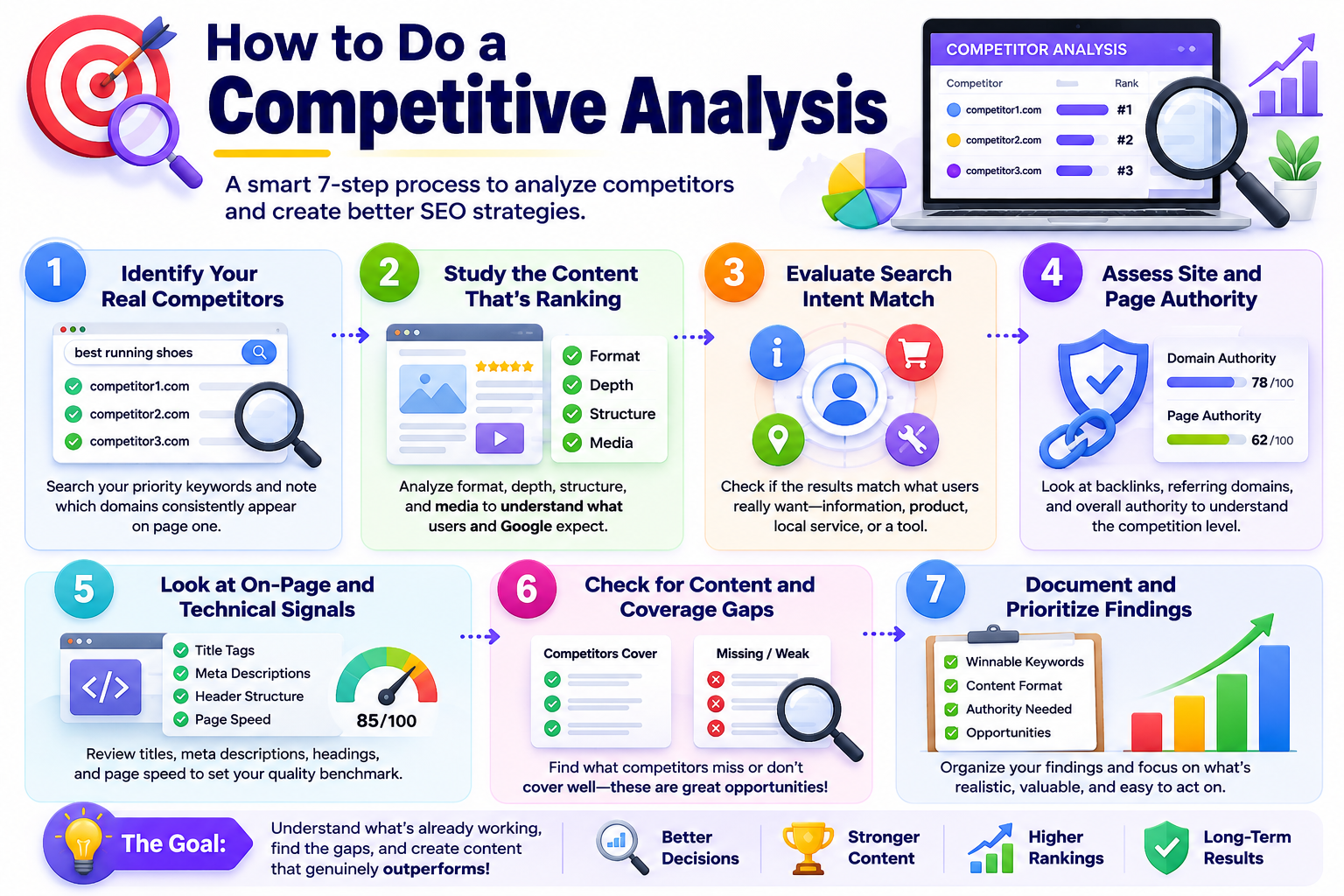
Start by searching your priority keywords and noting which domains consistently appear on page one. Do this for a representative sample of keywords, not just one or two, since rankings vary by topic. Patterns will emerge — a handful of domains usually show up again and again.
For each competing page, look at:
- Format — is it a guide, a listicle, a tool, a comparison, a product page?
- Depth — how thoroughly does it cover the topic?
- Structure — how are headings and sections organized?
- Media — does it use images, videos, tables, or interactive elements?
This tells you the baseline quality and format users and Google currently expect for that topic.
Check whether the ranking pages match what someone searching that keyword actually wants — information, a product to buy, a local business, or a specific tool. If the top results are all product pages, a blog post likely won't rank there, no matter how well it's written. Understanding search intent is its own topic worth studying separately, but it's essential context for competitive analysis.
Ranking well tends to correlate with a strong backlink profile, a healthy number of referring domains, and consistent topical relevance built up over time. Some SEO tools summarize this into scores like Domain Authority or Page Authority — useful for quick comparisons, but worth remembering these are third-party metrics, not figures Google itself uses to rank pages. A newer or smaller site can still compete, especially on less contested keywords, but it helps to know upfront if you're facing highly authoritative competitors.
Skim competing pages for title tags, meta descriptions, header structure, and page speed. Weak execution here won't hand you the top spot by itself, but reviewing it helps you see the baseline your own pages need to meet or exceed on technical and on-page basics.
Compare what multiple competitors cover against what none of them cover well. These gaps — a missing FAQ section, an outdated statistic, an unanswered follow-up question — are often the easiest way to create something genuinely more useful than what's currently ranking.
Turn your research into a clear record you can act on: which keywords are realistically winnable, which need a different content format, and which require building authority first. This is where a template becomes useful.
Use this simple structure for each target keyword or topic:
| Field | What to Record |
|---|---|
| Target keyword / topic | The keyword or topic being analyzed |
| Top 5 ranking URLs | The current page-one competitors |
| Content format | Guide, listicle, product page, tool, etc. |
| Search intent | Informational, commercial, transactional, navigational |
| Content gaps | What's missing or outdated across competitors |
| Content strengths | What competitors do particularly well |
| Backlink & authority signals | Rough sense of referring domains and topical authority of top results |
| On-page observations | Title tag, headings, structure notes |
| SERP features present | Featured snippet, People Also Ask, images, etc. |
| Opportunity level | High / medium / low, based on gaps and authority needed |
| Next action | Create new content, update existing page, deprioritize |
Fill one row per keyword, or one sheet per competitor if you're tracking a single rival across many topics. The goal is a document you can revisit, not a one-time exercise.
Only looking at direct business rivals. The sites ranking in Google for your keywords are often not the companies you'd list as competitors offline.
Copying competitor content instead of improving on it. Matching what already ranks rarely outranks it. The value is in identifying what's missing.
Ignoring search intent. A well-written page that doesn't match what searchers actually want won't rank, no matter how it compares to competitors on paper.
Treating it as a one-time task. Rankings, content, and competitors change. Revisiting the analysis periodically keeps it useful.
Competitive analysis in SEO means studying the pages currently ranking for your target keywords to understand their format, depth, authority, and gaps. It's not about copying competitors — it's about identifying exactly what it takes to genuinely outperform them, then using that insight to guide content creation, prioritization, and strategy. Done well, it turns guesswork into a clear, repeatable process for deciding what to build next.
We'll map your real SERP competitors, find the content gaps, and show you exactly where the ranking opportunities are.
Get a Free Audit