What Is Keyword Research?

-
nimda
- June 10, 2026
What Is Keyword Research?
Keyword research is the process of identifying, analyzing, and organizing the search terms people use in search engines to understand user intent, discover content opportunities, and improve SEO performance.
It serves as one of the most important foundations of search engine optimization because it helps website owners, marketers, and content creators understand what their audience is actively searching for online. Rather than guessing what users want, keyword research provides insight into real search behavior, allowing content to be aligned with actual demand.
Whether someone is searching for information, comparing products, researching solutions, or looking to complete a purchase, every search begins with a query. Keyword research helps uncover those queries and reveals the motivations behind them.
Modern keyword research is no longer just about finding popular phrases and inserting them into content. Search engines have become increasingly sophisticated in understanding topics, context, entities, and user intent. As a result, keyword research has evolved into a process of understanding entire subject areas and the relationships between concepts.
When performed effectively, keyword research helps create content that satisfies user needs, supports topical authority, improves content planning, and strengthens long-term organic visibility.
Why Keyword Research Matters
Every day, billions of searches are performed across search engines. Each search represents a need, question, problem, curiosity, or goal.
Keyword research helps uncover these needs by revealing:
- What people search for
- How they describe their problems
- The language they use
- The topics they care about
- The intent behind their searches
Without keyword research, content creators often rely on assumptions. While assumptions may occasionally be correct, they rarely provide the same level of accuracy as actual search data.
Keyword research helps answer important questions such as:
- What topics should a website cover?
- Which questions are users asking?
- What information is missing from existing content?
- Which pages should be created?
- How should content be organized?
The answers to these questions help guide SEO and content strategies while ensuring content aligns with real user demand.
How Keyword Research Supports SEO

It helps determine:
- Content topics
- Site structure
- Topic clusters
- Content priorities
- Internal linking opportunities
- Search intent alignment
- Content optimization decisions
Search engines aim to provide the most relevant results for every query. Keyword research helps identify what relevance looks like for specific searches.
By understanding the language people use and the information they seek, websites can create content that better matches search expectations.
This alignment between content and user intent is one of the key reasons keyword research remains a foundational SEO activity.
Understanding Keywords
A keyword is any word, phrase, or search query entered into a search engine.
Keywords represent the connection between what users want and the information available online.
For example:
Search Query | User Goal |
SEO | Learn about SEO |
What is keyword research | Understand a concept |
Best SEO tools | Compare solutions |
Ahrefs vs Semrush | Evaluate alternatives |
Buy SEO software | Complete a transaction |
Although these searches differ significantly, they all begin with keywords.
Modern SEO treats keywords as signals of intent rather than isolated words. Understanding the meaning behind a keyword is often more important than the keyword itself.
The Relationship Between Keywords and Search Intent
Every search query has a purpose.
This purpose is known as search intent.
Search intent explains why a user performs a search and what they hope to achieve.
Keyword research helps identify intent so content can be aligned with user expectations.
Informational Intent
Users want to learn something.
Examples:
- What is keyword research
- How search engines work
- What is search intent
These searches typically require educational content.
Navigational Intent
Users want to reach a specific website, platform, or page.
Examples:
- Google Search Console
- YouTube Studio
- Ahrefs login
Users already know where they want to go.
Commercial Investigation Intent
Users are researching options before making a decision.
Examples:
- Best keyword research tools
- SEO software reviews
- Ahrefs vs Semrush
These searches often involve comparisons and evaluations.
Transactional Intent
Users intend to take action.
Examples:
- Buy SEO software
- Subscribe to a platform
- Download an application
These searches typically occur near the end of a decision-making process.
Understanding search intent is critical because even well-written content may struggle if it fails to satisfy the intent behind a search query.
Types of Keywords
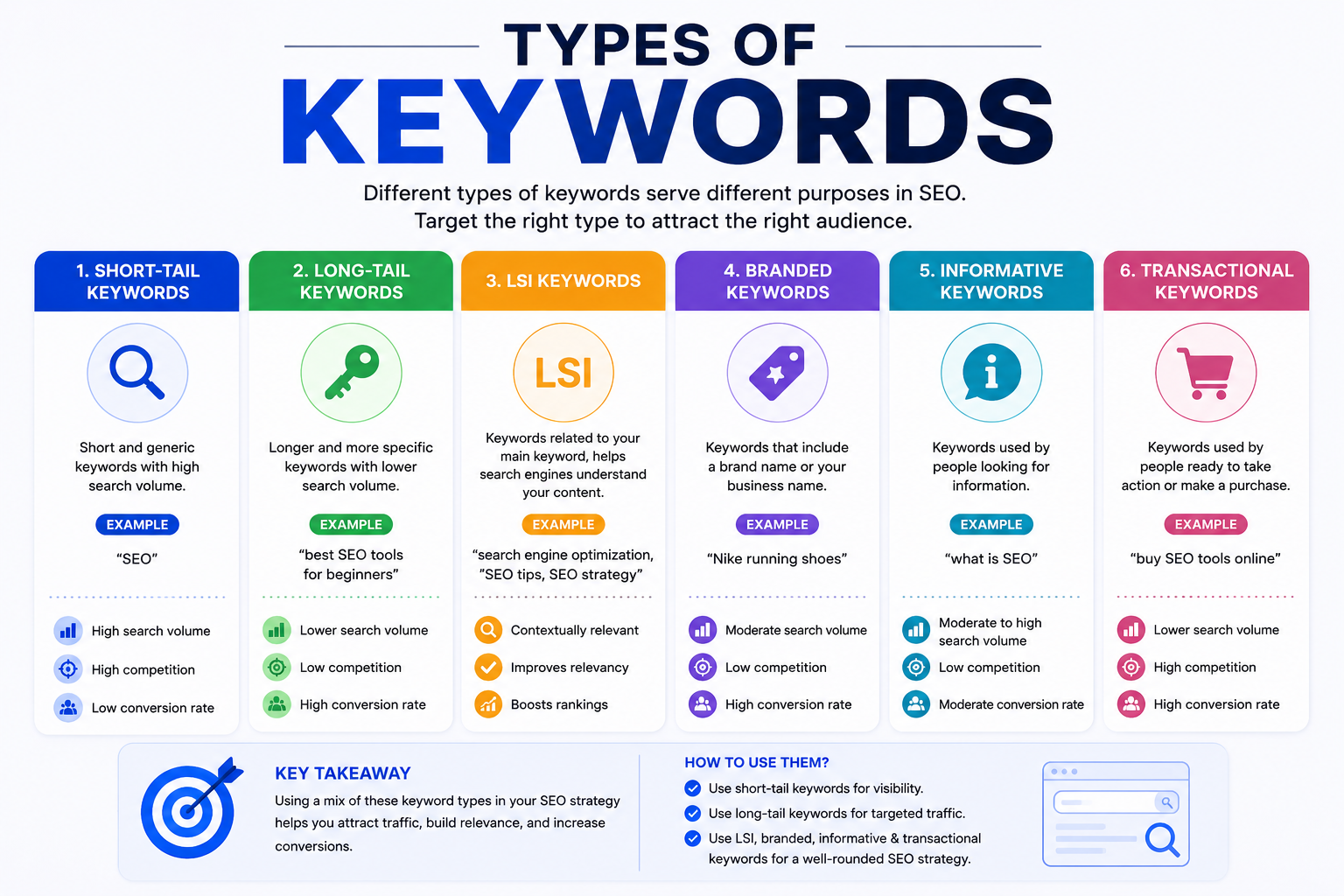
Understanding these categories helps create a more effective content strategy.
Short-Tail Keywords
Short-tail keywords are broad search terms that usually contain one or two words.
Examples:
- SEO
- Marketing
- Backlinks
These keywords often attract high search volume but are usually highly competitive.
Long-Tail Keywords
Long-tail keywords are more specific search queries.
Examples:
- What is keyword research in SEO
- How to perform keyword research
- Keyword research for beginners
Although search volume may be lower, these keywords often attract highly targeted visitors.
Question-Based Keywords
Question keywords reflect direct information needs.
Examples:
- What is keyword research
- Why is keyword research important
- How does keyword research work
They are particularly valuable for educational content.
Topic-Based Keywords
Topic-based keywords represent broader subject areas.
Examples:
- Keyword research
- Search intent
- Technical SEO
- Content strategy
These keywords often become the foundation of topic clusters.
Branded Keywords
Branded keywords include company, product, or brand names.
Examples:
- Ahrefs keyword research
- Google Search Console
- Semrush keyword tool
Users searching these terms already have familiarity with a specific brand.
Local Keywords
Local keywords include geographic modifiers.
Examples:
- SEO agency near me
- Web design company in Chicago
These keywords are primarily relevant to local search strategies.
How to Perform Keyword Research
Keyword research is a structured process rather than a one-time activity.
Although workflows vary, the process generally follows several key steps.
Step 1: Identify Core Topics
Begin by identifying the primary subjects relevant to your website.
For an SEO-focused website, core topics might include:
- Keyword research
- Search intent
- Technical SEO
- Link building
- Content optimization
These topics become the foundation for future research.
Step 2: Generate Seed Keywords
Seed keywords are broad terms that describe a topic.
For keyword research, seed keywords may include:
- Keywords
- Keyword research
- Search queries
- SEO keywords
These initial keywords help uncover additional opportunities.
Step 3: Expand Related Searches
Next, identify related terms, questions, and variations.
Examples may include:
- Keyword difficulty
- Search volume
- Keyword mapping
- Keyword clustering
- Long-tail keywords
This expands understanding of the topic.
Step 4: Analyze Search Intent
Review search results to understand what users expect.
Ask:
- Are users seeking information?
- Are they comparing options?
- Are they looking for a specific website?
- Are they ready to take action?
Intent should guide content creation.
Step 5: Evaluate Keyword Metrics
Assess available data such as:
- Search volume
- Keyword difficulty
- Relevance
- Search trends
These metrics help prioritize opportunities.
Step 6: Organize Keywords Into Topic Clusters
Group related keywords into logical themes.
This prevents content overlap and improves topical organization.
Step 7: Create Content Around User Needs
The final objective is not simply targeting keywords.
The goal is creating content that satisfies user needs while covering topics comprehensively.
Keyword Research Example
Understanding the theory behind keyword research is important, but seeing it applied in a real-world scenario makes the process easier to understand.
Imagine you manage a website focused on SEO education.
One of your core topics is:
Keyword Research
A basic keyword research process may uncover the following related searches:
Primary Topic
- Keyword research
Supporting Informational Searches
- What is keyword research
- How to do keyword research
- Why is keyword research important
- Keyword research for beginners
Related Concepts
- Search intent
- Search volume
- Keyword difficulty
- Long-tail keywords
- Seed keywords
Advanced Concepts
- Keyword clustering
- Keyword mapping
- Topical authority
- Semantic SEO
Rather than creating a single page targeting every keyword, a more effective approach would be to build a topic cluster.
For example:
Topic | Dedicated Content |
Keyword Research | Pillar Article |
Search Intent | Supporting Article |
Long-Tail Keywords | Supporting Article |
Keyword Difficulty | Supporting Article |
Keyword Mapping | Supporting Article |
Keyword Cannibalization | Supporting Article |
This structure helps search engines understand topical relationships while allowing each article to cover its subject thoroughly.
Keyword Research Tools
Keyword research is often supported by specialized tools that provide search data and insights.
These tools help uncover search opportunities and analyze user behavior.
Common features include:
- Search volume estimates
- Keyword difficulty metrics
- Related keyword suggestions
- Question-based searches
- Search trend analysis
- Competitor keyword insights
- SERP analysis
Keyword research tools provide valuable data, but they should not replace critical thinking.
A keyword with high search volume is not automatically a good target. Relevance, intent, and content quality often matter more than raw numbers.
The purpose of a tool is to assist decision-making, not make decisions on your behalf.
Understanding Keyword Metrics
Keyword research often involves evaluating several types of data.
These metrics help assess opportunities and prioritize content creation.
Search Volume
Search volume estimates how many times a keyword is searched during a specific period.
Higher search volume generally indicates greater interest.
However, volume alone does not determine value.
A highly relevant keyword with lower search volume may generate better results than a broad keyword with massive competition.
Keyword Difficulty
Keyword difficulty estimates how challenging it may be to compete for a particular keyword.
Factors that may influence difficulty include:
- Existing competition
- Content quality
- Website authority
- Backlink profiles
Difficulty scores should be treated as estimates rather than absolute measurements.
Search Intent
Search intent indicates the goal behind a search query.
Intent often determines the type of content users expect to find.
Understanding intent is frequently more important than search volume.
Relevance
Relevance measures how closely a keyword aligns with a topic or website.
A highly relevant keyword generally creates a stronger user experience than a loosely related keyword with higher traffic potential.
Search Trends
Search trends reveal how interest changes over time.
Some topics maintain consistent demand while others experience seasonal or temporary spikes.
Understanding trends helps prioritize content opportunities more effectively.
What Is Keyword Mapping?
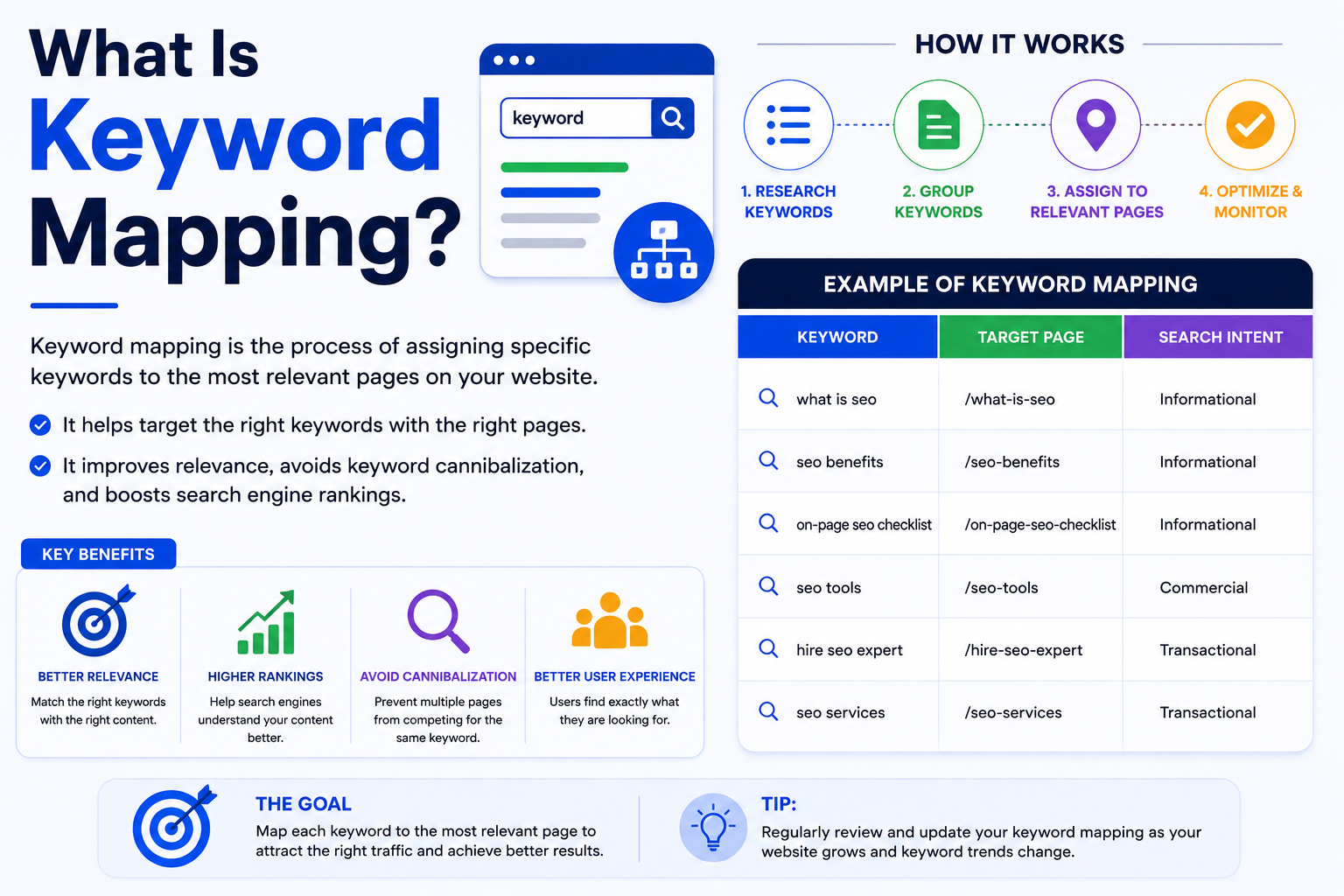
Keyword mapping is the process of assigning keywords to specific pages on a website.
The goal is to ensure that each page serves a clear purpose within the overall content structure.
Keyword mapping helps:
- Prevent keyword cannibalization
- Improve site organization
- Clarify content focus
- Support internal linking
- Strengthen topical relevance
For example:
Page | Primary Focus |
What Is Keyword Research | Keyword Research |
What Is Search Intent | Search Intent |
What Are Long-Tail Keywords | Long-Tail Keywords |
What Is Keyword Cannibalization | Keyword Cannibalization |
Instead of multiple pages competing for the same topic, each page supports a distinct search intent and content objective.
Keyword Research and Semantic SEO
Keyword research has changed significantly as search engines have evolved.
In the past, SEO often focused heavily on exact-match keywords.
Modern search engines understand much more than individual words.
They analyze:
- Topics
- Context
- Entity relationships
- User intent
- Semantic relevance
Because of this evolution, keyword research now focuses on understanding subject matter rather than merely collecting keyword lists.
For example, a page about keyword research may naturally discuss:
- Search intent
- Search queries
- Search volume
- Long-tail keywords
- Keyword difficulty
- Topic clusters
Search engines recognize these relationships and use them to better understand content.
This is one reason topical depth has become increasingly important in modern SEO.
Keyword Research and Topic Clusters
Effective keyword research often leads to the development of topic clusters.
A topic cluster is a group of related content pieces organized around a central subject.
For example:
Core Topic
Keyword Research
Supporting Topics
- Search Intent
- Keyword Difficulty
- Long-Tail Keywords
- Keyword Mapping
- Keyword Clustering
- Search Volume
Each supporting topic contributes additional depth to the overall subject area.
This structure helps:
- Improve content organization
- Strengthen topical authority
- Create logical internal linking opportunities
- Enhance user experience
Topic clusters allow websites to cover subjects comprehensively while maintaining clear topical boundaries.
Keyword Research and Topical Authority
Topical authority refers to the degree of expertise and coverage a website demonstrates within a subject area.
Keyword research contributes directly to topical authority because it helps identify:
- Important topics
- Supporting concepts
- User questions
- Content gaps
- Related entities
Rather than publishing random articles, keyword research helps create structured content ecosystems.
Over time, this improves both user experience and topical relevance.
Websites that consistently cover a subject from multiple angles often develop stronger authority signals than those that publish isolated content pieces.
Common Keyword Research Mistakes
Many websites struggle with keyword research because they misunderstand its purpose.
Focusing Only on Search Volume
High search volume does not guarantee success.
A keyword may attract significant traffic but have little relevance to a website’s audience.
Ignoring Search Intent
Content that fails to satisfy intent often struggles regardless of keyword targeting.
Understanding what users expect is essential.
Targeting Extremely Broad Keywords
Broad keywords are often highly competitive and may not clearly communicate user needs.
Specific keywords frequently provide better opportunities.
Keyword Stuffing
Repeating keywords excessively does not improve SEO.
Modern search engines evaluate overall content quality and relevance rather than keyword frequency.
Creating Multiple Pages for the Same Topic
This can create keyword cannibalization, where pages compete against each other instead of supporting one another.
Treating Keywords as Exact-Match Targets
Modern SEO requires understanding topics and concepts rather than focusing exclusively on exact wording.
Challenges of Keyword Research
Keyword research is valuable, but it is not perfect.
Several challenges can affect decision-making.
Search Volume Estimates Are Not Exact
Most tools provide estimates rather than precise numbers.
Actual search activity may vary.
User Behavior Changes
Search trends evolve over time.
Topics that perform well today may lose interest in the future.
Search Intent Can Shift
The intent behind certain queries may change as search engines adjust results to better meet user expectations.
Not Every Keyword Deserves Its Own Page
Some keywords represent the same intent and should be addressed within a single piece of content.
Understanding content boundaries is essential.
Competitive Landscapes Change
New competitors, content updates, and algorithm changes can influence keyword opportunities.
Keyword research should therefore be viewed as an ongoing process rather than a one-time task.
Best Practices for Effective Keyword Research
The most effective keyword research strategies share several characteristics.
Start With User Needs
Focus on understanding the audience before searching for keywords.
Think in Topics Rather Than Keywords
Modern SEO rewards topical relevance and comprehensive coverage.
Prioritize Intent
Always consider what users hope to accomplish through a search.
Focus on Relevance
A highly relevant keyword is often more valuable than a higher-volume alternative.
Organize Content Strategically
Use keyword research to build logical content structures and topic clusters.
Continuously Refine Research
Search behavior evolves over time.
Regular updates help maintain relevance.
Build Content Around Questions
Questions often reveal valuable informational opportunities and user concerns.
Frequently Asked Questions
What is keyword research in SEO?
Keyword research is the process of identifying and analyzing the search terms people use in search engines to understand user intent and create relevant content.
Why is keyword research important?
Keyword research helps websites understand audience interests, identify content opportunities, and align content with real search demand.
What are long-tail keywords?
Long-tail keywords are highly specific search queries that typically contain several words and target narrower user needs.
What is a keyword research tool?
A keyword research tool is software designed to provide search data, keyword suggestions, trend information, and related insights.
What is the difference between keyword research and search intent?
Keyword research identifies what people search for, while search intent explains why they perform those searches.
How often should keyword research be updated?
Keyword research should be reviewed regularly because search behavior, trends, competition, and user interests change over time.
What is keyword mapping?
Keyword mapping is the process of assigning keywords and topics to specific pages to improve content organization and prevent keyword cannibalization.
Does keyword research still matter in modern SEO?
Yes. Although search engines have become more advanced, keyword research remains essential for understanding users, planning content, and building topical authority.
Final Thoughts
Keyword research is the process of discovering, analyzing, and organizing the search terms people use to find information online. It provides valuable insight into user behavior, search intent, and content opportunities, making it one of the most important foundations of SEO.
Modern keyword research extends far beyond finding popular phrases. It involves understanding topics, identifying relationships between concepts, analyzing search intent, organizing content strategically, and building comprehensive topical coverage.
By helping websites align content with real user needs, keyword research supports stronger content planning, improved search visibility, better user experiences, and long-term topical authority. Whether creating a single article or developing an entire content ecosystem, effective keyword research serves as the bridge between what people search for and the information they hope to find.

6 Comments
[…] Keyword research helps bloggers identify the language people use when searching for information. […]
[…] Pages Category Pages Duplicate Content Core Web Vitals Related Guides Before you dive in KR Keyword Research Find what shoppers search SI Search Intent Match pages to intent URL URL Structure Build clean, readable URLs SH […]
[…] keyword research identifies the words and phrases people use when searching for products, services, and businesses […]
[…] example, an article about keyword research could naturally link to separate resources about search intent, long-tail keywords, and keyword […]
[…] before the writing even begins if it is based entirely on assumptions about what people search for. Keyword research helps uncover the words, topics, questions, and search needs people use when looking for […]
[…] Keyword research usually begins with a broad topic related to a website, product, service, or area of expertise. […]