An SEO strategy is a planned approach to improving a website's visibility in organic search results. It connects business goals, audience research, and technical execution into one coherent plan, rather than treating SEO as a list of disconnected tasks.
An SEO strategy is a planned approach to improving a website's visibility in organic search results. It connects business goals, audience research, and technical execution into one coherent plan, rather than treating SEO as a list of disconnected tasks like "add keywords" or "build links."
Without a strategy, SEO efforts tend to be reactive. A page gets optimized here, a few backlinks get built there, but nothing ties back to a clear objective. A strategy fixes this by giving every SEO action a reason: which audience it serves, which business goal it supports, and how success will be measured.
Search engines like Google evaluate hundreds of signals to decide which pages deserve to rank. Trying to influence all of them at once, without prioritization, wastes time and budget. A strategy solves this by answering three questions before any work begins:
Who is the website trying to reach?
What are they searching for, and why?
How will the website earn visibility for those searches, realistically, given its current state?
A strategy also creates a shared reference point. Content writers, developers, and marketers can all check their work against the same plan, instead of pulling in different directions.
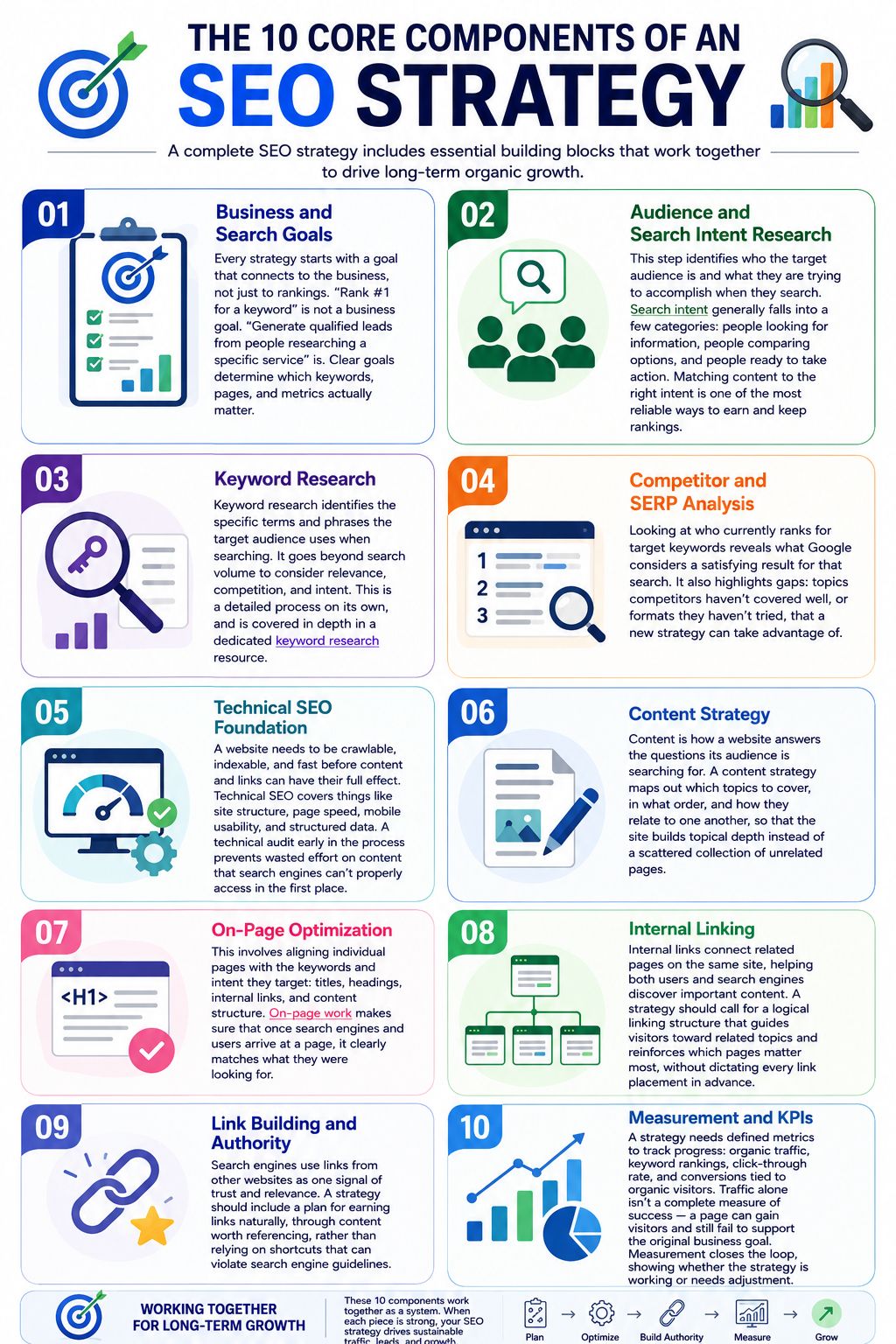
A complete SEO strategy typically includes the following building blocks. Each one is a discipline in its own right, so this article covers what they are and how they fit together, not how to execute each one in depth.
Every strategy starts with a goal that connects to the business, not just to rankings. "Rank #1 for a keyword" is not a business goal. "Generate qualified leads from people researching a specific service" is. Clear goals determine which keywords, pages, and metrics actually matter.
This step identifies who the target audience is and what they are trying to accomplish when they search. Search intent generally falls into a few categories: people looking for information, people comparing options, and people ready to take action. Matching content to the right intent is one of the most reliable ways to earn and keep rankings.
Keyword research identifies the specific terms and phrases the target audience uses when searching. It goes beyond search volume to consider relevance, competition, and intent. This is a detailed process on its own, and is covered in depth in a dedicated keyword research resource.
Looking at who currently ranks for target keywords reveals what Google considers a satisfying result for that search. It also highlights gaps: topics competitors haven't covered well, or formats they haven't tried, that a new strategy can take advantage of.
A website needs to be crawlable, indexable, and fast before content and links can have their full effect. Technical SEO covers things like site structure, page speed, mobile usability, and structured data. A technical audit early in the process prevents wasted effort on content that search engines can't properly access in the first place.
Content is how a website answers the questions its audience is searching for. A content strategy maps out which topics to cover, in what order, and how they relate to one another, so that the site builds topical depth instead of a scattered collection of unrelated pages.
This involves aligning individual pages with the keywords and intent they target: titles, headings, internal links, and content structure. On-page work makes sure that once search engines and users arrive at a page, it clearly matches what they were looking for.
Internal links connect related pages on the same site, helping both users and search engines discover important content. A strategy should call for a logical linking structure that guides visitors toward related topics and reinforces which pages matter most, without dictating every link placement in advance.
Search engines use links from other websites as one signal of trust and relevance. A strategy should include a plan for earning links naturally, through content worth referencing, rather than relying on shortcuts that can violate search engine guidelines.
A strategy needs defined metrics to track progress: organic traffic, keyword rankings, click-through rate, and conversions tied to organic visitors. Traffic alone isn't a complete measure of success — a page can gain visitors and still fail to support the original business goal. Measurement closes the loop, showing whether the strategy is working or needs adjustment.
Decide what the website needs SEO to accomplish, and for whom.
Understand what they search for and why.
Identify existing technical issues, content gaps, and ranking positions.
Not every keyword or page is worth the same effort. Weigh each opportunity by its potential impact against the effort required and its importance to the business goal, and work on the highest-value items first.
Decide which pages need to be created, and which existing pages need improvement.
Fix crawlability, speed, and structural problems that could limit results.
SEO strategies succeed through steady, ongoing work, not a single burst of activity.
Review performance against the original goals and adjust the plan based on real data.
Keywords should serve a business objective, not the other way around.
Even excellent content struggles to rank on a site that is slow or difficult for search engines to crawl.
Search engines and competitors keep changing, so strategies need regular review.
A high ranking that doesn't lead to traffic or conversions isn't delivering real value.
Competitor research should inform a strategy, not replace original thinking about the target audience.
An SEO strategy turns scattered optimization tasks into a coordinated plan built around clear goals, real audience research, and measurable outcomes. It brings together technical health, content, and authority-building under one framework, so that every piece of SEO work has a purpose. Strategies aren't fixed documents; they should be revisited as search behavior, competitors, and business goals evolve.
Get a free audit and a tailored roadmap from the Vertisols team — no guesswork, just a plan built around your goals.
