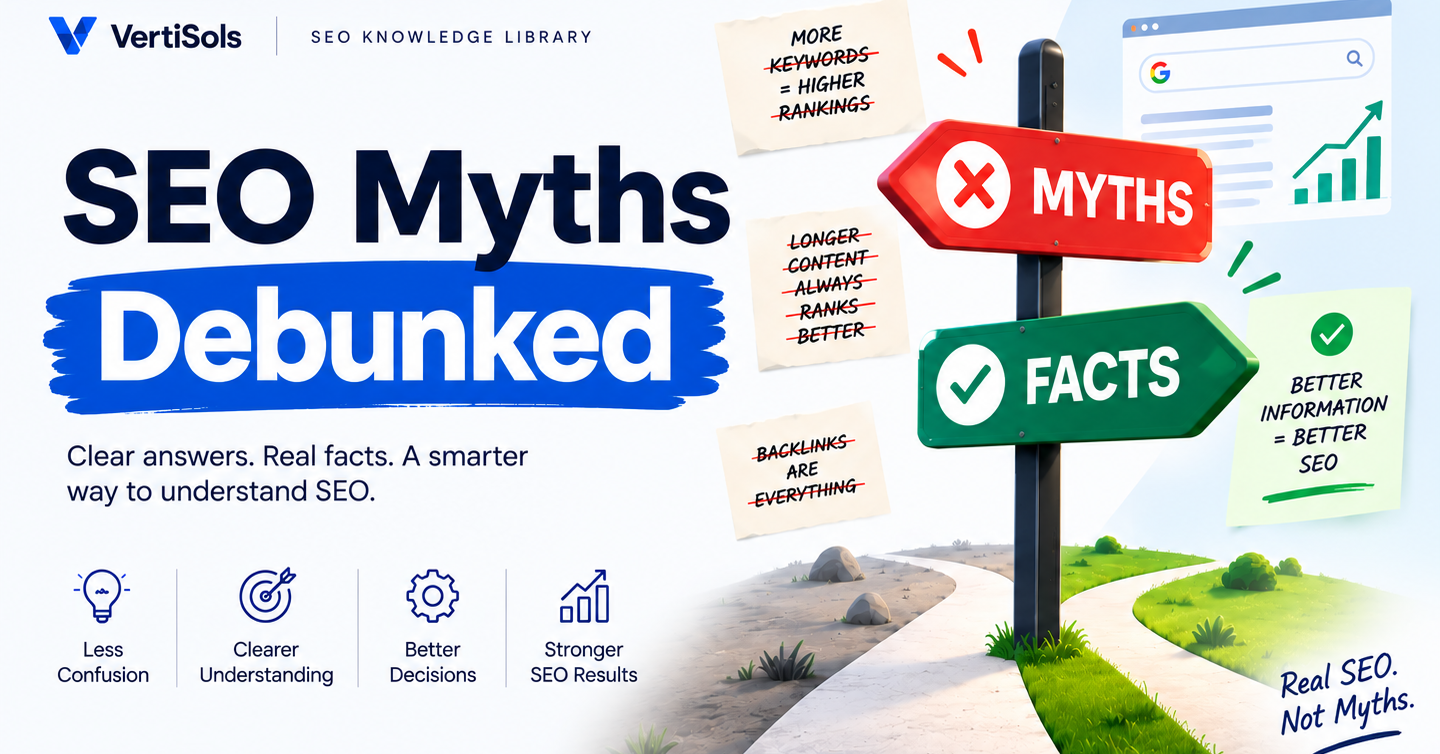
SEO is surrounded by advice, shortcuts, and claims that are repeated so often that they can start to sound like facts. Some are outdated, some confuse an industry observation with a Google recommendation, and others were never accurate in the first place.
Understanding common SEO myths matters because following bad advice can waste time, produce poor content, or lead to tactics that do more harm than good. Google uses many signals and systems to evaluate search results, rather than relying on one simple ranking formula.
The goal is not to cover every SEO misconception. Instead, this guide focuses on common claims that can lead beginners and site owners toward ineffective or outdated practices.
When evaluating an SEO claim, separate documented Google guidance from industry observations and unsupported claims presented as rules. That distinction is often more useful than memorizing a list of ranking factors.
Myth 1: SEO Is All About Keywords
Keywords are important because they help search engines and users understand what a page is about. However, SEO is not simply a matter of repeating a target keyword throughout an article.
Google’s Search Essentials recommends using words that people would use to search for the content and placing them in relevant, prominent locations. That does not mean repeating an exact phrase throughout the page is necessary.
Reality: Use relevant keywords naturally, but focus primarily on satisfying the searcher’s intent and clearly covering the topic.
Myth 2: More Content Always Means Better Rankings
Publishing more pages does not automatically make a website more authoritative or improve its rankings.
Google specifically warns against producing content primarily to attract search traffic or following an arbitrary publishing or word-count target. Its guidance emphasizes helpful, reliable, people-first content rather than content created simply to increase the amount of material on a website.
Reality: A smaller collection of useful, original resources can be more valuable than hundreds of thin or repetitive pages.
Myth 3: Every Article Must Be a Certain Length
There is no universal word count that guarantees good rankings.
A 500-word article can be appropriate for a straightforward question, while a complex subject may require considerably more explanation. Google explicitly asks content creators whether they are writing to a particular word count because they heard Google has a preferred word count. The answer is no.
Reality: Write enough to answer the user’s question accurately and completely, then stop.
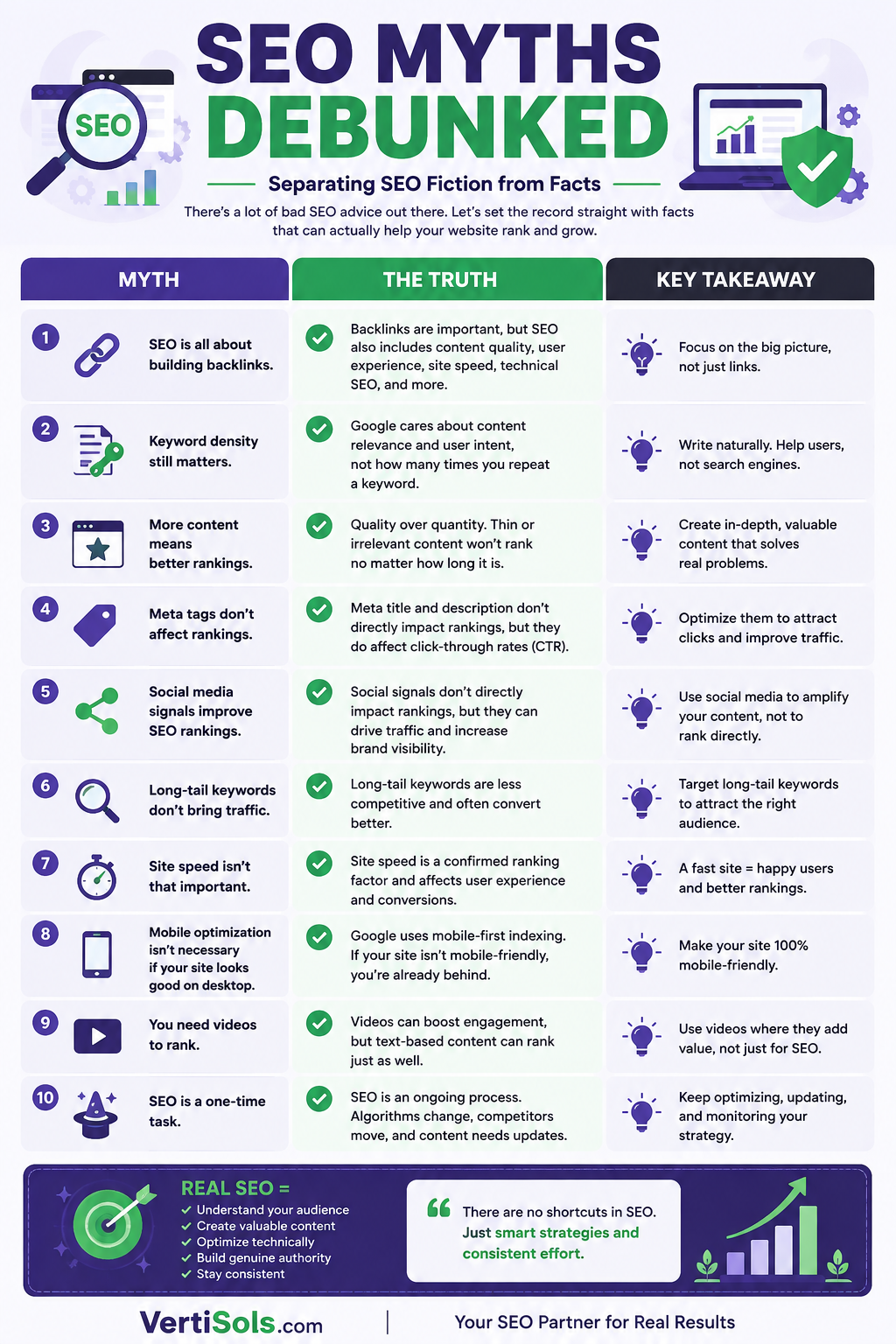
Myth 4: Keyword Density Is a Ranking Factor You Must Hit
There is no ideal keyword density percentage that every page should achieve.
Trying to reach an exact keyword percentage can encourage unnatural writing and unnecessary repetition. Search systems use many signals to understand and rank content, so mechanical repetition is not a sound SEO strategy.
Reality: Mention the main topic and relevant terminology naturally where they genuinely help the reader.
Myth 5: Meta Descriptions Directly Improve Rankings
Meta descriptions are useful, but they are not a direct ranking shortcut.
Google primarily generates search snippets from the content on the page. It may use the meta description when it provides a better representation of the page. A well-written description can therefore help users understand what a result offers, but it should not be treated as a guaranteed ranking factor.
Reality: Write unique, accurate meta descriptions to help represent the page clearly in search results and potentially encourage relevant clicks. Do not treat them as a guaranteed ranking factor.
Myth 6: Duplicate Content Always Causes a Google Penalty
Duplicate content is often misunderstood.
Google explains that duplicate content is not, by itself, a violation of its spam policies. When multiple URLs contain substantially similar information, Google’s systems may select a representative or canonical URL and avoid showing unnecessary duplicates in search results.
Reality: Duplicate content can create indexing, canonicalization, and user-experience problems, but it is not automatically a ranking penalty.
Myth 7: AI-Generated Content Is Automatically Penalized
Google’s guidance does not say that content is automatically unacceptable simply because generative AI was used to produce it.
The important issue is the quality, originality, and purpose of the resulting content. Google says generative AI can be useful for research and adding structure, but using it to generate many pages without adding value can fall under its scaled content abuse policies.
Reality: AI itself is not the deciding issue. Content still needs to be accurate, useful, original where originality is expected, and created to help people rather than to manipulate search rankings.
Myth 8: More Backlinks Always Mean Better Rankings
Backlinks are not simply a numbers game.
Google’s ranking systems include link analysis systems, and PageRank remains part of Google’s core ranking systems. However, search results are produced using many signals and systems rather than a simple calculation based on the number of links pointing to a page.
A large number of low-quality or manipulative links should not be confused with earning relevant references from useful websites.
Reality: Links are one part of a broader ranking system. Focus on earning legitimate references through useful content rather than treating backlink volume as a ranking formula.
Myth 9: You Must Submit Every Page to Google
Submitting a URL through Google Search Console can be useful for troubleshooting or requesting a crawl, but it does not guarantee indexing or ranking.
Google’s Search Essentials explains that meeting technical requirements and best practices does not guarantee crawling, indexing, or serving. Google also discovers URLs through its normal crawling processes.
Reality: Make important pages discoverable through a sound site structure and internal links. Use Search Console to inspect or request crawling when appropriate, but understand that crawling, indexing, and ranking are separate processes.
Myth 10: A Perfect PageSpeed Score Guarantees Better Rankings
Website performance matters, but a perfect PageSpeed score does not guarantee a top position.
Google describes page experience as one part of its overall search systems. Its guidance recommends considering factors such as Core Web Vitals, mobile usability, security, intrusive elements, and whether visitors can easily access the main content. Google also makes clear that relevance remains important even when page experience is not perfect.
Reality: Aim for a good overall page experience, including strong Core Web Vitals, mobile usability, security, and easy access to the main content. Do not expect a performance score alone to overcome weak or irrelevant content.
Myth 11: Updating the Date Makes Old Content Fresh
Simply changing a publication or update date does not make outdated content genuinely useful.
Google specifically warns against changing dates merely to make pages appear fresh when the underlying content has not substantially changed. Freshness systems are also designed around queries where newer information is actually important.
Reality: Update content when there is a meaningful reason to do so, such as correcting information, adding important developments, or improving the resource.
Myth 12: SEO Is a One-Time Task
SEO is not something you complete once and then never revisit. Search behavior, competitors, websites, and search systems can change over time.
That does not mean every page needs constant editing. Ongoing SEO can include monitoring search performance, fixing important technical problems, improving content when it becomes outdated, and responding to meaningful changes in user needs.
Reality: Treat SEO as an ongoing process of evaluation and improvement, not a one-time checklist.
Myth 13: Google Has One Fixed Ranking Factor List
SEO is sometimes presented as though Google has a fixed checklist where completing enough items guarantees a position.
In reality, Google’s ranking systems use many signals and systems to determine which results are most relevant and useful for a particular query. Different searches can require different types of results, and ranking systems continue to evolve.
Reality: Google Search uses many systems and signals. There is no single fixed checklist that guarantees a particular ranking position.
How to Identify an SEO Myth
When you encounter a strong SEO claim, ask a few simple questions:
Does the claim come from Google Search Central or another authoritative source?
Is it describing a confirmed ranking signal or merely an industry observation?
Does it promise a guaranteed ranking improvement?
Is the advice based on an outdated Google system?
Does it encourage keyword stuffing, link manipulation, or mass content production?
Does it focus on search engines at the expense of users?
Can the claim be tested or supported with credible evidence?
Be especially cautious when someone presents a single tactic as a guaranteed way to reach the top of Google. Search results depend on many systems and signals, and no legitimate SEO technique can guarantee a specific ranking position.
What Actually Matters in SEO?
Instead of chasing SEO myths, focus on the fundamentals:
Create helpful, reliable, people-first content.
Match the page to the user’s search intent.
Make important content accessible and understandable to search engines.
Provide a good overall page experience across devices.
Monitor performance and improve the site when evidence shows something needs attention.
These principles are more useful than chasing arbitrary keyword counts, word counts, publishing volumes, or supposed ranking formulas. Broader topics such as keyword research, technical SEO, content strategy, and SEO best practices deserve their own dedicated resources rather than being expanded here.
Final Takeaway
SEO myths usually develop when a useful practice is simplified into an absolute rule. Keywords, content, links, page experience, and AI-assisted workflows can all matter in the right context, but none should be reduced to a shortcut or guaranteed ranking formula.
The safest approach is to separate documented search guidance from industry observations, outdated practices, and unsupported claims. Good SEO is about helping people find useful content while making important pages accessible and understandable to search engines—not chasing secret ranking tricks.
