What Are Meta Descriptions?
-
nimda
- June 15, 2026
Introduction
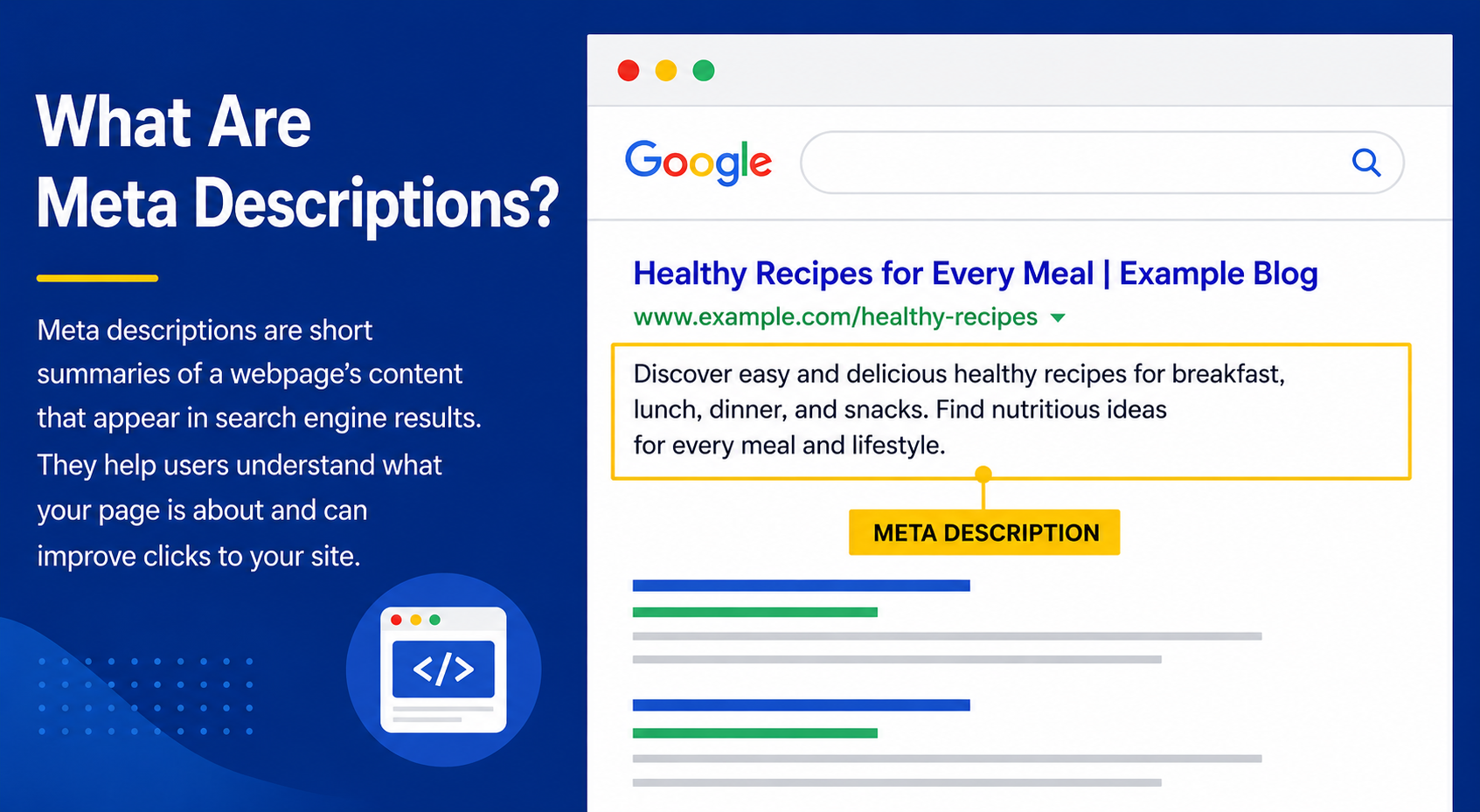
A meta description is a short HTML snippet that summarizes a webpage for search engines and users. It usually appears under the page title in search results and acts as a preview of what the page is about before a user clicks.
In modern SEO, meta descriptions are not a direct ranking factor in most search engines, but they strongly influence click-through rate (CTR), which indirectly affects organic performance. This makes them a critical part of how pages are presented in search results.
To understand meta descriptions properly, you need to see them not as a “ranking tool,” but as a SERP communication layer between your content and user intent.
What a Meta Description Actually Is (and Where It Lives)
A meta description is an HTML attribute placed inside the <head> section of a webpage:
<meta name=”description” content=”A concise summary of the page content”>
It is designed to:
- Summarize the page
- Help search engines understand page relevance
- Influence user click behavior in search results
In search engines like Google, it may appear as the descriptive snippet under the blue title link—but not always.
The Real Role of Meta Descriptions in Search
Most beginner SEO content describes meta descriptions as “summaries,” but this is incomplete.
In reality, meta descriptions function as:
1. A Click-Decision Trigger
Users decide whether to click based on:
- Clarity of topic
- Relevance to intent
- Perceived value of the page
2. A SERP Relevance Signal (Indirect)
Search engines evaluate:
- Whether the snippet matches the query
- Whether users engage with it (CTR behavior)
- Whether the page satisfies intent after clicking
3. A Fallback Content Source
If search engines cannot find a better snippet, they may use your meta description.
How Search Engines Actually Use Meta Descriptions
Search engines like Google do NOT guarantee that your meta description will appear in search results.
Instead, they dynamically choose snippets based on:
- Query match with page content
- Section-level relevance (H2/H3 text)
- User intent variation
- Semantic alignment between query and page
Key Insight:
A meta description is suggested text, not fixed output.
Why Google Often Rewrites Meta Descriptions

One of the most misunderstood SEO behaviors is snippet rewriting.
Search engines may ignore your meta description when:
1. Query Intent Mismatch
If the user query is more specific than your description, Google pulls a more relevant section.
2. Better On-Page Text Exists
If an H2 or paragraph better matches the query, it replaces your meta description.
3. Multi-Intent Pages
Pages covering multiple subtopics often trigger dynamic snippet selection.
4. Contextual Personalization
SERPs may vary based on device, location, and search history.
👉 This means your content structure often matters more than your meta description itself.
Meta Descriptions vs What They Are NOT
To build conceptual clarity, it is important to define boundaries.
Meta descriptions are NOT:
- ❌ A direct ranking factor
- ❌ A guaranteed SERP element
- ❌ A keyword stuffing field
- ❌ A replacement for page content
- ❌ A CTR guarantee
They are:
- ✔ A SERP preview suggestion
- ✔ A user engagement influence tool
- ✔ A semantic summary hint for search engines
- ✔ A click optimization layer
The SEO Function of Meta Descriptions in Modern Systems
Modern SEO systems treat meta descriptions as part of a broader on-page search presentation layer, which includes:
- Title tags
- URL structure
- Heading hierarchy
- Structured content blocks
- Internal linking context
Together, these elements determine how a page is interpreted and displayed in search results.
A strong meta description alone cannot compensate for weak content structure—but it can enhance already well-structured pages.
What Makes a High-Performance Meta Description

A high-performing meta description is not “creative”—it is intent-aligned and behavior-focused.
Core Characteristics:
1. Intent Match Precision
It must align with what the user is actually searching for.
2. Clear Value Communication
It should answer: “Why should I click this result?”
3. Natural Language Flow
It must read like human explanation, not keyword targeting.
4. Controlled Length
Typically 140–160 characters (flexible depending on SERP behavior).
5. Semantic Support of Page Content
It must reflect actual on-page content structure.
Examples: Weak vs Strong Meta Descriptions
❌ Weak Example (Generic + Keyword-Focused)
“Meta descriptions SEO meta tags website SEO tips meta description guide best SEO meta description writing”
Problem:
- Keyword stuffing
- No user value
- No intent clarity
⚠️ Average Example (Basic Summary)
“This article explains what meta descriptions are and how they work in SEO.”
Problem:
- Too generic
- No engagement trigger
- No value differentiation
✅ Strong Example (Intent + Value + Clarity)
“Learn what meta descriptions are, how search engines use them, and why they influence click-through rates in modern SEO.”
Why it works:
- Clear intent match
- Value-oriented
- Natural readability
- Click incentive built-in
Meta Descriptions and Search Intent Alignment
Meta descriptions must adapt to different intent types:
Informational Intent
Focus on explanation and learning outcomes.
Navigational Intent
Focus on helping users identify the correct page or brand.
Comparative Intent
Highlight clarity and differentiation between options.
Problem-Solving Intent
Emphasize solution or outcome.
When alignment is strong, CTR increases even if ranking position remains the same.
Internal SEO Ecosystem: Where Meta Descriptions Fit
Meta descriptions are not isolated—they belong to a structured SEO ecosystem:
- Title tags define primary topic signal
- Headings structure semantic meaning
- Body content defines depth and authority
- Internal links define topical relationships
- Meta descriptions define SERP presentation layer
Important Insight:
Meta descriptions influence pre-click behavior, while content structure influences post-click satisfaction.
Common Misconceptions About Meta Descriptions
1. “They improve rankings directly”
False. They influence CTR, not rankings directly.
2. “Google always uses them”
False. They are often rewritten dynamically.
3. “Longer descriptions perform better”
False. Relevance matters more than length.
4. “Every page must have a perfect meta description”
False. Some pages perform better with auto-generated snippets.
Advanced SEO Insight: Snippet Selection Behavior
Search engines evaluate multiple sources before choosing a snippet:
- Meta description tag
- H1 and H2 headings
- Paragraph-level text matching query intent
- Structured data (when applicable)
This means:
👉 Your page structure can override your meta description entirely.
To improve snippet control:
- Write clear section headings
- Use intent-focused subheadings
- Keep content semantically organized
- Avoid vague paragraph openings
Final Thoughts
Meta descriptions are not ranking shortcuts—they are behavioral optimization elements inside search ecosystems.
Their real value lies in how they shape user decision-making before a click, not how they influence algorithms directly.
When combined with strong content structure, semantic clarity, and intent alignment, meta descriptions become a powerful layer of SEO presentation that improves visibility through engagement—not manipulation.

1 Comment
[…] Meta descriptions are useful, but they are not a direct ranking shortcut. […]