Small businesses often assume that search engine optimization is something only large companies with big budgets can afford to do well. That's not true. SEO for small businesses is really about visibility: making sure that when a potential customer searches for what you offer, your business is one of the results they see. Done correctly, it can be one of the more cost-effective ways for a small business to compete with larger, better-funded competitors, though results depend on the industry, the level of competition, and how consistently the work gets done.
This article explains what SEO means for small businesses specifically, why it matters, and how to approach it in a practical, sustainable way.
What Makes Small Business SEO Different
SEO itself doesn't change based on business size. The core mechanics of how search engines crawl, index, and rank pages are the same whether a website belongs to a multinational retailer or a neighborhood bakery. What changes is strategy and scale.
Large companies often compete for broad, highly competitive keywords and can afford large content teams, extensive backlink campaigns, and long-term investment. Small businesses typically can't match that volume, so the smarter approach is focus. Small business SEO usually means:
- Targeting more specific, less competitive keywords rather than broad industry terms
- Prioritizing local relevance, since most small businesses serve a defined geographic area
- Making efficient use of limited time and budget
- Building credibility and trust signals gradually rather than all at once
In other words, small business SEO isn't a smaller version of enterprise SEO. It's a more targeted version of it.
Why SEO Matters for Small Businesses
Many small businesses rely on word of mouth, foot traffic, or paid advertising to bring in customers. SEO adds another channel that works differently from these: it captures people who are already searching for a solution.
When someone searches "plumber near me" or "best accounting software for freelancers," they already have intent. They're not being interrupted by an ad; they're actively looking. Ranking well for these searches means a small business shows up exactly when it's needed, without paying for every single click the way pay-per-click advertising requires.
SEO also compounds over time. A well-optimized page can continue attracting visitors months or years after it's published, unlike a paid ad that stops working the moment the budget runs out. For a small business with limited marketing resources, this long-term value is often what makes SEO worth the initial effort.
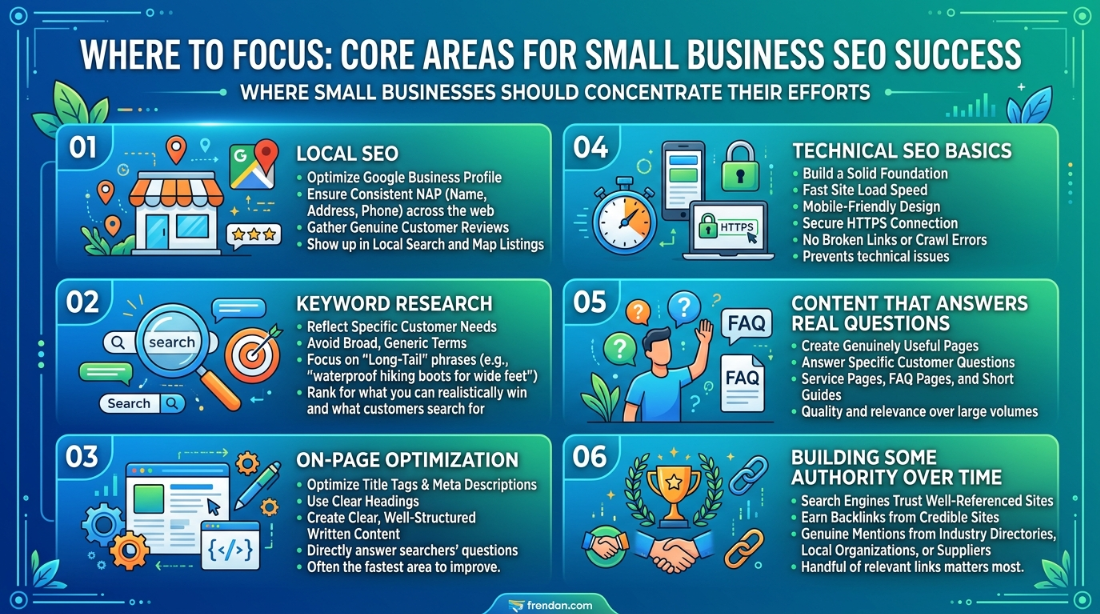
Core Areas Small Businesses Should Focus On
Local SEO
For most small businesses, especially those with a physical location or a defined service area, local SEO is the highest priority. This includes optimizing a Google Business Profile, ensuring the business's name, address, and phone number (often called NAP) are consistent across the web, and gathering genuine customer reviews. Local SEO deserves its own deeper explanation, but the short version is: if your business serves a specific area, showing up in local search results and map listings matters more than ranking nationally.
Keyword Research
Small businesses get the most value from keywords that reflect specific customer needs rather than broad, generic terms. A general term like "shoes" is extremely competitive and often too vague to convert into a sale. A more specific phrase like "waterproof hiking boots for wide feet" attracts fewer searches but far more qualified visitors. This kind of targeted keyword research is a discipline of its own, but the underlying idea is simple: rank for what you can realistically win, and what your actual customers are searching for.
On-Page Optimization
This covers the elements on each web page that help search engines understand what the page is about: title tags, meta descriptions, headings, and the actual written content. For small businesses, on-page optimization is often the fastest area to improve because it doesn't require external resources like backlinks. Clear, well-structured pages that directly answer what a searcher is looking for tend to perform better over time.
Technical SEO Basics
Small business websites don't need enterprise-level technical infrastructure, but they do need a solid foundation: a site that loads quickly, works properly on mobile devices, uses secure HTTPS, and doesn't have broken links or major crawl errors. These technical basics don't guarantee rankings on their own, but ignoring them can hold back everything else.
Content That Answers Real Questions
Instead of trying to produce large volumes of content, small businesses benefit from creating a smaller number of genuinely useful pages that answer the specific questions their customers ask. This could be a service page that clearly explains what's included, an FAQ page, or a short guide related to the business's expertise. Quality and relevance matter more than quantity.
Building Some Authority Over Time
Search engines also weigh how trusted and well-referenced a website is elsewhere on the web, largely through backlinks from other credible sites. Small businesses don't need an aggressive link-building campaign to start; a few genuine mentions from industry directories, local organizations, or suppliers can help. This is a broader topic on its own, but the short version is: a handful of relevant, earned links matters more than a large number of low-quality ones.
Common Mistakes Small Businesses Make with SEO
Trying to rank for keywords that are too competitive
Competing directly with national brands for broad terms rarely works for a small, newer website. Specificity is an advantage, not a limitation.
Neglecting the Google Business Profile
For location-based businesses, this is often more impactful than the website itself, yet it's frequently left incomplete or unclaimed.
Inconsistent business information online
When a business's name, address, or phone number differs across directories, review sites, and its own website, it creates confusion for both users and search engines.
Expecting immediate results
SEO is not a quick fix. It typically takes weeks to months to see meaningful movement, especially for newer websites with limited history.
Publishing content without a clear purpose
Pages created just to "have more content" without answering a real user question rarely perform well and can dilute the site's overall relevance.
A Simple Starting Checklist
- Claim and fully complete a Google Business Profile
- Confirm business name, address, and phone number are consistent everywhere online
- Identify a short list of specific, realistic keywords tied to actual customer searches
- Review each core page's title tag, meta description, and headings
- Confirm the website loads quickly and works well on mobile
- Collect and respond to customer reviews
- Publish content that directly answers common customer questions
Knowing Whether It's Working
SEO progress isn't always visible day to day, so it helps to check a few basic signals periodically: whether the site is showing up in search for its target terms, whether organic visits are trending upward, and whether that traffic is turning into inquiries or sales. Tracking this in detail is its own topic, but even a simple monthly glance at these numbers is enough to tell whether the current approach is working.
Summary
SEO for small businesses isn't about outspending larger competitors. It's about being specific, consistent, and patient. By focusing on local visibility, realistic keyword targets, clean on-page fundamentals, and genuinely useful content, a small business can build steady, long-term visibility in search results without needing an enterprise-sized budget or team. The businesses that succeed with SEO over time are usually the ones that treat it as an ongoing practice rather than a one-time project.
Explore More Guides
Want a free SEO audit for your business?
Our team can review your website's local, on-page, and technical SEO, and show you exactly where the opportunities are.
Get Your Free Audit