
Why Keyword Research Matters For SEO
SEO content can miss its audience before the writing even begins if it is based entirely on assumptions about what people search for. Keyword research helps uncover the words, topics, questions, and search needs people use when looking for information online.
That makes keyword research an important part of SEO. It helps websites make more informed decisions about what to publish, how to describe a topic, and which searches a page should be relevant to.
However, keyword research is not about collecting keywords and repeating them throughout a page. Its real value comes from understanding search behavior and user needs.
What Is Keyword Research?
Keyword research is the process of identifying and evaluating the words and phrases people use in search engines.
These can include broad terms, specific questions, product-related searches, informational queries, and longer, more detailed phrases.
For example, someone interested in SEO might search for:
SEO
SEO basics
how SEO works
why keyword research matters for SEO
keyword research tools
These searches are related, but they do not necessarily represent the same need.
Google recommends thinking about the words users might search for when looking for your content. It also notes that its language systems can understand how a page relates to queries even when the exact terms are not used.
This means keyword research should be used to understand a topic and its audience—not as a checklist of exact phrases to insert into content.
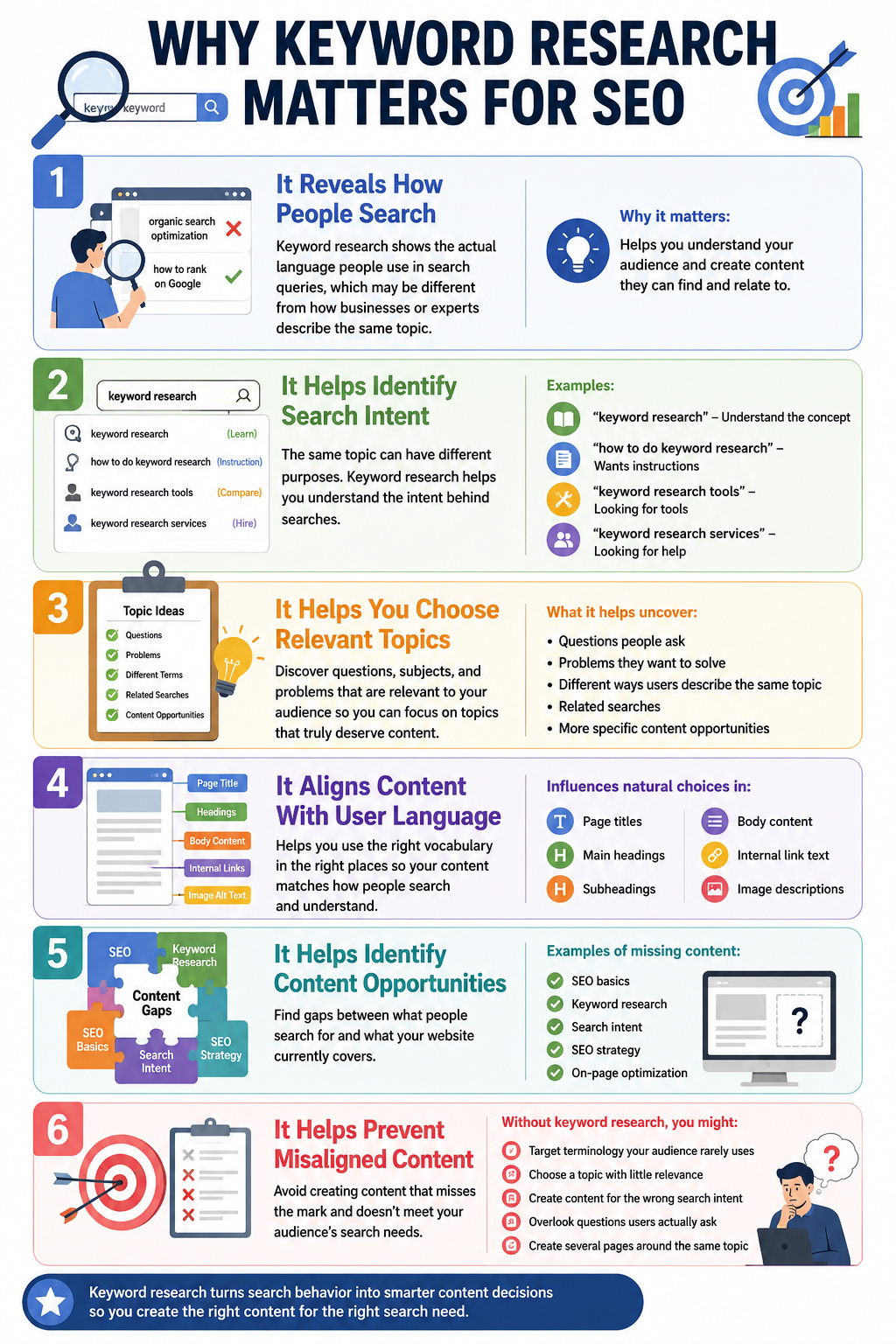
Why Keyword Research Matters for SEO
1. It Reveals How People Search
Businesses and SEO professionals may describe a topic differently from the people they want to reach.
Keyword research provides evidence about the language people actually use in search queries.
For example, an SEO professional may talk about organic search optimization, while a beginner may search for how to rank on Google.
Both phrases relate to SEO, but they reflect different ways of describing the subject.
Understanding this language can help you create content that is easier for your intended audience to discover and understand.
2. It Helps Identify Search Intent
The same general topic can produce searches with very different purposes.
Consider these examples:
“keyword research” — someone may want to understand the concept.
“how to do keyword research” — someone wants instructions.
“keyword research tools” — someone may be comparing or looking for tools.
“keyword research services” — someone may be looking for professional help.
Keyword research can therefore provide clues about search intent, or the underlying reason behind a query.
Recognizing that difference helps prevent a common SEO problem: creating a page that technically targets a keyword but does not actually answer what the searcher wants.
A complete guide to search intent deserves separate treatment, but understanding it is an important reason keyword research matters.
3. It Helps You Choose Relevant Topics
Keyword research can uncover questions, subjects, and problems that are relevant to an audience.
Instead of choosing every article topic based on assumptions, you can use search behavior as one source of evidence when deciding what deserves coverage.
This can help identify:
Questions people ask
Problems they want to solve
Different ways users describe the same topic
Related searches
More specific content opportunities
The objective is not to publish an article for every variation. It is to understand which topics genuinely deserve useful content.
4. It Aligns Content With User Language
A page can be technically correct while still using terminology that does not match how its audience searches.
Keyword research helps identify the vocabulary surrounding a subject.
That information can influence natural choices in:
Page titles
Main headings
Subheadings
Body content
Internal link text
Image descriptions where relevant
Google’s Search Essentials recommends using words that people would use to look for your content and placing descriptive terms in prominent parts of a page.
This does not mean repeating the same keyword unnecessarily. Google’s systems are designed to understand relationships between words and concepts, so useful, well-focused content matters more than mechanical repetition.
5. It Helps Identify Content Opportunities
Keyword research can reveal gaps between what people search for and what a website currently explains.
For example, a website may already have a general article about SEO but lack focused resources answering questions about:
SEO basics
keyword research
search intent
These insights can help shape a more useful content structure.
The goal should be to fill genuine information gaps rather than create multiple pages that say essentially the same thing.
6. It Helps Prevent Misaligned Content
Without keyword research, content planning can become guesswork.
A website might:
Target terminology its audience rarely uses
Choose a topic that has little relevance to its readers
Create content for the wrong search intent
Overlook questions users actually ask
Create several pages around the same underlying topic
The problem is not necessarily poor writing. A well-written article can still perform poorly if it is fundamentally misaligned with the search need it is trying to address.
Keyword research helps reduce that risk by providing a better understanding of the search landscape before content is created.
Keyword Research Is More Than Search Volume
Search volume can be useful when evaluating keywords, but it should not be treated as the only measure of value.
A keyword with high search volume is not automatically the best choice for a particular page.
Relevance and intent matter too.
Before prioritizing a keyword, consider:
Is it relevant?
Does the search relate directly to your audience and subject?
Does the intent fit?
Would someone searching the term expect the type of information your page provides?
Can the content satisfy the need?
Can your page provide a genuinely useful answer?
These questions help move keyword research away from simple volume chasing and toward better content decisions.
A Simple Example
Imagine a website wants to create an article about SEO.
The team might assume that “SEO optimization techniques” is the most appropriate phrase to target.
Research could reveal that people also search for terms such as:
SEO best practices
how SEO works
SEO basics
how to improve Google rankings
SEO strategy
The important insight is not that all these phrases should be placed on one page.
Instead, they can reveal different questions and content needs.
One search may deserve a definition, another a practical guide, and another a broader strategic resource.
This is where keyword research becomes useful: it helps turn search behavior into better content decisions.
Does Keyword Research Guarantee Rankings?
No.
Keyword research can help you understand relevant searches and make better content decisions, but it does not guarantee search rankings.
Google’s ranking systems use many signals and systems to determine which pages are relevant and useful for a particular query.
Content quality, relevance, technical accessibility, competition, and other factors can also affect how a page performs.
Therefore, keyword research should be viewed as a foundation for informed SEO decisions, not a ranking formula.
Key Takeaway
Keyword research matters because it helps SEO begin with evidence instead of assumptions.
It shows how people describe topics, what questions they ask, and what kinds of information they may be seeking. That understanding can guide topic selection, content planning, search-intent alignment, and the natural use of relevant terminology.
The goal is not to use a keyword as many times as possible.
The goal is to understand the searcher’s need and create content that genuinely satisfies it.
Good keyword research helps you create the right content for the right search need.
Related SEO Topics
To explore the subject further, related resources can cover search intent, keyword research methods, keyword strategy, on-page SEO, and content strategy. Each topic should be addressed separately so that readers can explore the specific concept without repeating the same information.
