
-
Asher Feroze
- September 1, 2026
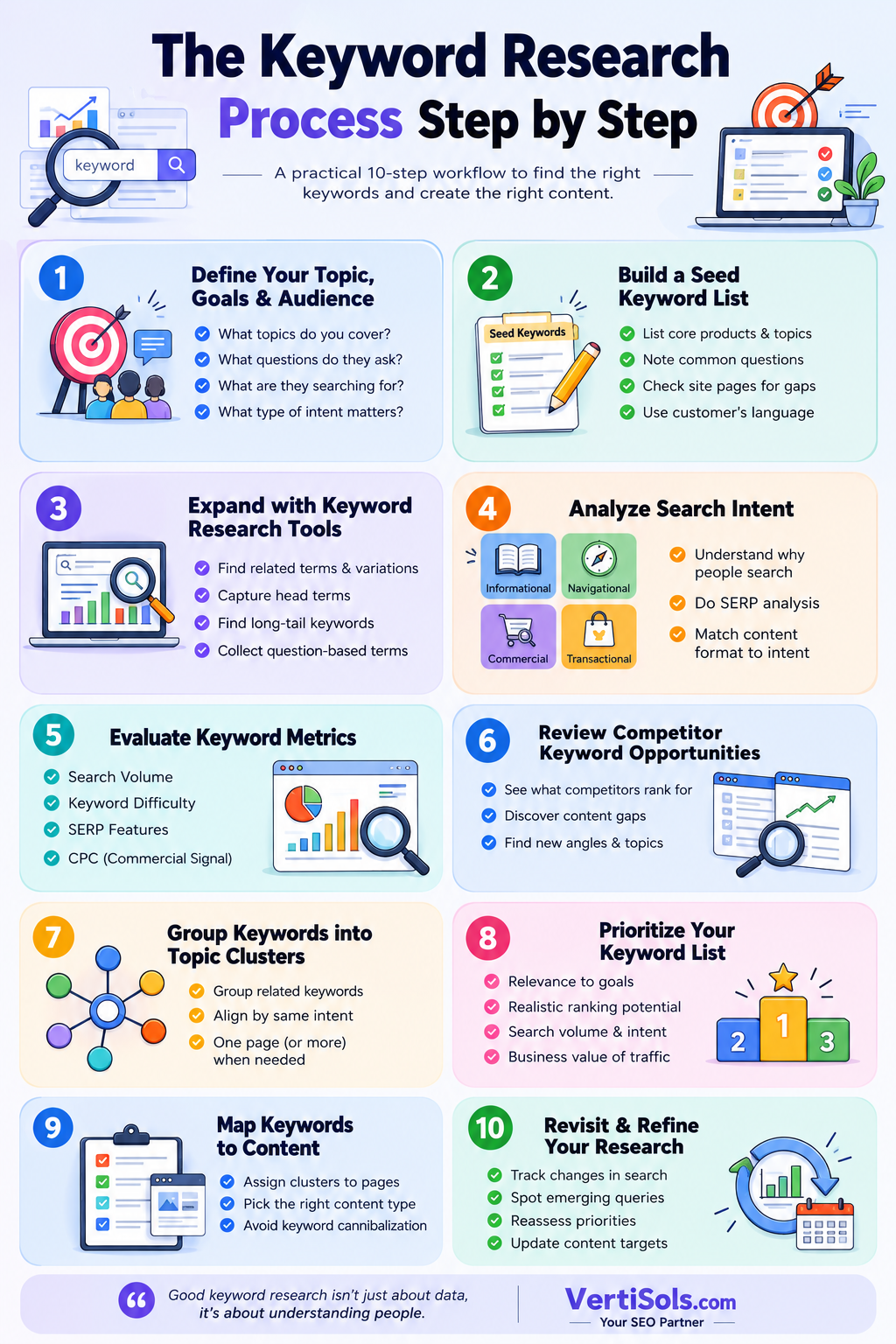
Keyword research helps you understand what people search for and how those searches relate to your content. This guide breaks the process down into clear, practical steps you can follow for any website, blog, or online business.
What Keyword Research Does
Keyword research is the process of discovering, analyzing, and prioritizing the search terms your target audience uses to find information, products, or services related to your business.
Done well, it does three things:
- Confirms there is real search demand before you invest time in content
- Reveals the exact language your audience uses, so your content speaks their way
- Helps you understand search intent, so the content you create actually satisfies the searcher
Keyword research isn’t a one-time task. It’s a recurring process that evolves as your audience and market change.
Step 1: Define Your Topic, Goals, and Audience
Before opening any keyword tool, get clear on what you’re covering and who you’re trying to reach. Ask:
- What topics does the website cover?
- What questions does the audience ask?
- What information, products, or services are they searching for?
- What type of search intent is relevant to the topic?
This context shapes every decision that follows, from which keywords you pick to how you group them later.
Step 2: Build a Seed Keyword List
Seed keywords are broad, foundational terms that describe your core topics. Think of them as starting points, not final targets.
To build your seed list:
- List your main products, services, and topic categories in plain language
- Note the questions customers or clients commonly ask
- Review your own site’s navigation and existing page titles for topic gaps
- Think about how a customer, not an industry insider, would phrase a search
For example, an SEO agency might start with seed terms like “keyword research,” “on-page SEO,” or “local SEO,” then expand from there.
Step 3: Expand the List with Keyword Research Tools
Once you have seed keywords, use keyword research tools to expand that list with related search terms, questions, and variations. Most tools pull data from actual search query databases and return metrics like search volume, competition level, and related terms.
At this stage, aim for breadth. Capture:
- Head terms (short, broad phrases like “SEO tools”)
- Long-tail keywords (longer, more specific phrases like “best free SEO tools for small business blogs”)
- Question-based keywords (phrases starting with what, how, why, best, etc.)
Long-tail keywords are often more specific and may have lower individual search volume. Their specificity can make them useful for identifying narrower search needs, although competition and ranking difficulty still vary by query.
Step 4: Analyze Search Intent
Search volume alone doesn’t tell you whether a keyword is worth targeting. You also need to understand why someone is searching that term. This is search intent.
Search intent generally falls into four categories:
- Informational — the searcher wants to learn something (“what is keyword research”)
- Navigational — the searcher is looking for a specific site or brand (“Ahrefs login”)
- Commercial investigation — the searcher is comparing options before deciding (“best keyword research tools”)
- Transactional — the searcher is ready to take action (“buy SEO keyword tool subscription”)
Before targeting a keyword, search it yourself and study the current top-ranking pages. This process, often called SERP analysis, helps you understand what type of content Google currently considers relevant for the query. If Google is consistently returning product pages for a term, a blog post is unlikely to rank well for it, and vice versa. Matching content format to intent is one of the most overlooked parts of keyword research.
Step 5: Evaluate Keyword Metrics
With intent confirmed, filter your list using a few core metrics:
- Search volume — how often the term is searched, usually shown as a monthly average
- Keyword difficulty — an estimate of how hard it is to rank for the term, based on the strength of currently ranking pages
- SERP features — elements such as featured snippets, People Also Ask, maps, videos, and shopping results can change how much visibility traditional organic listings receive
- CPC — cost-per-click can provide an additional indication of commercial interest, although it is primarily a paid-search metric
No single metric tells the whole story. A lower-volume keyword with strong intent and low competition can be more valuable than a high-volume keyword you have little chance of ranking for.
Step 6: Review Competitor Keyword Opportunities
Examine competing pages that already rank for your target searches to discover related keywords, content gaps, and search patterns you may have missed. This can reveal topics you hadn’t considered or areas where competitors are weak.
A full competitor keyword analysis is a broader exercise on its own. For this step, the goal is simply to use competitor rankings as one more input into your keyword list.
Step 7: Group Keywords into Topic Clusters
Trying to target one page per keyword is inefficient and often leads to duplicate or overlapping content. Instead, group closely related keywords that share the same search intent, and determine whether they belong on one page or separate pages.
For example, “keyword research tools,” “best keyword research software,” and “free keyword research tools” likely belong on the same page, since a searcher typing any of these expects a similar type of content. A cluster can occasionally support more than one page when the underlying intents are genuinely different.
This clustering approach also supports a stronger site structure, since it naturally organizes content around core topics rather than scattered, disconnected keywords.
Step 8: Prioritize Your Keyword List
With a full, organized list in hand, prioritize based on:
- Relevance to your business goals
- Realistic ranking potential given your site’s current authority
- Search volume and intent quality
- Business value of the traffic (a smaller, high-intent audience often outperforms a larger, low-intent one)
For newer or less-established websites, prioritizing highly relevant terms with realistic competition can provide more achievable opportunities than immediately pursuing the most competitive keywords.
Step 9: Map Keywords to Content
Assign each keyword cluster to either an existing page or a new piece of content. Avoid assigning overlapping clusters to multiple pages, which can contribute to keyword cannibalization.
At this stage, decide the content format each cluster calls for, based on the intent you identified in Step 4: a blog article, a product or service page, a comparison page, or a resource guide.
Step 10: Revisit and Refine Your Research
Keyword research isn’t finished once content is published. Search behavior shifts and new terms emerge. Revisit your keyword data periodically to:
- Review changing search behavior
- Identify emerging queries
- Reassess existing keyword priorities
- Update content targets when search intent changes
Treating keyword research as an ongoing process, rather than a one-time project, keeps your content aligned with how your audience is actually searching over time.
Common Keyword Research Mistakes
- Chasing volume over intent. A high-volume keyword with the wrong intent will rarely convert or rank well.
- Ignoring keyword relevance. Choosing keywords simply because they have high search volume can attract visitors who are not looking for what your page provides. Relevance to the topic and search intent should come first.
- Ignoring long-tail keywords. They can help identify narrower, more specific search needs that broader terms miss.
- Skipping SERP analysis. Metrics from a tool can’t fully replace looking at what’s actually ranking.
- Targeting one keyword per page without clustering. This leads to thin, repetitive content that competes with itself.
Keyword Research Checklist
- [ ] Topic, goals, and target audience defined
- [ ] Seed keyword list created
- [ ] Keyword list expanded using a research tool
- [ ] Search intent analyzed for each priority term
- [ ] Search demand, competition, and other relevant metrics reviewed
- [ ] Competitor keyword opportunities reviewed
- [ ] Keywords grouped into topic clusters
- [ ] Clusters prioritized by relevance and ranking potential
- [ ] Keywords mapped to specific pages or content
- [ ] Research revisited and refined regularly
Summary
The keyword research process moves from broad to specific: starting with your topic and audience, expanding into a full list of relevant terms, filtering by intent and metrics, and ending with a clear map of which content should target which keywords. Following these steps turns an unstructured list of search terms into an organized set of keyword opportunities that can guide content planning.
