-
nimda
- June 20, 2026
Introduction
Keywords remain an important part of SEO, but successful optimization is no longer about repeating a phrase throughout a page. Modern search engines are designed to understand topics, context, and relationships between concepts. As a result, where keywords appear often matters more than how many times they are used.
Effective keyword placement helps search engines understand what a page is about while helping users quickly determine whether the content matches their needs. When used correctly, keywords improve clarity, reinforce topical relevance, and support a better user experience.
This guide explains keyword placement best practices, the locations that matter most, common mistakes to avoid, and how to use keywords naturally without sacrificing readability.
What Is Keyword Placement?
Keyword placement refers to the strategic positioning of important words and phrases within a webpage.
Search engines analyze various elements of a page to understand its topic. Keywords placed in prominent locations provide contextual signals that help clarify what the content covers and how relevant it may be to specific search queries.
Good keyword placement helps answer questions such as:
What is this page about?
What topic does it primarily cover?
Which search queries is it relevant to?
What information should users expect to find?
The purpose of keyword placement is not to manipulate rankings. Its purpose is to improve communication between content creators, users, and search engines.
Why Keyword Placement Matters
Search engines evaluate hundreds of signals when analyzing a page, but content relevance remains one of the most important factors.
Strategic keyword placement helps:
Clarify page topics
Reinforce content relevance
Improve content organization
Support search intent alignment
Enhance user experience
Make information easier to scan and understand
When keywords appear in meaningful locations, they provide context that helps both users and search engines interpret the content more accurately.
Which Keyword Placements Matter Most?
Not every placement carries equal importance.
Some locations provide stronger contextual signals than others because they help establish the page’s primary topic early.
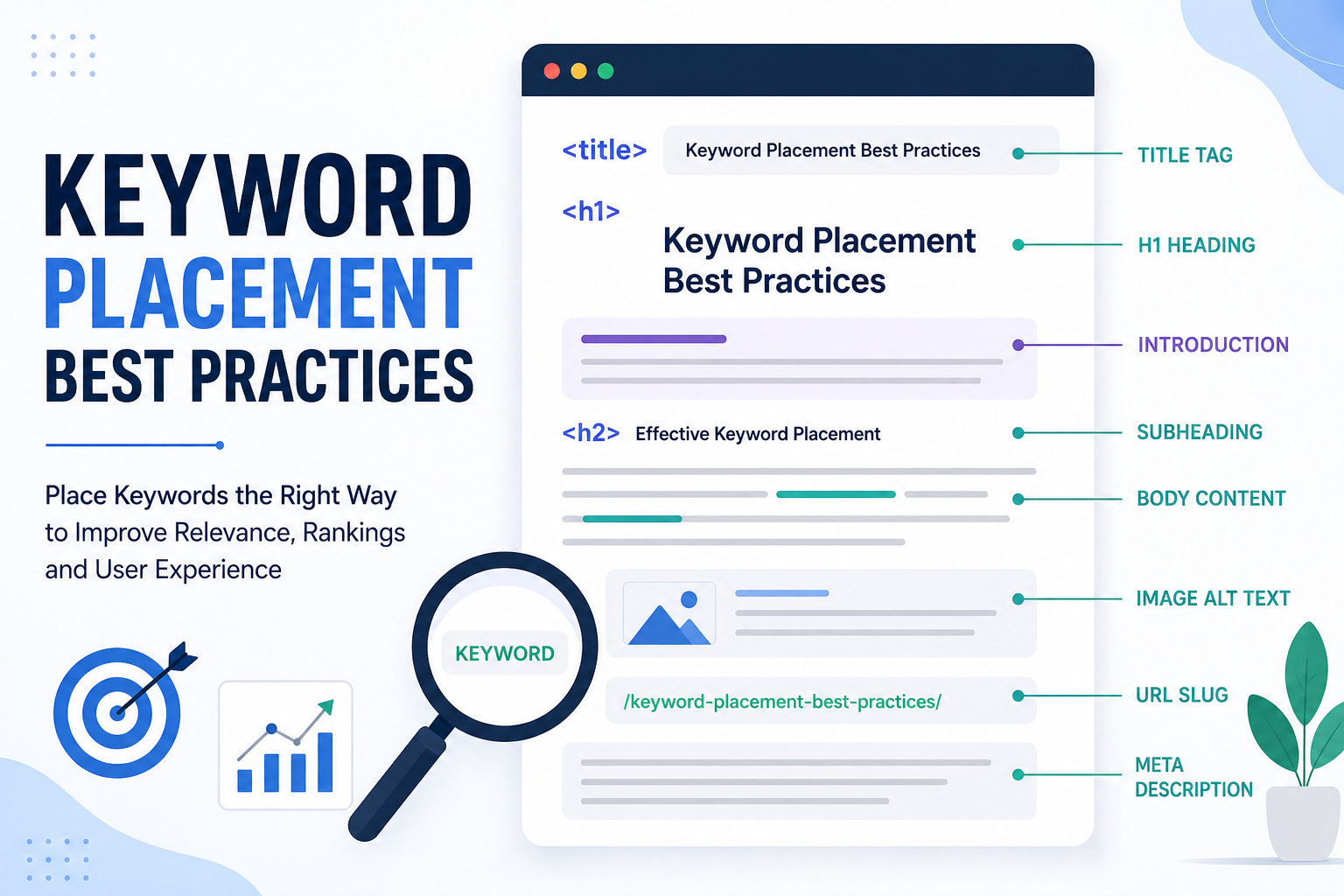
A practical keyword placement hierarchy looks like this:
Page Title
H1 Heading
Introduction
Relevant H2 and H3 Headings
Main Body Content
URL Structure
Meta Description
Image Elements
If you are optimizing a page with limited time, focus on the first four areas before worrying about secondary elements.
The goal is not to place keywords everywhere. The goal is to place them where they provide the most value and clarity.
Place Keywords Naturally in the Page Title
The page title is often the first thing users see in search results.
It is also one of the strongest indicators of a page’s topic.
Including the primary keyword naturally in the title helps establish relevance immediately.
For example:
Less Specific
Guide to Improving Website Visibility
More Specific
Keyword Placement Best Practices for Better Content Optimization
The title should accurately describe the content rather than simply include a keyword.
A useful title is clear, informative, and aligned with user expectations.
Include the Primary Keyword in the H1 Heading
The H1 heading usually represents the main topic of a page.
Search engines use this heading to better understand content focus, while users use it to confirm they have landed on the right page.
A strong H1 should:
Clearly identify the topic
Match the page’s purpose
Include the primary keyword naturally
Remain easy to read
For example:
Keyword Placement Best Practices
This immediately communicates the subject of the page without sounding forced.
Use Keywords Early in the Introduction
The opening section provides critical context.
Including the primary keyword naturally within the first paragraph helps establish topical relevance from the beginning.
More importantly, the introduction should clearly explain what readers will learn.
Rather than inserting keywords mechanically, focus on creating an opening that answers the user’s question and sets expectations for the rest of the content.
Use Keywords in Relevant Subheadings
Headings help organize information into logical sections.
When appropriate, related keywords can be included in H2 and H3 headings to reinforce topical relevance.
Examples include:
Common Keyword Placement Mistakes
How Search Engines Interpret Keywords
Keyword Placement and User Experience
Not every heading needs a keyword.
The primary purpose of headings is to improve content structure and readability.
Use Keywords Naturally Throughout the Content
Keywords should appear where they make sense within the content.
Search engines now evaluate context and topical relationships rather than relying solely on exact-match keyword repetition.
This means content should focus on explaining a subject thoroughly rather than repeating the same phrase unnecessarily.
Natural keyword usage typically creates a better reading experience and stronger topical relevance.
Use Related Terms Instead of Repeating the Same Keyword
A common misconception is that repeating a keyword many times improves rankings.
Modern search engines are capable of understanding related concepts and semantic relationships.
For example, an article about keyword placement may naturally include terms such as:
keyword optimization
content structure
page relevance
search visibility
heading hierarchy
topical signals
semantic relevance
content organization
Using related language often provides a more complete explanation of the topic while improving readability.
Instead of focusing on keyword frequency, focus on topic coverage.
Optimize URL Structure When Appropriate
URLs provide additional context about page content.
A descriptive URL helps both users and search engines understand the topic before the page is opened.
For example:
example.com/keyword-placement-best-practices
Simple and descriptive URLs are generally more effective than long URLs filled with multiple keywords.
The objective is clarity rather than keyword repetition.
Consider Keyword Placement in Meta Descriptions
Meta descriptions are written primarily for users.
Although they are not considered a direct ranking factor, they help searchers understand what a page offers.
Including important keywords naturally within a meta description can improve relevance and make search snippets easier to understand.
A useful meta description should:
Summarize the page accurately
Reflect search intent
Provide useful context
Encourage clicks through clarity
The emphasis should always remain on helping users make informed decisions.
Use Keywords in Image Elements When Relevant
Images can provide additional context when properly optimized.
Relevant keywords may appear naturally in:
Image file names
Alt text
Image captions
For example:
File Name
keyword-placement-guide.jpg
Alt Text
Diagram illustrating keyword placement best practices within a webpage.
The purpose of image optimization is accessibility and context.
Alt text should accurately describe the image rather than serve as a location for keyword stuffing.
Example of Effective Keyword Placement
Understanding the theory is useful, but seeing it applied makes implementation easier.
Imagine the target keyword is:
Keyword Placement Best Practices
Page Title
Keyword Placement Best Practices for Better Content Optimization
URL
/keyword-placement-best-practices
H1 Heading
Keyword Placement Best Practices
Introduction
Learning keyword placement best practices can help search engines and users understand your content more effectively.
Subheading
Common Keyword Placement Mistakes
Body Content
The article discusses related concepts such as content relevance, heading structure, semantic signals, search intent, and content organization.
In this example, the keyword appears in important locations without being repeated excessively.
Match Keyword Placement With User Expectations
Every keyword placed in a title, heading, or introduction creates an expectation.
For example, a page titled “Keyword Placement Best Practices” should help readers understand:
where keywords should be placed
which placements matter most
common mistakes to avoid
modern SEO recommendations
If the content fails to deliver that information, keyword placement alone cannot make the page useful or relevant.
Keywords communicate a topic, but content must fulfill the promise created by those keywords.
Pages that align keyword usage with user expectations are more likely to satisfy both readers and search engines.
Keyword Placement Should Never Harm Readability
The primary purpose of content is communication.
If adding a keyword makes a sentence feel awkward or unnatural, it is usually better to rewrite the sentence.
Consider the difference:
Less Natural
Keyword placement best practices are important because keyword placement best practices help improve keyword placement best practices.
More Natural
Strategic keyword usage helps search engines understand page topics while improving content organization for readers.
Effective optimization should feel invisible to users.
Content should always read naturally and prioritize understanding over keyword inclusion.
Common Keyword Placement Mistakes
Many optimization issues stem from misunderstanding how search engines interpret content.
Keyword Stuffing
Repeating the same phrase excessively often harms readability and provides little value.
Using Exact-Match Keywords Everywhere
Search engines understand related language. Repeating identical phrases is rarely necessary.
Ignoring Content Structure
Poor heading organization can make content harder to understand.
Over-Optimizing URLs
Long URLs packed with keywords create clutter without improving usability.
Writing for Search Engines Instead of Users
Content should solve problems and answer questions. Keywords should support that goal rather than become the focus.
Common Keyword Placement Mistakes at a Glance
| Mistake | Why It Happens | Better Approach |
|---|---|---|
| Keyword stuffing | Trying to improve rankings through repetition | Focus on natural writing |
| Exact-match repetition | Following outdated SEO advice | Use related terms and variations |
| Ignoring headings | Lack of content structure | Organize content logically |
| Over-optimized URLs | Attempting to target multiple keywords | Keep URLs simple and descriptive |
| Forced keyword usage | Overemphasis on optimization | Prioritize readability |
| Writing for algorithms | Misunderstanding SEO goals | Focus on helping users |

A Practical Keyword Placement Workflow
When creating a new page, the following workflow can help ensure keywords are used effectively.
Step 1: Define the Primary Topic
Identify the main concept the page is intended to cover.
Step 2: Create a Clear Page Title
Write a title that accurately describes the topic and includes the primary keyword naturally.
Step 3: Write a Descriptive H1
Use a heading that reinforces the page’s focus.
Step 4: Introduce the Topic Early
Mention the primary keyword naturally within the opening section.
Step 5: Structure Content Logically
Use headings and subheadings that guide readers through the topic.
Step 6: Cover the Topic Thoroughly
Focus on answering questions rather than repeating keywords.
Step 7: Review for Readability
Read the content from a user’s perspective and remove anything that feels forced or repetitive.
How Modern Search Engines Evaluate Keyword Usage
Search engines have evolved far beyond simple keyword counting.
Today, they evaluate:
topical relevance
content quality
semantic relationships
user intent satisfaction
contextual understanding
content usefulness
Keywords remain valuable signals, but they are only one piece of a much larger picture.
Pages that explain topics comprehensively often perform better than pages that rely heavily on keyword repetition.
Practical Keyword Placement Checklist
Before publishing a page, review the following:
Is the primary keyword included naturally in the title?
Does the H1 clearly reflect the topic?
Is the keyword mentioned in the introduction?
Are headings organized logically?
Does the content use related terminology naturally?
Is the URL descriptive and concise?
Does the meta description provide useful context?
Are image elements optimized appropriately?
Does the content satisfy user expectations?
If most of these questions can be answered yes, keyword placement is likely supporting the page effectively.
Final Thoughts
Keyword placement best practices are not about finding every possible location to insert a keyword. They are about helping search engines and users understand the purpose of a page.
Strategically placing keywords in titles, headings, introductions, URLs, and other important page elements provides valuable context while maintaining a positive reading experience. At the same time, relying on related terminology and natural language helps create content that feels informative rather than optimized.
The most effective approach is to focus on clarity, relevance, and user intent. When content genuinely answers questions and keywords are placed naturally in meaningful locations, optimization becomes a byproduct of usefulness rather than the primary objective.
Good keyword placement supports great content. It does not replace it.
