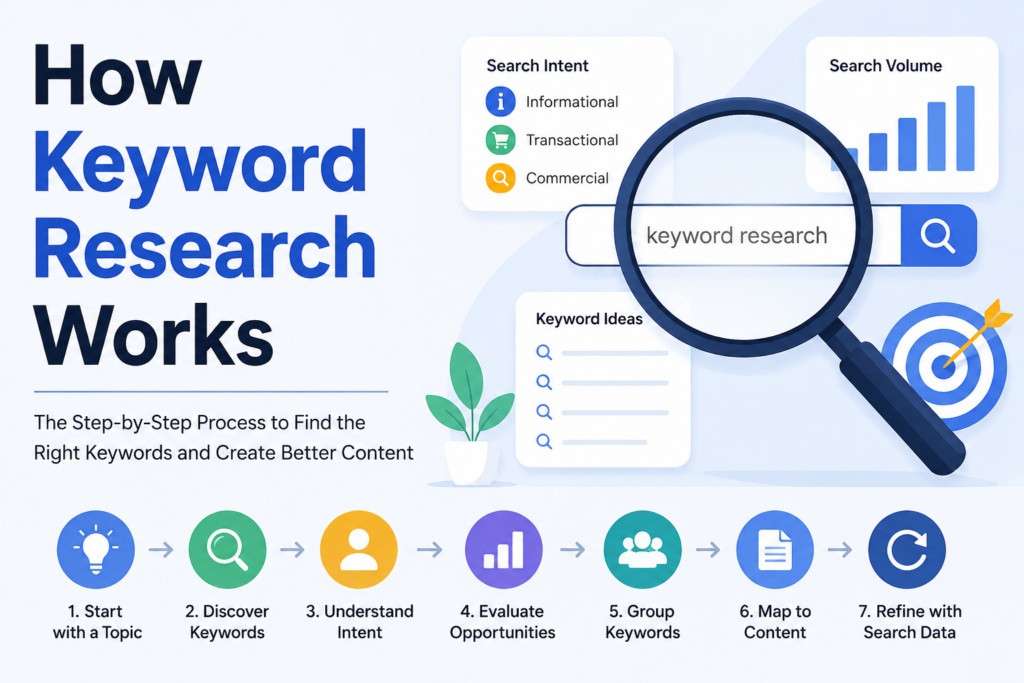
How Keyword Research Works
Keyword research is the process of discovering, analyzing, and organizing the search queries people use to find information, products, services, or answers online.
It helps SEO professionals understand what people search for, why they search, and how different queries relate to each other. The process is not simply about collecting keywords with high search volume. It involves discovering search terms, understanding search intent, evaluating opportunities, grouping related queries, and connecting them with useful content.
1. Start With a Topic
Keyword research usually begins with a broad topic related to a website, product, service, or area of expertise.
For example, an SEO website might begin with the topic keyword research.
This broad topic can then be used to discover more specific search queries, such as:
how keyword research works
keyword research process
keyword research tools
how to find SEO keywords
keyword search volume
The broad starting term is often called a seed keyword. It provides a starting point for discovering additional keyword ideas rather than being the final keyword a page must target.
2. Discover Related Search Terms
The next step is expanding the initial topic into a wider set of relevant search queries.
Keyword research tools can generate keyword ideas from seed terms. Google Keyword Planner, for example, can provide keyword ideas and historical search data such as average monthly searches and advertising competition.
Other sources can reveal different types of search information:
Google Search suggestions can reveal common query variations.
Related searches can uncover closely connected searches.
People Also Ask can reveal questions related to a topic.
Search Console can show queries for which an existing website already appears.
Competitor research can reveal search terms associated with competing content.
Industry terminology can uncover language commonly used by a particular audience.
The purpose is to understand the different ways people express the same or related needs.
3. Understand Search Intent
Finding keywords is only part of the process. The next step is determining why someone is searching for a particular query.
For example:
what is keyword research → informational intent
how to do keyword research → informational or instructional intent
keyword research tool → commercial investigation or tool-seeking intent
buy keyword research service → transactional intent
Search intent helps determine what type of content is appropriate for a query.
A keyword with substantial search volume may still be a poor content opportunity if the page does not satisfy the searcher’s actual purpose.
4. Evaluate Keyword Opportunities
After collecting keyword ideas, they can be evaluated based on relevance, search behavior, and available keyword data.
Common metrics and considerations include:
Search volume — an estimate of how frequently a keyword is searched. Search-volume figures can fluctuate and may differ between tools because they use different data sources and methodologies. Google notes that its Keyword Planner search-volume statistics are based on historical data and are rounded estimates.
Keyword difficulty — a third-party SEO metric that estimates how difficult it may be to rank organically for a query.
Advertising competition — a Google Keyword Planner metric describing competition among advertisers. It should not be treated as a direct measurement of organic SEO difficulty.
Search intent — the purpose behind the search.
Relevance — how closely the query matches the subject, audience, and purpose of the website.
These factors should be considered together rather than treated as ranking guarantees.
For example, a broad keyword with high search volume may be less useful than a more specific query that closely matches the audience’s needs and the site’s content.
5. Group Similar Keywords
Keyword research also involves organizing related search terms into meaningful groups.
Suppose the research produces:
keyword research
keyword research process
how keyword research works
keyword research steps
keyword research strategy
These queries may address closely related aspects of the same subject.
Grouping them helps determine whether several terms can be addressed naturally on one page or whether different search intents justify separate resources.
The goal is not to create a separate page for every keyword. Instead, related queries should be grouped according to their meaning and search intent.
This helps create a clearer content structure while reducing unnecessary duplication between pages.
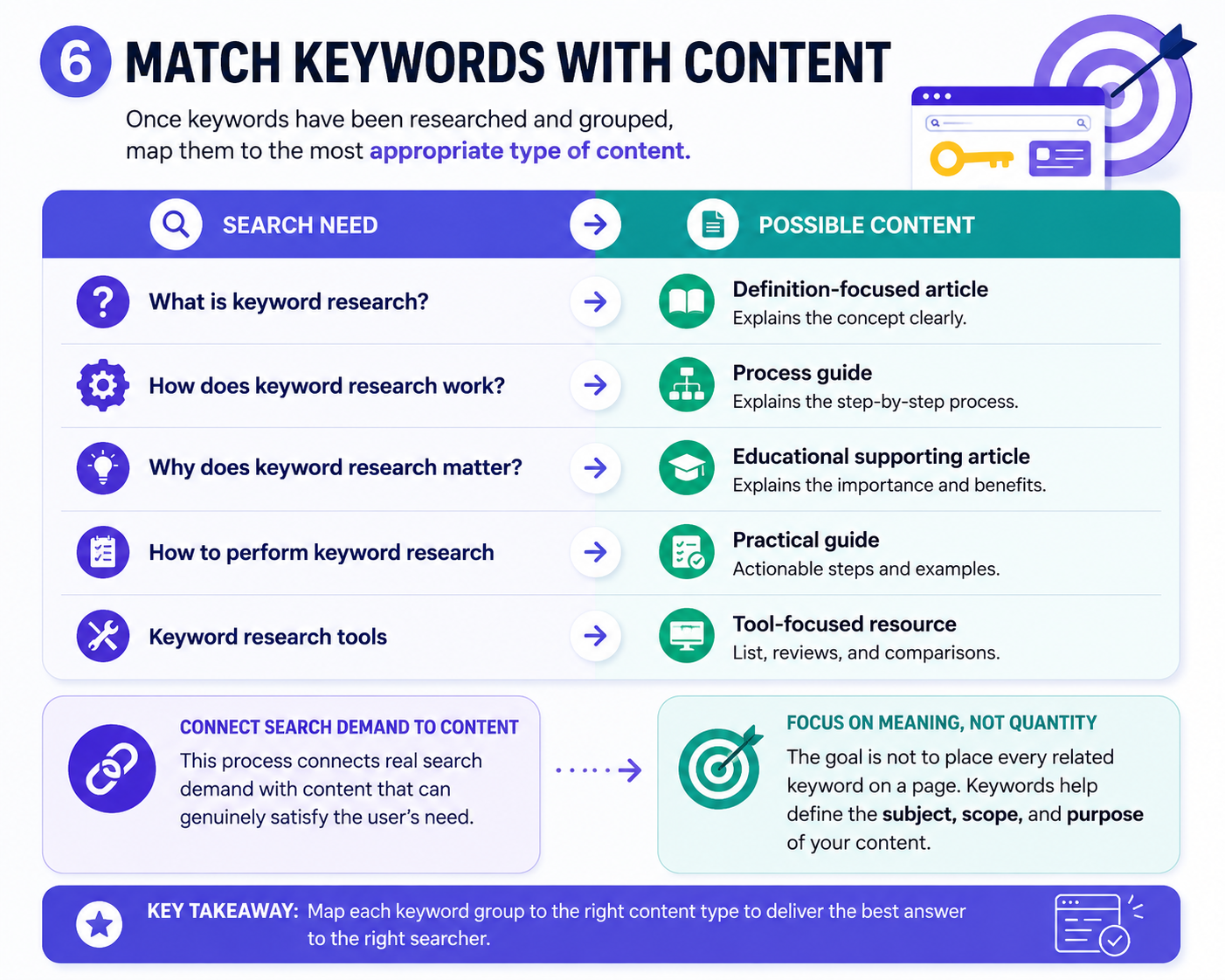
6. Match Keywords With Content
Once keywords have been researched and grouped, they can be mapped to appropriate content.
For example:
| Search Need | Possible Content |
|---|---|
| What is keyword research? | Definition-focused article |
| How does keyword research work? | Process guide |
| Why does keyword research matter? | Educational supporting article |
| How to perform keyword research | Practical guide |
| Keyword research tools | Tool-focused resource |
This process connects search demand with content that can genuinely satisfy the user’s need.
The objective is not to place every related keyword on a page. Instead, keywords help define the subject, scope, and purpose of content.
7. Refine the Research With Search Data
Keyword research does not have to end when a page is published.
Once a website begins appearing in Google Search, its own performance data can reveal how people actually find its content.
Google Search Console’s Performance report can show queries, clicks, impressions, CTR, and average position. It can also help identify queries that generate impressions but relatively few clicks, as well as the pages Google shows for specific queries.
This makes Search Console useful for refining keyword research and finding opportunities to improve existing content.
For example, a page created around one target query may also begin receiving impressions for closely related searches. Those queries can reveal additional questions or topics worth addressing.
Example: How Keyword Research Works
Consider a website creating content about SEO.
Step 1: Choose a seed keyword
Seed keyword: keyword research
Step 2: Discover related queries
Research may uncover:
how keyword research works
keyword research process
keyword research steps
keyword research tools
long-tail keywords
Step 3: Identify search intent
The first three queries are primarily informational and focus on understanding the process.
Step 4: Group related queries
how keyword research works
keyword research process
keyword research steps
These queries have closely related meanings and could potentially be addressed by one comprehensive process-focused article.
Step 5: Map the content
The page could focus on explaining how keyword research moves from a broad topic to keyword discovery, intent analysis, evaluation, grouping, and content mapping.
The result is not simply a list of keywords. It is a clearer understanding of what people want to learn and how those searches can be organized into useful content.
How Keyword Research Works in Simple Terms
The process can be summarized as:
Topic → Seed Keyword → Keyword Ideas → Search Intent → Evaluation → Keyword Grouping → Content Mapping → Search Data
Each stage answers a different question:
Topic: What subject are we researching?
Seed keyword: What broad term can we use as a starting point?
Keyword ideas: What related searches exist?
Intent: Why are people searching?
Evaluation: Which opportunities are relevant?
Grouping: Which queries belong together?
Content mapping: What should each page address?
Search data: What can actual performance teach us?
Final Takeaway
Keyword research works by turning a broad topic into a structured understanding of search demand.
It combines keyword discovery, search intent analysis, keyword evaluation, grouping, content mapping, and performance data.
The goal is not to collect as many keywords as possible. The goal is to understand what people are searching for, recognize the differences between their search needs, and connect those needs with useful content.
Keyword metrics can support these decisions, but they do not guarantee rankings. Good keyword research is ultimately about understanding search behavior and content relevance, not simply finding phrases to place on a webpage.
