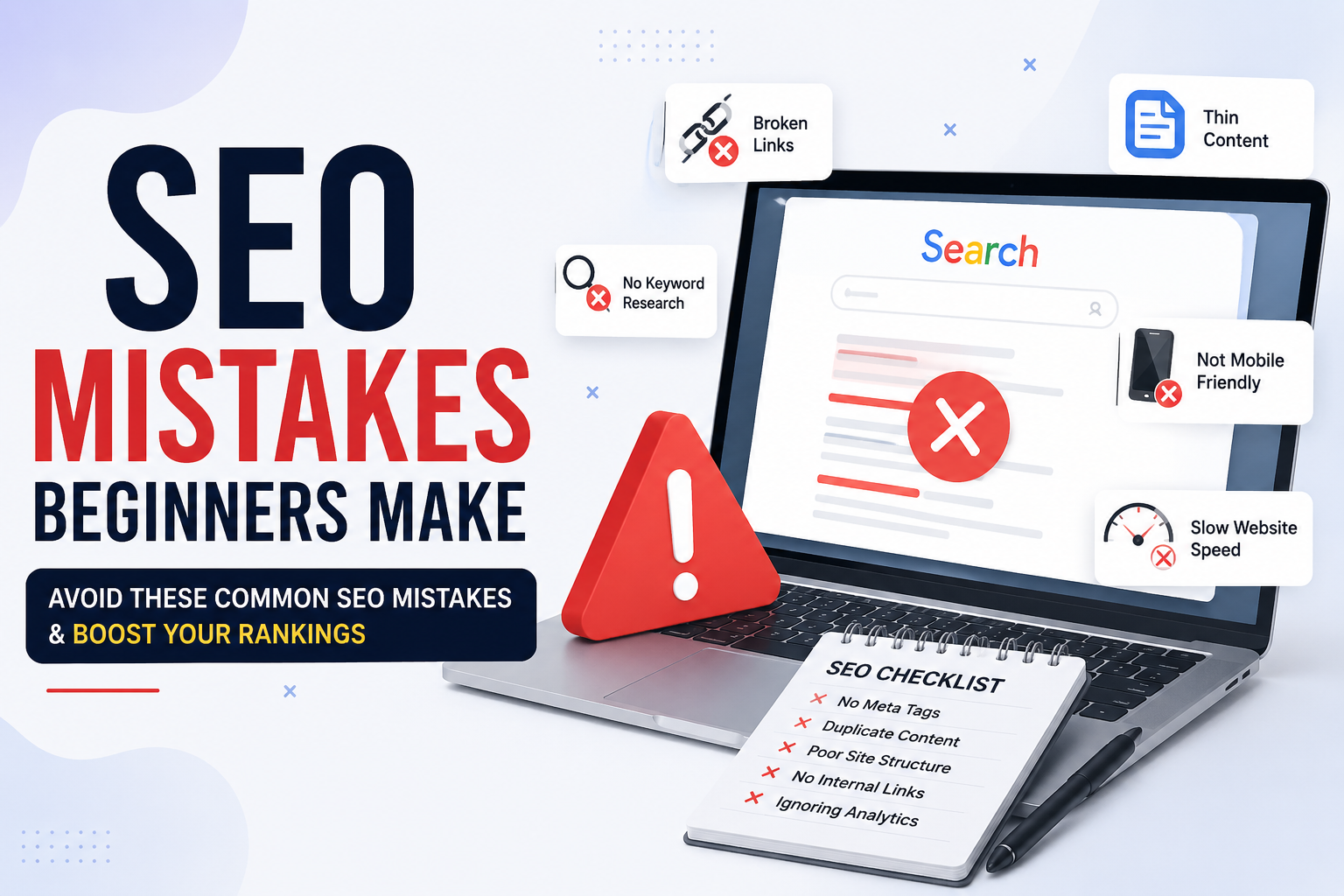
Beginners often make SEO harder than it needs to be. They may focus on keyword density, backlinks, publishing frequency, or tool scores while overlooking search intent, useful content, technical accessibility, and the experience of the people visiting the site.
Some mistakes can also create indexing problems, poor user experiences, or spam signals. The good news is that most beginner SEO mistakes are avoidable when you understand which practices actually matter.
1. Choosing Keywords Without Understanding Search Intent
One of the most common SEO mistakes is choosing keywords based only on search volume.
A keyword may have thousands of monthly searches, but that does not mean it is the right target for your page. You also need to understand search intent—the reason behind a user’s search.
For example, someone searching for “what is internal linking” is looking for an explanation. Someone searching for “internal linking services” has a different intent.
If your page does not satisfy the intent behind the query, strong keyword optimization alone is unlikely to make it successful.
Better approach: Understand what users expect to find before creating or optimizing a page. Search volume is useful for research, but it should not replace search-intent analysis.
2. Stuffing Keywords Into Content
Beginners sometimes believe that repeating a target keyword more often will improve rankings.
This can lead to unnatural sentences such as:
“Our SEO services provide the best SEO services for businesses looking for SEO services.”
Keyword stuffing makes content difficult to read and does not create additional value for users. Google’s spam policies identify keyword stuffing as a form of spam.
Instead, use the primary topic naturally and include related terminology where it genuinely helps explain the subject.
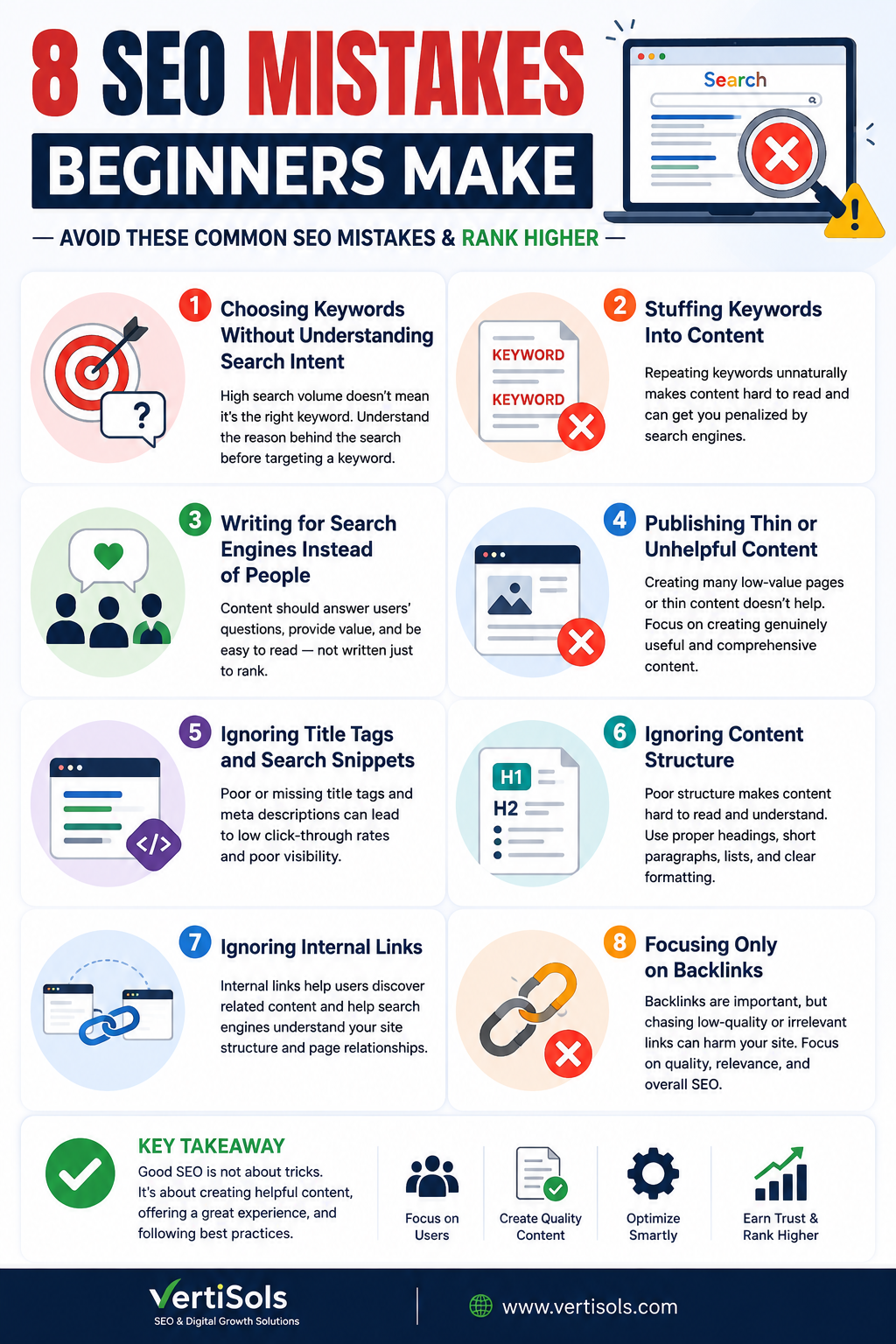
3. Writing for Search Engines Instead of People
SEO should help search engines understand useful content, but the content itself should primarily serve the reader.
A common beginner mistake is creating pages around keywords rather than questions, problems, and information users actually need.
Good SEO content should:
- Answer the user’s question clearly
- Provide useful and accurate information
- Be easy to navigate
- Use headings logically
- Avoid unnecessary repetition
- Provide enough detail to satisfy the search intent
Google’s guidance emphasizes helpful, reliable, people-first content rather than content created primarily to manipulate search rankings.
4. Publishing Thin or Unhelpful Content
Creating many short pages simply to target more keywords can produce a website full of pages that provide little value.
For example, publishing separate pages with almost identical content for minor keyword variations may create unnecessary duplication rather than useful topical coverage.
A better strategy is to create a genuinely useful page that addresses the topic properly and then build related supporting content when there is a distinct search intent.
The objective should not be to publish as many pages as possible. It should be to publish pages that deserve to exist.
5. Ignoring Title Tags and Search Snippets
A page can contain excellent information but still have weak search-result presentation.
Beginners sometimes leave title tags and meta descriptions incomplete, duplicated, or poorly written.
A descriptive title helps communicate the page’s subject. A useful meta description can also help searchers understand what the page offers, although Google may generate a different snippet when it considers another page excerpt more relevant.
These elements should accurately represent the page rather than being filled with repeated keywords.
6. Ignoring Content Structure
Large blocks of text make online content difficult to scan.
Beginners may focus heavily on keywords while overlooking basic content structure.
Use:
- One clear main heading
- Descriptive subheadings
- Short paragraphs
- Lists when appropriate
- Relevant internal links
- Clear navigation between related topics
A logical structure helps both readers and search engines understand how information is organized.
7. Ignoring Internal Links
Internal links connect related pages within the same website.
Beginners often concentrate on getting backlinks while overlooking the links they can control themselves.
A well-planned internal linking structure can help users discover related information and help search engines understand relationships between pages.
For example, an article about keyword research could naturally link to separate resources about search intent, long-tail keywords, and keyword mapping.
Internal links should be useful and contextually relevant rather than added simply to increase the number of links on a page.
8. Focusing Only on Backlinks
Backlinks can be useful, but SEO is not simply a competition to collect as many links as possible.
Beginners may waste time pursuing low-quality links, automated link-building schemes, or irrelevant websites.
Google’s guidance specifically addresses link spam and manipulative link practices.
A stronger approach is to create content that is genuinely useful and earn relevant references naturally.
9. Ignoring Technical SEO Basics
Technical SEO can become highly advanced, but beginners should first understand the fundamentals.
A page needs to be accessible to search engines and meet the basic technical requirements for appearing in Search. Beginners do not need to master advanced technical SEO, but they should watch for issues such as:
- Pages accidentally blocked from crawling
- Incorrect
noindexdirectives - Broken links
- Poor URL structures
- Duplicate URLs
- Incorrect canonical signals
- Mobile usability problems
- Slow or unstable pages
You do not need to become a technical SEO specialist before publishing your first article. However, ignoring basic technical problems can prevent otherwise good content from performing properly.
10. Accidentally Creating Duplicate Pages
Duplicate or near-duplicate content can occur for many reasons, including URL variations, filtering systems, regional versions, and technical configurations.
Duplicate content itself is not automatically a spam violation. Google uses canonicalization to select a representative URL when multiple pages contain substantially similar content. A rel="canonical" declaration, redirect, sitemap, or other signal can indicate your preferred URL, but Google’s canonical choice is ultimately a decision made by its systems and may differ from your preference.
Beginners should therefore avoid creating unnecessary versions of the same page and should understand canonical URLs when duplicate or similar URLs are unavoidable.
11. Assuming Indexed Means Ranking
Getting a page indexed does not mean it will automatically rank prominently for its target queries.
Crawling is when search engines access a page. Indexing is when a page is considered for inclusion in Google’s index. Ranking is the process of determining which eligible pages to show and in what order for a particular search.
Beginners sometimes treat these as the same thing. They are not. A page can be indexed and still have little search visibility because it does not satisfy the search intent strongly enough, faces strong competition, or has other quality or relevance limitations.
Understanding this distinction prevents a common mistake: assuming that submitting a page for indexing is the same as optimizing it to perform well in organic search.
12. Expecting Immediate Rankings
SEO is not an instant process.
A new page may need time to be discovered, crawled, indexed, evaluated, and displayed consistently in search results. Rankings can also change as search systems, competitors, and user behavior change.
Because of this, repeatedly changing a page after only a few days can make it difficult to determine whether an SEO strategy is actually working.
Instead, monitor performance over a reasonable period and make changes based on evidence.
13. Ignoring Search Console Data
Beginners sometimes publish content and then never check how it performs.
Google Search Console can provide useful information about search queries, impressions, clicks, indexing, and other aspects of search performance.
This data can reveal opportunities that were not obvious during keyword research.
For example, a page may begin receiving impressions for related queries that were not part of the original content strategy. Those queries can help identify areas where the page could be improved—provided the additional information genuinely belongs on that page.
14. Changing URLs Without a Plan
Changing URLs casually can create unnecessary SEO problems.
If an existing URL must change, the old and new URLs should be mapped carefully and appropriate redirects should be configured. For permanent URL changes, Google recommends server-side permanent redirects such as 301 or 308 redirects when technically possible. It also recommends avoiding unnecessary redirect chains and updating internal links to the new URLs.
Beginners should therefore avoid changing established URLs simply because a slightly different slug looks better.
15. Relying Too Heavily on SEO Tools
SEO tools are useful for research, technical checks, competitor analysis, and performance monitoring. However, beginners can make the mistake of treating tool scores as if they were Google’s ranking criteria.
Keyword difficulty, content scores, authority metrics, traffic estimates, and optimization grades are third-party measurements. They can help inform decisions, but none should be treated as a guaranteed ranking formula.
Use SEO tools as research and decision-support systems. Combine their data with search intent, the actual search results, your audience’s needs, and reliable search-engine documentation.
16. Believing Every SEO Myth
SEO contains many outdated tips and unsupported claims.
Common examples include:
- Believing a specific keyword density guarantees rankings
- Assuming more backlinks are always better
- Thinking every page must target a separate keyword
- Believing publishing more frequently automatically produces better rankings
- Assuming a particular SEO plugin setting guarantees higher rankings
Search engines continuously change their systems, and SEO recommendations should be based on reliable documentation, testing, and established best practices rather than shortcuts.
17. Over-Optimizing Every Page
SEO optimization should improve a page, not turn it into a collection of optimization signals.
Beginners sometimes add excessive keywords, internal links, headings, bold text, structured data, and other elements simply because they believe more optimization must be better.
It is not.
Every optimization should have a clear purpose. If an element does not improve understanding, accessibility, navigation, or search-engine interpretation, it may not be necessary.
18. Measuring SEO Only by Rankings
Rankings are useful, but they are not the only SEO performance indicators.
A page ranking well for a keyword is not necessarily successful if it generates no meaningful visits or fails to satisfy users.
Depending on the website’s goals, useful performance measures can include:
- Organic clicks
- Search impressions
- Relevant search queries
- Organic traffic
- Engagement signals
- Conversions
- Indexed pages
- Search visibility
The right metrics depend on what the website is trying to achieve.
How Beginners Can Avoid These SEO Mistakes
A simple approach can prevent many problems:
- Understand the search intent before choosing a target topic.
- Create useful, original content for people.
- Use keywords naturally instead of forcing them into sentences.
- Build clear page structures.
- Connect related pages with useful internal links.
- Fix basic crawling and indexing problems.
- Avoid manipulative link-building tactics.
- Use SEO tools as research aids rather than ranking formulas.
- Monitor organic search performance and make changes based on evidence.
- Keep learning from current search-engine documentation.
The goal is not to make every page perfectly optimized. The goal is to build a website that is useful, accessible, understandable, and technically sound.
SEO Beginner Mistakes Checklist
Before publishing a page, ask:
- Does this page satisfy a clear search intent?
- Is the content genuinely useful?
- Is the primary topic used naturally?
- Is the title descriptive and relevant?
- Is the page easy to scan?
- Are related pages linked where useful?
- Can search engines crawl and index the page?
- Are there unnecessary duplicate versions?
- Have I avoided manipulative SEO tactics?
- Am I measuring performance instead of relying on assumptions?
Final Takeaway
The biggest SEO mistakes beginners make usually come from focusing too heavily on individual ranking tactics instead of the overall quality and usefulness of a website.
The strongest foundation is straightforward: understand search intent, create helpful content, maintain a crawlable and indexable website, connect related resources with useful internal links, and use search-performance data to guide improvements.
The goal is not to manipulate rankings. It is to make each page useful, accessible, understandable, and genuinely relevant to the search it is intended to serve.
