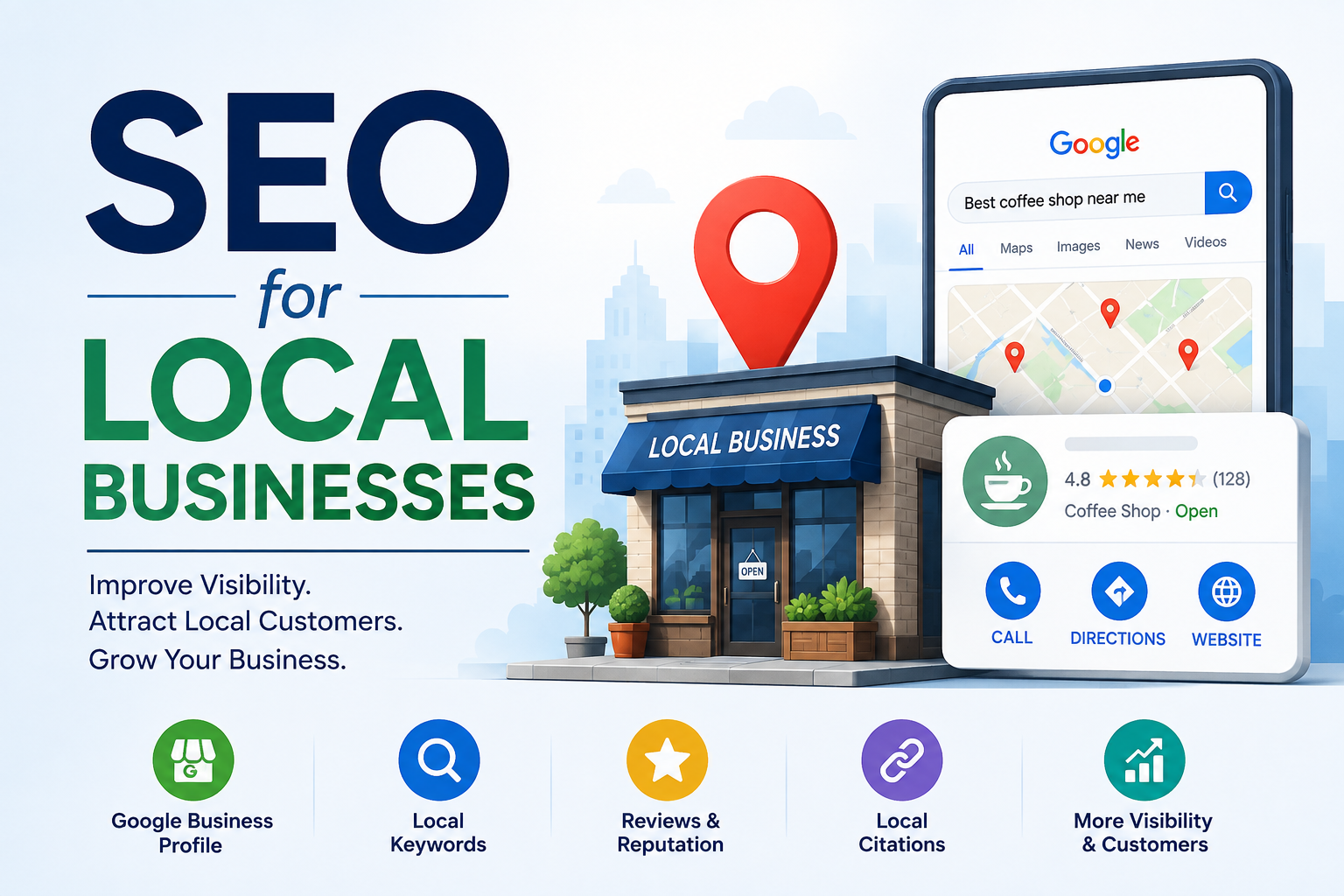
Local businesses depend on being discovered by people who are looking for products or services in a specific area. A restaurant, dentist, plumber, law firm, salon, retailer, or other local business can use search engine optimization (SEO) to improve how easily potential customers find its website and business information online.
SEO for local businesses combines traditional website SEO with local relevance. It helps search engines understand what a business offers, where it operates, and whether it is relevant to a person’s local search.
The goal is not simply to attract more website visitors. It is to become visible when people are searching for something the business genuinely provides.
What Is SEO for Local Businesses?
SEO for local businesses is the process of improving a business’s website and online presence so that it can appear more prominently for relevant searches with local intent.
For example:
- dentist in Lahore
- plumber near me
- restaurant in Chicago
- coffee shop near me
- emergency electrician in Houston
These searches indicate that the person is looking for a product, service, or business connected to a particular geographic area.
Local search visibility can occur through Google’s local results, Google Maps, and traditional organic search results. Google explains that local results are primarily influenced by relevance, distance, and prominence.
How Local SEO Differs From General SEO
Traditional SEO focuses largely on helping webpages appear for relevant searches.
Local business SEO has an additional layer: geographic relevance.
For example:
General search:
“how to choose a dentist”
Local search:
“dentist in Lahore”
The first search is primarily informational. The second has a stronger local intent because the searcher is looking for a business serving a particular area.
This means a local business needs more than an optimized website. It also needs accurate business information, a clear geographic presence, and signals that help search engines understand the relationship between the business, its services, and its service area.
Local SEO should therefore not be reduced to adding city names to webpages. Geographic keywords are only one part of a much broader local search ecosystem.
How Google Determines Local Rankings
Google states that local results are mainly based on three factors:
Relevance
Relevance describes how well a business matches what someone is searching for.
For example, if someone searches for “family dentist,” a dental practice with relevant information about its services is more likely to be considered relevant than an unrelated business.
Complete and accurate business information can help Google understand what a business offers.
Distance
Distance refers to how far a business is from the searcher or the location included in the search.
For a search such as “restaurant near me,” the searcher’s location can influence which businesses appear.
Distance is therefore different from a normal website ranking factor that a business can directly optimize. A business cannot simply add more location keywords to make itself physically closer to a searcher.
Prominence
Prominence refers to how well-known a business is.
Google says prominence can be influenced by information it has about a business across the web, including links and reviews. A business’s position in Google’s regular search results can also be relevant to local visibility.
These three concepts are useful for understanding why local rankings can differ from one searcher or location to another.
There is also no legitimate way to pay Google or request a better organic local ranking.
Google Business Profile
A Google Business Profile is an important part of the online presence of an eligible local business.
It can provide customers with information such as:
- Business name
- Address
- Phone number
- Website
- Business category
- Opening hours
- Photos
- Services
- Other business attributes
Google recommends keeping business information complete and accurate because this helps customers understand what the business does, where it is located, and when it is available.
However, not every website or business is eligible for a Business Profile. Google states that eligible businesses generally either have a physical location customers can visit or travel to customers to provide their services.
A Business Profile should accurately represent the real-world business rather than being created simply to target additional locations.
Storefront Businesses vs Service-Area Businesses
Local businesses do not all operate in the same way.
Storefront Businesses
A storefront business serves customers at its physical location.
Examples include:
- Restaurants
- Dentists
- Retail stores
- Hair salons
- Medical clinics
These businesses can generally display their eligible physical address on their Business Profile.
Service-Area Businesses
A service-area business travels to customers rather than serving them at a customer-facing storefront.
Examples include:
- Plumbers
- Cleaners
- Electricians
- Mobile mechanics
Google provides specific rules for service-area businesses. A service-area business can use a Business Profile for its central location and designate the areas it serves. If customers are not served at the business address, the address should be removed from public display.
This distinction is important because serving customers in several cities does not automatically mean creating a separate Google Business Profile for every city.
Local Keyword Research
Local keyword research identifies the words and phrases people use when searching for products, services, and businesses in particular areas.
For example, a bakery might identify searches such as:
- bakery in Lahore
- birthday cakes Lahore
- custom cakes near me
- wedding cakes in Lahore
Good local keyword research considers both what the customer wants and where the customer wants it.
However, keywords should be used naturally. Repeating a location name throughout a page does not create genuine local relevance.
The most useful approach is to understand the services, products, locations, and search intents that are genuinely connected to the business.
Creating Useful Local Website Content
A local business website should make it easy for users and search engines to understand:
- What the business offers
- Who it serves
- Where it operates
- How customers can contact it
- What makes its services relevant to the target audience
Important pages may include service pages, product pages, location pages, contact information, and other useful resources.
For example, a plumbing company could create a detailed page explaining its emergency plumbing services and clearly identify the areas it genuinely serves.
The content should provide useful information rather than simply repeating phrases such as “plumber in [city]” throughout the page.
Location Pages
Businesses operating in multiple genuine locations may benefit from individual location pages.
A useful location page can provide information such as:
- Physical address
- Opening hours
- Local contact information
- Services available at that location
- Directions
- Location-specific information
- Relevant local details
The important distinction is between genuine location pages and pages created solely to target keywords.
Creating dozens of almost identical pages by replacing one city name with another provides little value when the business has no meaningful presence or information for those locations.
Location pages should exist because they help users—not simply because a business wants to rank for more city names.
NAP and Business Information Consistency
NAP stands for Name, Address, and Phone number.
Businesses should keep important identifying information accurate and consistent across their website, Business Profile, and relevant online sources.
Consistency helps reduce confusion for customers and supports a clearer representation of the real-world business.
However, NAP consistency should not be treated as a magic ranking technique. The more important principle is accurate and trustworthy business information.
Google specifically recommends that businesses represent themselves consistently with how they are recognized in the real world and keep their address or service area accurate.
Online Reviews
Customer reviews are an important part of a local business’s online reputation.
Businesses can encourage genuine customers to leave honest feedback and can respond appropriately to reviews.
Useful review practices include:
- Asking genuine customers for feedback
- Responding professionally to reviews
- Addressing legitimate concerns
- Avoiding fake reviews
- Avoiding purchased or manipulated reviews
Reviews should represent genuine customer experiences. They should not be manufactured simply to influence search visibility.
Google also identifies review information as one of the sources that can contribute to local prominence.
Local Citations
A local citation is an online mention of a business’s identifying information.
Citations may appear on:
- Business directories
- Industry websites
- Local organizations
- Chambers of commerce
- Relevant community websites
The focus should be on accurate, relevant, and trustworthy sources rather than producing large numbers of low-quality directory listings.
Citations are best viewed as part of the broader information ecosystem surrounding a business, not as a shortcut to higher local rankings.
Google can obtain information about businesses from multiple sources across the web, including publicly available webpages, third-party data, user contributions, and Business Profile information.
On-Page SEO for Local Businesses
Local businesses still need a well-optimized website.
Important on-page elements include:
- Descriptive page titles
- Useful meta descriptions
- Clear headings
- Service and product information
- Descriptive URLs
- Internal links
- Optimized images
- Helpful original content
Local information should be incorporated naturally.
For example, a restaurant’s catering page should clearly explain its catering services and relevant service area rather than repeatedly inserting the same geographic keyword.
Local SEO does not replace standard SEO fundamentals. It builds on them by adding genuine geographic relevance.
Local Link Building and Prominence
Links from relevant websites can help connect a business with its industry and local community.
Potential sources include:
- Local organizations
- Industry associations
- Community websites
- Local publications
- Relevant business partners
- Local events and organizations
The objective should be to earn useful references rather than purchase large quantities of links.
Google’s explanation of local prominence includes information from across the web, including links and other references to the business.
Structured Data for Local Businesses
Structured data provides machine-readable information that can help search engines understand certain details about a webpage.
A local business may use relevant Schema.org structured data, such as LocalBusiness or a more specific applicable subtype, to describe information about the business.
Potential information can include:
- Business name
- Address
- Telephone number
- Opening hours
- URL
- Other applicable business details
Structured data should accurately represent information associated with the business and webpage.
It is important to understand that structured data is not a guarantee of higher rankings or enhanced search features. It is a supporting technical element, not a replacement for useful content, accurate business information, or a strong website.
Fake Locations and Other Local SEO Risks
Businesses should not create fake locations simply to appear in additional local searches.
Google requires Business Profiles to represent real-world businesses accurately. Virtual offices are generally not eligible when the business does not actually operate from that location. Google also limits how businesses should represent service areas and physical locations.
Common problems include:
Fake Business Locations
Creating profiles for locations where the business does not genuinely operate can violate Google’s guidelines.
Keyword-Stuffed Business Names
Adding unnecessary keywords or locations to a real business name is not an appropriate way to optimize a Business Profile. Google requires the business name to reflect the real-world name of the business.
Duplicate Location Pages
Creating nearly identical webpages for cities where the business has no meaningful presence can produce thin or repetitive content.
Keyword Stuffing
Repeatedly inserting city and service keywords can make content unnatural without creating additional value.
Manipulated Reviews
Fake, purchased, or otherwise manipulated reviews can undermine trust and violate platform policies.
Creating Profiles for Every Service Area
A service-area business should not create separate Business Profiles simply because it serves multiple cities. Google’s guidelines provide specific rules for service-area businesses and their profiles.
What Local SEO Can and Cannot Control
Local SEO can improve the information and signals surrounding a business, but it cannot guarantee a specific ranking position.
Businesses can control:
- Accuracy of their business information
- Website quality
- Service information
- Location information
- Business Profile completeness
- Genuine customer-review requests
- Website content
- Technical SEO
- Relevant business relationships
- Accuracy of structured data
Businesses cannot directly control:
- A searcher’s physical location
- Competitor activity
- Google’s exact ranking position
- Whether a particular local search feature appears
- How Google’s systems evaluate every business against its competitors
This distinction is important because local search results can change according to the searcher’s location, query, competition, and other factors.
Measuring Local SEO Performance
Local SEO should be measured using more than rankings alone.
Useful website metrics include:
- Search impressions
- Organic clicks
- Search queries
- Organic conversions
- Local landing-page traffic
- Leads and enquiries
Business Profile data can provide additional information about how customers interact with the business’s presence in Google.
Depending on the business, useful outcomes may include:
- Phone calls
- Website visits
- Direction requests
- Booking enquiries
- Store visits
- Service enquiries
- Sales
The most valuable measurement is the connection between local visibility and real business outcomes.
A restaurant may care about calls, directions, and reservations, while a plumber may focus more heavily on phone enquiries and service leads.
A Practical Local SEO Checklist
- Create, claim, and verify an eligible Google Business Profile
- Keep the business name accurate
- Use an appropriate business category
- Keep address or service-area information accurate
- Maintain accurate opening hours
- Clearly describe products or services
- Optimize important website pages
- Research relevant local search terms
- Create useful location pages where they genuinely apply
- Maintain consistent business information
- Encourage genuine customer reviews
- Respond appropriately to customer feedback
- Maintain relevant local citations
- Earn relevant local and industry references
- Use appropriate structured data
- Avoid fake locations and duplicate profiles
- Monitor website and Business Profile performance
- Measure leads, calls, bookings, visits, or other meaningful outcomes
Final Thoughts
SEO for local businesses is about helping search engines and customers understand what a business offers, where it operates, and why it is relevant to a particular local search.
A strong local presence starts with accurate business information and a useful website. From there, businesses can strengthen local visibility through relevant content, an accurate Google Business Profile, genuine reviews, trustworthy online references, appropriate location pages, and sound SEO practices.
The most important principle is authenticity. A business should optimize the online representation of its real-world presence, not create artificial locations, keyword-stuffed profiles, or repetitive pages simply to target more searches.
Local SEO is therefore not just about adding a city name to a webpage. It is about building a consistent, useful, and trustworthy connection between the business, its services, its locations, and the people searching for them.
