SEO best practices are the established approaches that help search engines discover, understand, and evaluate website content while providing a genuinely useful experience for visitors. They aren’t tricks or shortcuts — they’re the consistent principles behind creating a website that’s useful to people and understandable to search engines.
Google’s Search Essentials groups its core guidance into technical requirements, spam policies, and key best practices. Meeting that guidance doesn’t guarantee a page will be crawled, indexed, or ranked — SEO works best as an ongoing process, not a one-time checklist.
Why SEO Best Practices Matter
A page can contain excellent information and still struggle if search engines can’t access it properly. A technically flawless page can also fail if its content doesn’t satisfy what the searcher actually needs. Effective SEO brings several things together: useful content, search intent alignment, clear structure, technical accessibility, and a good page experience. The goal isn’t optimizing for one signal in isolation — it’s building a site that works on all of these fronts at once.
SEO Best Practices by Category
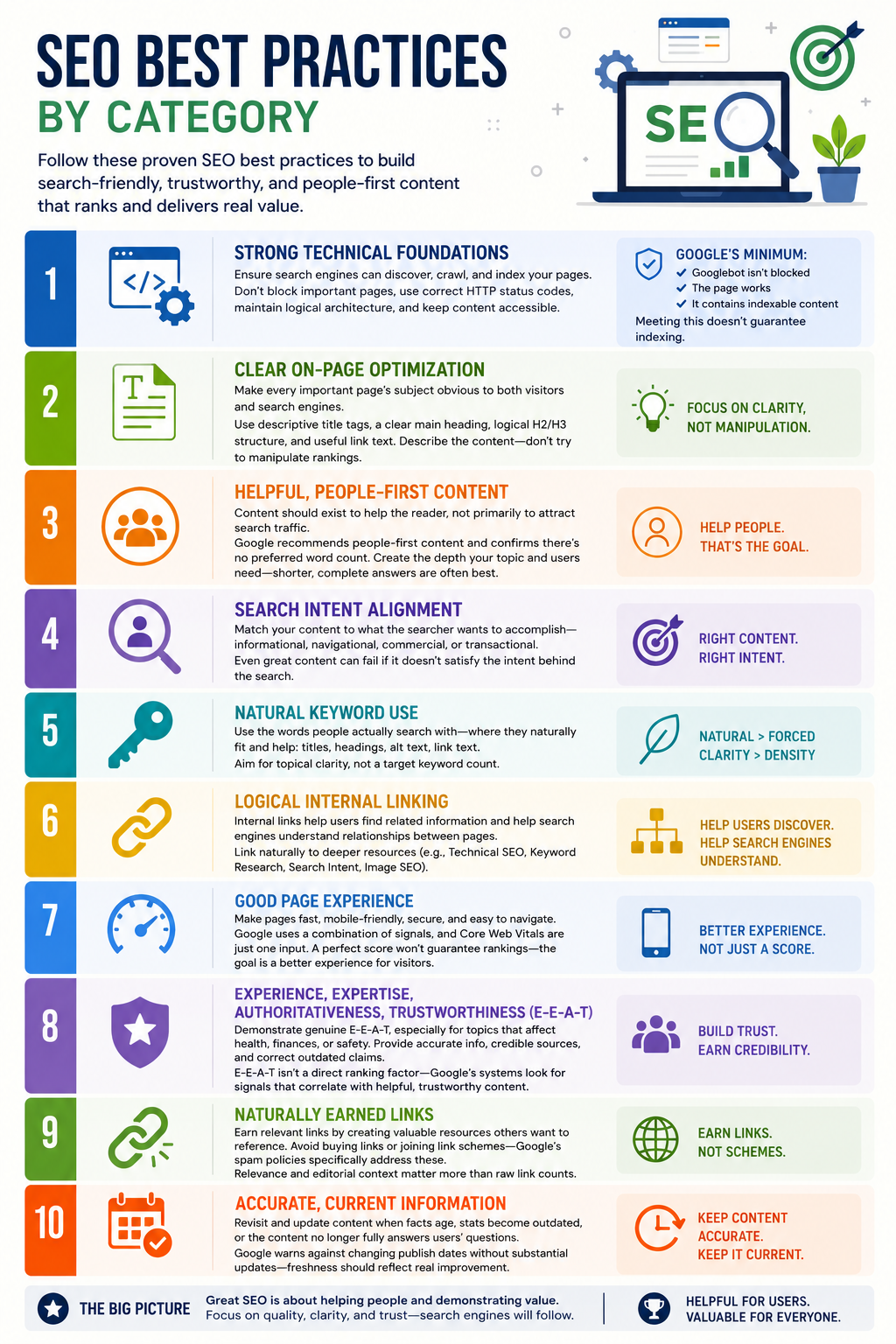
1. Strong Technical Foundations
Search engines need to be able to discover, crawl, and index important pages before anything else matters. This means avoiding accidental indexing blocks, using correct HTTP status codes, maintaining logical site architecture, and keeping important content accessible to crawlers. Google’s minimum requirement is simple: Googlebot isn’t blocked, the page works, and it contains indexable content — though meeting that bar still doesn’t guarantee indexing. Technical SEO deserves its own dedicated resource rather than full treatment here.
2. Clear On-Page Optimization
On Page SEO: Every important page should make its subject obvious to visitors and search engines alike — through descriptive title tags, a clear main heading, logical H2/H3 structure, and useful link text. Page elements should describe the actual content, not be engineered primarily to manipulate rankings.
3. Helpful, People-First Content
Content should exist to help the reader, not primarily to attract search traffic. Google explicitly recommends people-first content and states there’s no preferred word count to target — content depth should be determined by the topic and user need, not an arbitrary length. A shorter, complete answer is usually more useful than a padded one.
4. Search Intent Alignment
A well-written, technically sound page can still fail if it doesn’t match what the searcher is trying to accomplish — informational, navigational, commercial, or transactional. Someone searching “what is keyword research” wants an explanation, not a pitch. Search intent gets fuller treatment in its own dedicated resource.
5. Natural Keyword Use
Keywords describe what a page is about, but effective SEO isn’t built on hitting a target repetition count. Google’s guidance is to use the words people actually search with, placed where they genuinely help — titles, headings, alt text, link text. The goal is topical clarity, not keyword density.
6. Logical Internal Linking
Internal links help visitors find related information and help search engines understand how pages relate to one another. An article like this one naturally connects to more detailed resources — Technical SEO, Keyword Research, Search Intent, Image SEO — without needing to explain those topics here.
7. Good Page Experience
Pages should be fast, mobile-friendly, secure, and easy to navigate. Google treats page experience as a combination of signals rather than a single ranking factor, and Core Web Vitals are one input among several — a perfect performance score alone won’t guarantee rankings. The real objective is a better experience for visitors, not a score.
8. Experience, Expertise, Authoritativeness, Trustworthiness (E-E-A-T)
Content should demonstrate genuine E-E-A-T, particularly for topics that affect health, finances, or safety — accurate information, credible sourcing, and correcting outdated claims. Google has clarified that E-E-A-T itself isn’t a specific ranking factor; rather, its systems use signals that correlate with helpful, trustworthy content. The practical takeaway: build content that deserves trust rather than trying to manufacture the signals.
9. Naturally Earned Links
Links from other sites help search engines discover and evaluate content, but the focus should be earning relevant references through genuinely useful resources — not buying links or joining link schemes, which Google’s spam policies specifically address. Relevance and editorial context matter more than raw link counts.
10. Accurate, Current Information
Pages should be revisited when facts age, statistics go stale, or the content no longer fully answers the user’s question. Google specifically warns against changing publish dates to appear fresh without substantially updating the content itself — freshness should reflect real improvement.
Avoiding Content Cannibalization
Each page should have a distinct purpose and search intent. Multiple pages built around the same intent — say, several near-identical takes on keyword research — compete with each other instead of complementing each other. The fix isn’t forcing artificial keyword differences; it’s giving each resource a genuinely distinct angle and audience need. This matters most when building out a large content library like this one.
Best Practices Aren’t a Ranking Checklist
Following every best practice here doesn’t guarantee a particular ranking. Google’s Search Essentials makes this explicit: meeting technical requirements and key best practices doesn’t guarantee a page will be crawled, indexed, or served in results. Best practices are the foundation for a high-quality website — not a formula for a guaranteed position.
The Core Principle
The strongest SEO practices all point to one idea: make your website useful for people and understandable for search engines. That means helpful content, matched search intent, clear structure, technical accessibility, sensible internal links, good page experience, and steering clear of manipulative tactics. Applied consistently, these principles build durable organic visibility — while keeping the focus where it belongs, on helping people find and use valuable information.
