
Keywords help describe what a webpage is about, but Google does not understand content by simply counting how many times a keyword appears. Its Search systems can use the words on a page, their surrounding context, relationships between concepts, and the meaning of a search query to determine how relevant the content may be.
That is why modern SEO is less about repeating an exact keyword and more about clearly communicating the topic, meaning, and context of a page.
Google Understands Keywords in Context
A keyword can have different meanings depending on the words surrounding it.
For example, consider the word “apple.” It could refer to a fruit or a technology company:
“How to grow an apple tree”
“Apple MacBook buying guide”
The keyword is the same, but the surrounding language makes the subject clear.
The same principle applies to SEO content. A page about technical SEO will naturally use different terminology from a page about SEO content writing, even though both contain the word “SEO.”
This surrounding language provides keyword context and helps communicate the subject of the page.
Google Looks Beyond Exact-Match Keywords
Google does not require a webpage to repeat the exact wording of a search query to understand its subject.
For example, a page about car maintenance might naturally discuss:
Engine oil
Brake pads
Tire pressure
Oil changes
Vehicle inspections
Routine servicing
The phrase “car maintenance” may not appear in every section, but these related concepts provide strong contextual information about the topic.
This is why effective SEO content should focus on meaning and relevance, rather than trying to achieve a particular keyword frequency.
Search Queries Have Meaning
A search query is more than a collection of individual words. The combination of words can reveal what the searcher wants to accomplish.
Compare:
“best running shoes”
with:
“how to clean running shoes”
Both searches involve running shoes, but their likely intent is different.
The first suggests that the searcher may be evaluating options, while the second suggests that the searcher wants instructions.
Understanding the meaning behind a search query is therefore important when creating content. A page that discusses the right keywords but does not address the user’s underlying need may still be a poor match for the search.
Related Keywords Help Establish Context
Related keywords are words and phrases that naturally belong to the same subject.
For example, content about VPS hosting might naturally include:
Virtual private server
Virtualization
CPU and RAM
SSD storage
Operating system
Server resources
Root access
VPS management
These terms are not included simply as keyword variations. They help explain the subject and give readers the information they need.
The same principle applies across SEO topics. A page about keyword research, for example, might naturally discuss search queries, search volume, search intent, keyword relevance, competitors, and related terms.
The important point is to use related terminology because it improves the explanation, not because every possible keyword needs to be included.
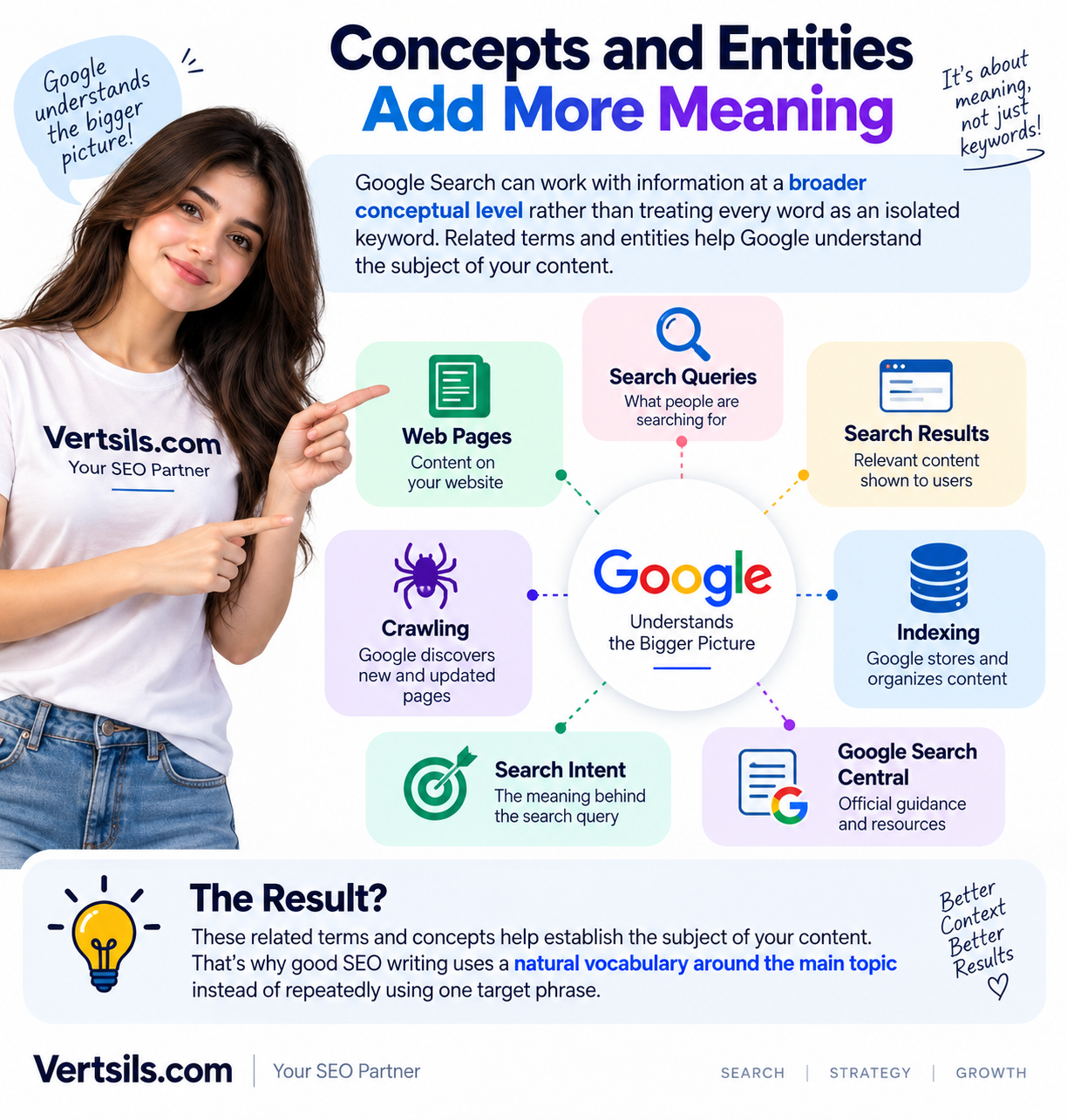
Concepts and Entities Add More Meaning
Google Search can work with information at a broader conceptual level rather than treating every word as an isolated keyword.
For example, an article about Google Search might naturally discuss:
Search queries
Search results
Crawling
Indexing
Search intent
Web pages
Google Search Central
These terms and concepts help establish the subject of the content.
This is one reason good SEO writing usually contains a natural vocabulary around the main topic instead of repeatedly using one target phrase.
Keyword Relevance Depends on the Whole Page
A keyword does not exist in isolation.
Google can evaluate the broader content of a page to understand what the page is actually about. Its systems can consider the relationship between the main topic, supporting information, terminology, and the search query.
For example, a page targeting “SEO audit” should explain what an SEO audit involves and discuss relevant concepts such as:
Technical issues
Indexing
On-page SEO
Internal links
Crawlability
Content quality
Simply mentioning “SEO audit” dozens of times would not provide the same contextual value.
The relevance of the information matters more than the number of times the keyword appears.
Keyword Repetition Is Not the Goal
Repeating a keyword excessively can make content unnatural and difficult to read.
For example:
“Our SEO services provide SEO services for businesses looking for SEO services and professional SEO services.”
This does not provide additional information. It simply repeats the same phrase.
Google identifies excessive, unnatural keyword repetition as keyword stuffing, which is considered a spam practice.
A better approach is to explain the subject naturally and use terminology that genuinely belongs to the topic.
Do You Need Every Keyword Variation?
No.
A common misconception is that a page needs to contain every possible variation of its target keyword.
For example, a page about how Google understands keywords does not need to repeatedly use:
How Google interprets keywords
How Google reads keywords
How search engines understand keywords
How Google understands search terms
Google keyword interpretation
These phrases are related, but forcing all of them into the page can make the writing unnatural.
Instead, explain the underlying concept clearly and use variations only when they fit naturally.
How to Write Content Google Can Understand
You cannot control exactly how Google’s Search systems interpret a page, but you can make the subject and purpose of your content clear.
A practical approach is to:
Define the main topic clearly.
Use the primary keyword naturally.
Include relevant terms that genuinely support the topic.
Explain important concepts rather than repeating phrases.
Address the searcher’s likely intent.
Use descriptive headings that reflect the content.
Avoid unrelated keyword variations.
Write primarily for people, not keyword frequency.
This approach creates content that is easier for readers to understand while also providing clear topical context for search engines.
Common Mistake: Writing for Keyword Density
Keyword density refers to the percentage or frequency of a keyword within a piece of content.
There is no need to write an article around an arbitrary keyword-density percentage.
For example, forcing a keyword into every heading or paragraph can reduce readability without improving the usefulness of the page.
Instead, focus on whether the article fully and naturally explains the subject.
If a keyword belongs in a sentence, use it. If a related term provides useful context, include it. If neither improves the content, leave it out.
The Key Takeaway
Google’s understanding of keywords goes beyond exact matches and repetition. Context, meaning, related terminology, concepts, and search intent all help communicate what a webpage is about.
For SEO content, the practical lesson is simple:
Use keywords naturally, explain the topic clearly, and provide relevant context instead of trying to repeat keywords as often as possible.
Good keyword optimization is not about making a page contain more keywords. It is about making the meaning and relevance of the content clear.
