
Running an online store is different from running a content website, and search engines treat the two differently too. An ecommerce site might have thousands of product pages, ever-changing inventory, and categories that overlap in confusing ways. SEO for ecommerce is the practice of structuring, optimizing, and maintaining an online store so that product and category pages can be found, understood, and ranked by search engines — while also helping shoppers find what they want to buy.
This article focuses specifically on what makes ecommerce SEO different from general SEO. It assumes you already understand basic search concepts and want to know how they apply to a store.
Why Ecommerce SEO Is Different
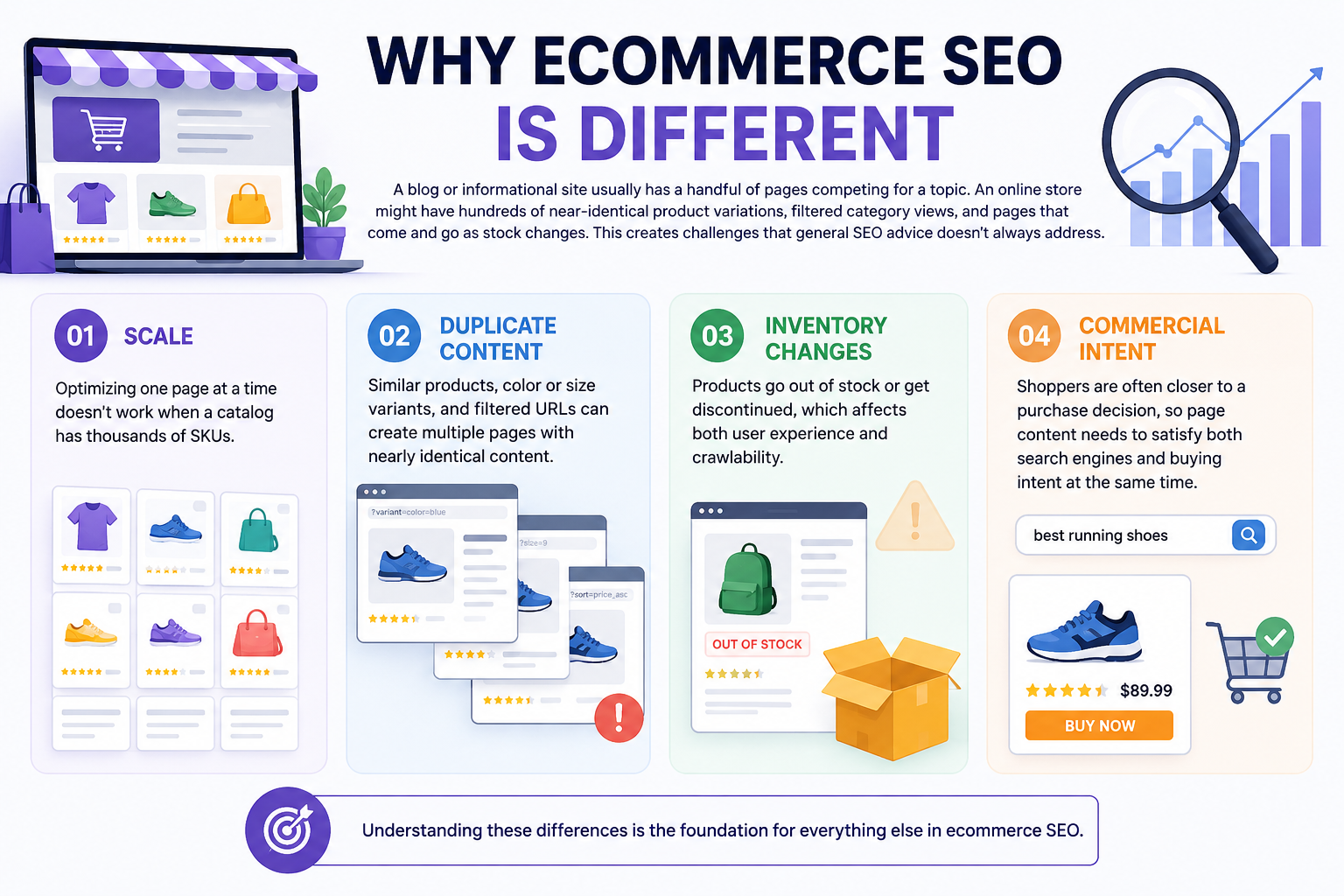
A blog or informational site usually has a handful of pages competing for a topic. An online store might have hundreds of near-identical product variations, filtered category views, and pages that come and go as stock changes. This creates challenges that general SEO advice doesn’t always address:
- Scale. Optimizing one page at a time doesn’t work when a catalog has thousands of SKUs.
- Duplicate content. Similar products, color or size variants, and filtered URLs can create multiple pages with nearly identical content.
- Inventory changes. Products go out of stock or get discontinued, which affects both user experience and crawlability.
- Commercial intent. Shoppers are often closer to a purchase decision, so page content needs to satisfy both search engines and buying intent at the same time.
Understanding these differences is the foundation for everything else in ecommerce SEO.
Product Page Optimization
Product pages are the core revenue-driving pages of a store, and they need enough unique content to be understood by search engines as distinct, valuable pages.
Unique product descriptions. Copying manufacturer descriptions word-for-word across many retailers is one of the most common causes of thin or duplicate content in ecommerce. Writing original descriptions that explain what a product does, who it’s for, and how it compares to alternatives gives search engines something meaningful to index.
Descriptive titles and headings. A clear H1 that includes the product name, along with a title tag that reflects how people actually search for the item, helps both relevance and click-through rate.
Structured product information. Specifications, sizing, materials, and compatibility details help answer buyer questions directly on the page, reducing the chance a shopper bounces to search elsewhere for answers.
Images and alt text. Product photos should be compressed for performance and include descriptive alt text, which supports accessibility and image search visibility.
Category Page Strategy
Category pages often carry more ranking potential than individual product pages because they target broader, higher-volume search terms like “running shoes” or “wireless headphones.”
A strong category page includes:
- A short, genuinely useful description of the category above or below the product grid
- Logical, consistent internal linking to subcategories and top products
- Clear breadcrumb navigation
- A URL structure that reflects the site’s category hierarchy
Category pages should not be treated as pure product listings with no text. Even a few well-written paragraphs can give search engines the context needed to rank the page for relevant terms.
Handling Duplicate Content and Faceted Navigation
Filters for size, color, price, and brand are useful for shoppers but can generate an enormous number of URL variations, many of which show nearly the same products. Left unmanaged, this can dilute crawl efficiency and create duplicate content signals.
There is no single correct solution, and the right mix depends on the platform, catalog size, and which filter combinations actually have search demand. Common approaches include:
- Canonical tags pointing low-value filtered variations back to the main category URL
- Crawl controls (such as robots.txt rules or link-level handling) to limit how deep filter combinations get crawled
- Keeping indexable, well-linked landing pages for filter combinations that do have real search demand (for example, a “blue running shoes” filter that gets meaningful search volume)
- Careful internal linking so search engines are guided toward the filter combinations worth indexing
noindexwhere appropriate, kept in mind that a page still needs to be crawled before anoindexdirective is seen, so it works best alongside crawl and linking controls rather than as a standalone fix
The underlying goal is the same across all of these: let shoppers filter freely without creating thousands of thin, competing pages for search engines to sort through.
Out-of-Stock and Discontinued Products
How a store handles unavailable products affects both user trust and SEO. A few practical patterns:
- Temporarily out of stock: Keep the page live, mark it clearly as unavailable, and offer alternatives or a restock notification if possible.
- Permanently discontinued with a close replacement: Redirect the old URL to the most relevant current product.
- Permanently discontinued with no replacement: Consider keeping a simple page explaining the product is no longer available, rather than returning a broken link, especially if the page has earned backlinks or rankings.
Removing pages abruptly without a plan can waste accumulated ranking signals and create a poor experience for anyone who lands there from search or a saved link.
Ecommerce Keyword Targeting
Ecommerce keyword research involves matching product, category, brand, and attribute terms to the right page type. Search intent matters more than volume here: a query like “best running shoes” usually calls for informational or comparison content, while “buy Nike running shoes” points toward a category or product page. Mapping keywords to the correct page type up front helps avoid building pages that compete with each other for the same search terms.
Site Structure and Navigation
A clear hierarchy — home page, top-level categories, subcategories, then products — makes it easier for both shoppers and search engines to understand how a catalog is organized. Important products should be reachable through a logical navigation and internal-linking structure, without requiring users or search engines to work through unnecessarily deep paths to find them.
Internal linking plays a supporting role here too: linking related products, “customers also bought” sections, and category-to-subcategory links all help distribute relevance throughout the site.
Reviews and Structured Data
Customer reviews add fresh, unique content to product pages and can influence purchase decisions directly on the page. When implemented with structured data (schema markup), review information can also become eligible for rich results in search, such as star ratings.
Product structured data can also communicate price, availability, and product identifiers to search engines in a standardized format, which supports accurate representation in search results and shopping-related features. It’s worth noting that structured data makes a page eligible for rich results — it doesn’t guarantee that search engines will display them.
Site Speed and Mobile Experience
Ecommerce sites tend to be image-heavy and script-heavy, which makes performance a recurring challenge. Slow-loading product pages or clunky mobile checkouts increase the likelihood of a shopper leaving before converting, and usability signals such as Core Web Vitals are part of how search engines assess page experience. Compressing images, minimizing unnecessary scripts, and testing the mobile buying flow are ongoing maintenance tasks rather than one-time fixes.
Common Mistakes in Ecommerce SEO
- Publishing thin category pages with no descriptive text
- Using manufacturer descriptions unchanged across many products
- Letting filtered navigation generate uncontrolled duplicate URLs
- Deleting out-of-stock or discontinued product pages without redirects
- Ignoring internal linking between related products and categories
- Treating product images as an afterthought for performance and accessibility
Summary
Ecommerce SEO applies core search optimization principles to the specific realities of running an online store: large catalogs, duplicate content risks, changing inventory, and strong commercial intent. Getting it right means giving product and category pages genuine, unique value; managing filtered navigation and out-of-stock products thoughtfully; and building a site structure that’s easy for both shoppers and search engines to navigate. These fundamentals stay relevant regardless of platform or catalog size, and they form the foundation for more advanced ecommerce SEO work down the line.
