
Blogging can help you build an audience, share knowledge, and attract visitors through organic search. But publishing useful articles alone does not guarantee that people will find them.
SEO for bloggers is the process of making blog content easier for search engines to discover, understand, and connect with relevant searches while keeping the content genuinely useful for readers.
The goal is not to write for search engines. It is to create helpful content that satisfies what people are looking for and then make that content easier to discover through search.
Why SEO Matters for Bloggers
Search engines can be an important source of long-term traffic for blogs. A well-optimized article can continue attracting visitors from relevant searches long after it is published.
SEO also helps bloggers understand what their audience wants to learn. Search queries reveal the questions, problems, and topics people are actively exploring.
However, SEO should support the content rather than control it. Google recommends creating helpful, reliable, people-first content instead of content designed primarily to manipulate search rankings.
What Makes SEO for Bloggers Different?
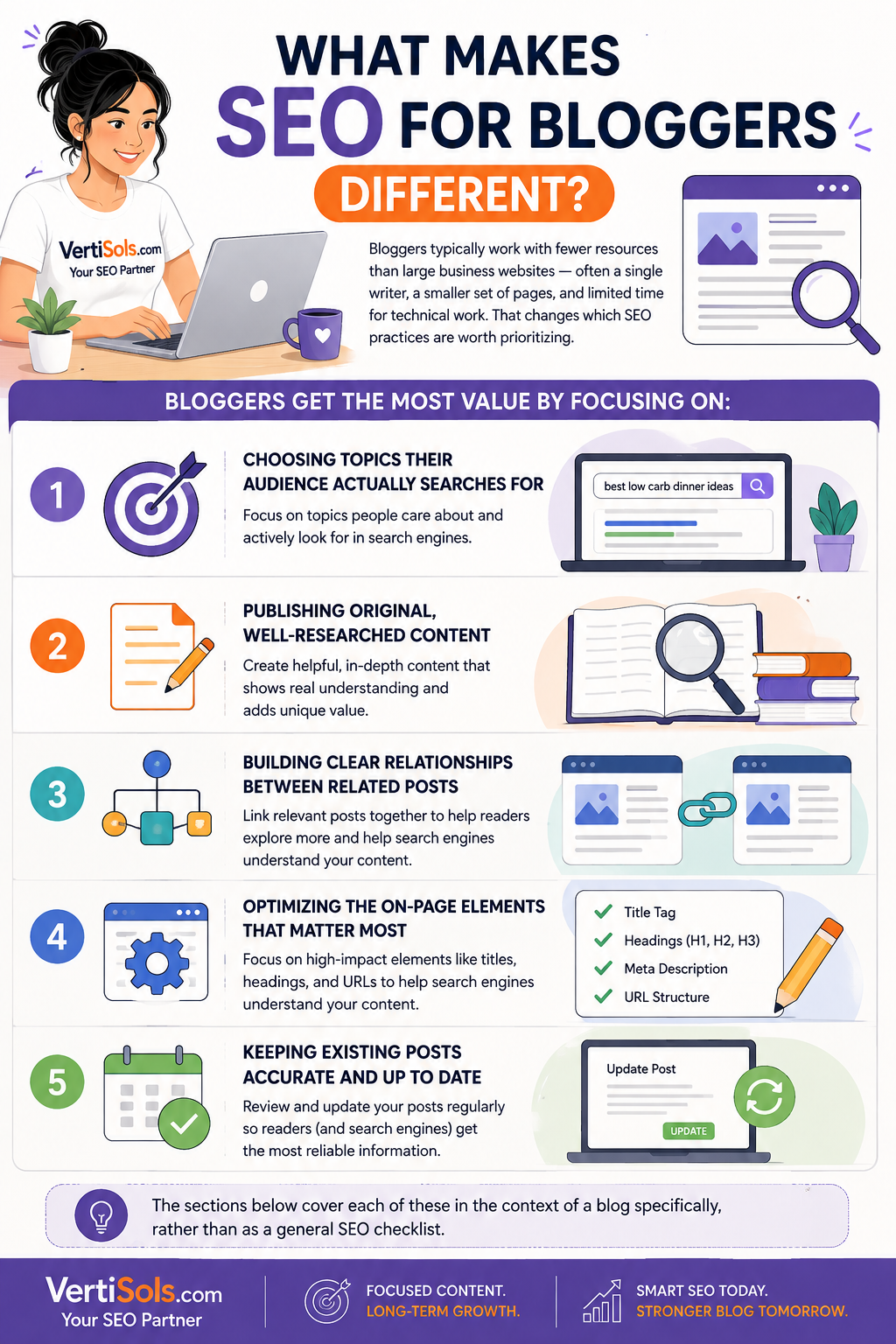
Bloggers typically work with fewer resources than large business websites — often a single writer, a smaller set of pages, and limited time for technical work. That changes which SEO practices are worth prioritizing.
Rather than trying to apply every SEO tactic at once, bloggers tend to get the most value from:
- Choosing topics their audience actually searches for
- Publishing original, well-researched content
- Building clear relationships between related posts
- Optimizing the on-page elements that matter most, such as titles, headings, and URLs
- Keeping existing posts accurate and up to date
The sections below cover each of these in the context of a blog specifically, rather than as a general SEO checklist.
Start With a Clear Blog Topic
A clear subject helps a blog build a coherent collection of content around related topics. Instead of publishing unrelated articles simply because they have search volume, choose topics that are relevant to your audience and connected to the purpose of the blog.
For example, a food blog might focus on:
- Easy home recipes
- Cooking techniques
- Ingredient guides
- Meal planning
- Kitchen tips
This creates a consistent topical focus and gives readers a reason to explore other articles on the site.
Understand Search Intent
Before writing an article, determine what the searcher actually wants.
Search intent is the underlying purpose behind a search query. A person searching for “how to start a vegetable garden” probably wants instructions, while someone searching for “best vegetables to grow in summer” may be looking for recommendations or ideas.
Your article should match that purpose.
Ask:
- What question is the reader trying to answer?
- What information do they expect to find?
- What format would make the answer easiest to understand?
- What additional information is necessary to satisfy the search?
Matching search intent is more useful than simply repeating a keyword throughout an article.
Choose Relevant Keywords
Keyword research helps bloggers identify the language people use when searching for information.
Look beyond one primary keyword. Consider related phrases, questions, synonyms, and closely connected concepts.
For example, an article targeting SEO for bloggers might naturally cover related terms such as:
- blog SEO
- SEO blog writing
- blogging SEO
- organic search traffic
- keyword research for blogs
- search intent
- SEO-friendly blog posts
- internal links
- blog content optimization
These terms should appear naturally where they help explain the subject. Avoid inserting keywords where they make the writing awkward or repetitive.
Google specifically identifies keyword stuffing as a spam practice, including excessive repetition that makes content sound unnatural.
Create Helpful, Original Content
The most important part of SEO for bloggers is the content itself.
A strong blog post should provide information that readers can actually use. It should answer the main question clearly, add useful context, and avoid simply rewriting information that already exists elsewhere.
Useful content can include:
- Original examples
- Practical explanations
- First-hand observations where appropriate
- Clear comparisons
- Step-by-step instructions
- Relevant data or evidence
- Answers to common questions
Google’s guidance encourages content that provides original information, substantial value, and a satisfying experience rather than content created primarily to attract search traffic.
Write SEO-Friendly Blog Titles
The title is important for both readers and search engines.
A good blog title should clearly communicate what the article covers without exaggeration or unnecessary keyword repetition.
For example:
Weak: SEO Tips SEO Guide SEO Blog SEO Blogging Tips
Better: SEO for Bloggers: How to Optimize Your Blog for Search
The second title gives readers a clear understanding of the page while naturally describing its topic.
Organize Your Blog Post Clearly
Use a logical heading structure to make longer articles easier to read and understand.
A typical article might use:
- One main title
- H2 headings for major sections
- H3 headings for supporting points
Keep paragraphs relatively short and use lists when they make information easier to scan.
Clear organization benefits readers and also helps search engines understand the relationships between different parts of the content.
Optimize Individual Blog Pages
Basic on-page SEO can help search engines understand each article.
Important elements include:
- Descriptive page titles
- Useful meta descriptions
- Clear headings
- Relevant and descriptive URLs
- Natural keyword usage
- Descriptive image alt text
- Helpful internal links
- Original, useful content
These elements should describe the page accurately rather than being treated as places to insert keywords.
Google’s SEO documentation explains that SEO can help search engines crawl, index, and understand website content.
Use Internal Links
Internal links connect one page on your blog to another relevant page on the same website.
For example, an article about SEO for bloggers could naturally link to a more detailed guide about keyword research, allowing readers to explore that subject without interrupting the main article.
Good internal linking can:
- Help readers discover related content
- Establish relationships between topics
- Help search engines discover other pages
- Strengthen the structure of your content library
Links should be added because they are useful to the reader, not simply to increase the number of internal links on a page.
Over time, a group of related posts connected through internal links can function as a content cluster — helping readers, and search engines, understand how your coverage of a subject fits together.
Optimize Images for Blog Content
Images can make blog posts easier to understand, but they should also be relevant and properly described.
Use meaningful image filenames and descriptive alt text when appropriate. Choose suitable image formats and avoid unnecessarily large files that can slow down the page.
Images should support the article rather than exist only as decoration.
Technical SEO Basics for Bloggers
Bloggers don’t need to become technical SEO specialists, but a few fundamentals are worth checking:
- Pages should load at a reasonable speed, especially on mobile devices.
- Each post should be crawlable and indexable, without accidental noindex or blocking settings.
- URLs should be descriptive rather than generic strings of numbers or characters.
- Images should include descriptive alt text.
- The blogging platform should allow control over titles, meta descriptions, and heading structure.
These fall under the broader umbrella of technical SEO, which is worth exploring in more depth separately for anyone managing a larger or more complex blog.
Keep Your Content Accurate and Trustworthy
Bloggers should make it clear who created the content when appropriate and should take care with factual claims.
For topics where accuracy matters, use reliable sources and distinguish established information from personal opinions or recommendations.
Google’s people-first guidance specifically encourages clear authorship and content that demonstrates appropriate experience and expertise.
Update Existing Blog Posts When Needed
SEO does not end when an article is published.
Information can become outdated, links can stop working, and search intent can change. Review important articles periodically and update them when there is a genuine reason to do so.
Do not change publication dates or add unnecessary information simply to make an article appear fresh. Google specifically cautions against changing dates when the content has not substantially changed.
Avoid Common Blogging SEO Mistakes
Several practices can weaken a blog’s search performance and reader experience.
Keyword Stuffing
Repeating the same keyword excessively can make content difficult to read and may be considered keyword stuffing.
Writing Only for Search Traffic
Publishing articles on random topics solely because they appear to have search demand can produce an unfocused blog. Google recommends creating content for an existing or intended audience rather than primarily for search engines.
Copying Existing Content
Simply rewriting information from other websites provides little additional value. Add original explanations, examples, analysis, or useful context instead.
Publishing Overlapping Articles
Publishing multiple posts that target essentially the same search intent — for example, “How to Start a Vegetable Garden,” “Beginner’s Guide to Starting a Vegetable Garden,” and “How Beginners Can Start a Vegetable Garden” — can cause those posts to compete with each other instead of each ranking well on its own. This is different from having several related posts on a topic; the issue is when two or more articles serve the same purpose for the same reader. Give each one a clearly different angle or purpose instead.
Publishing Large Amounts of Low-Value Content
More articles do not automatically mean better SEO. Google warns against scaled content created primarily to manipulate search rankings when it provides little value to users.
Chasing a Specific Word Count
There is no ideal word count that guarantees better rankings. Write enough to satisfy the reader’s needs, then stop.
Google explicitly states that its systems do not have a preferred word count.
A Simple SEO Workflow for Bloggers
A practical blogging SEO process can be summarized as:
- Choose a topic relevant to your audience.
- Research the search queries and questions surrounding that topic.
- Identify the primary search intent.
- Create an outline that answers the reader’s main question.
- Write original, people-first content, using relevant keywords and related terminology naturally.
- Optimize the title, URL, headings, images, and other on-page elements.
- Add useful internal links to related content.
- Review for accuracy and completeness, publish, monitor performance, and update later if there’s a genuine reason to.
The process should remain focused on helping readers. SEO is the supporting layer that makes useful content easier to discover.
SEO for Bloggers: Quick Checklist
- Choose a topic relevant to your audience.
- Understand the search intent.
- Research relevant keywords and related questions.
- Write original and useful content.
- Create a clear, descriptive title.
- Structure the article with useful headings.
- Optimize the URL and on-page elements.
- Add relevant internal links.
- Use descriptive image alt text where appropriate.
- Make the page easy to read on different devices.
- Check facts, links, and important information.
- Review and update valuable content when necessary.
- Avoid keyword stuffing and low-value mass publishing.
Final Thoughts
SEO for bloggers is less about manipulating rankings and more about making valuable content discoverable.
Start with the reader, understand what they are searching for, create the best useful answer you can, and then apply sensible SEO practices to help search engines understand the page.
When bloggers consistently publish original, well-targeted content and connect it through clear internal linking, individual posts can build into a growing library of content that continues attracting relevant visitors over time. Google’s current guidance continues to emphasize people-first content, originality, accessibility, and a satisfying user experience.
