-
nimda
- June 5, 2026
Every search begins with a goal.
When someone enters a query into a search engine, they are trying to accomplish something specific. They may want to learn new information, visit a particular website, compare available options, or complete a purchase.
Search engines attempt to understand this underlying purpose and deliver results that best satisfy it. This purpose is known as search intent.
Understanding search intent helps explain why certain pages rank for specific keywords, why some content performs better than others, and how search engines determine which results are most relevant to users.
This guide explores the four primary types of search intent, how they differ, and why they play a central role in modern search.
What Is Search Intent?
Search intent, sometimes called user intent or keyword intent, refers to the reason behind a search query.
Rather than focusing solely on the words typed into a search box, search engines attempt to understand what the user is actually trying to achieve.
For example, someone searching “what is SEO” is usually looking for information, while someone searching “buy SEO software” is typically ready to take action.
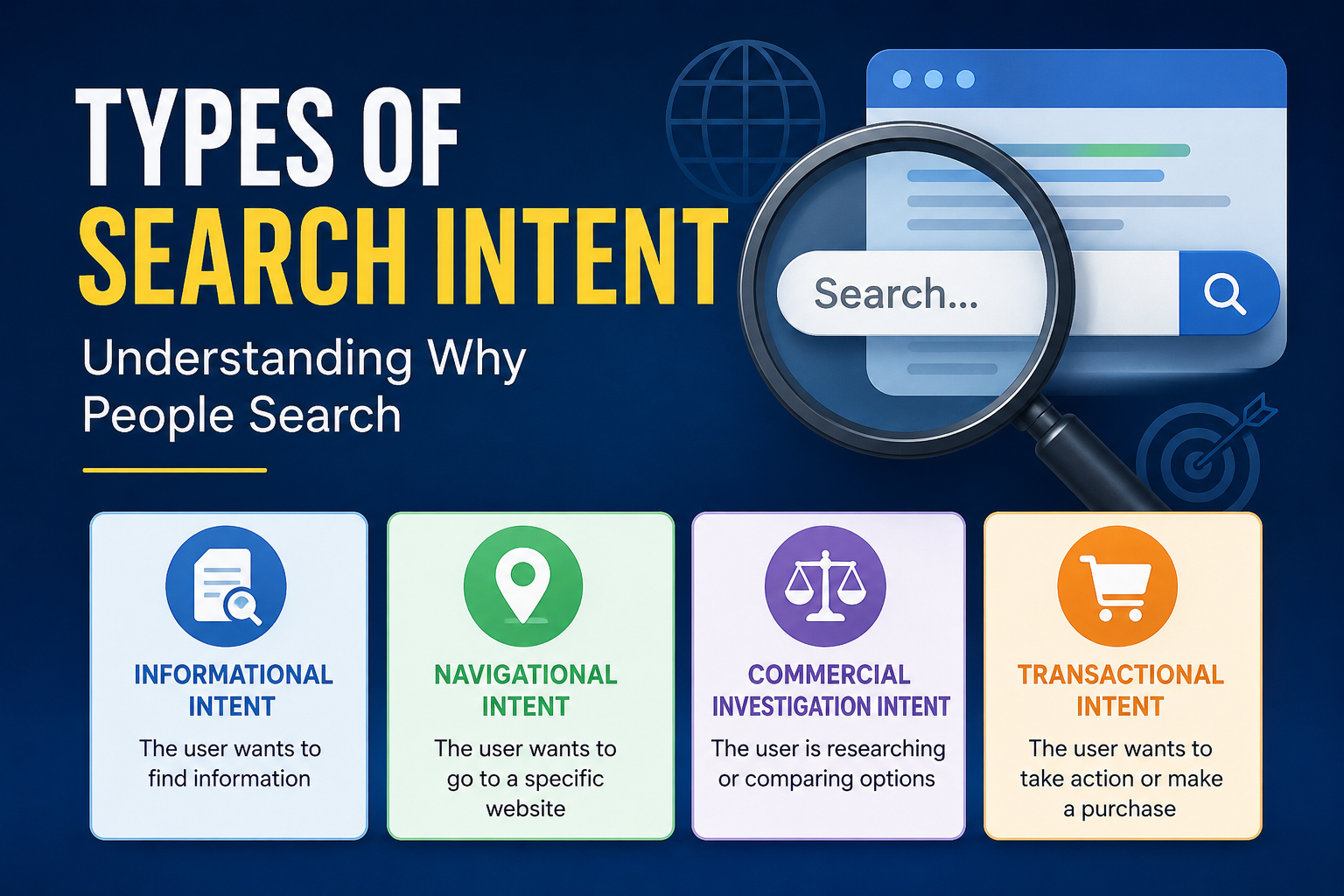
Although millions of unique searches occur every day, most queries can be grouped into four major intent categories:
Informational Intent
Navigational Intent
Commercial Investigation Intent
Transactional Intent
These categories help search engines organize search results according to user expectations.
Why Search Intent Became Important
Early search engines relied heavily on keyword matching.
If a page contained the same words as a search query, it often had a strong chance of ranking regardless of whether it fully satisfied the user’s needs.
As search technology evolved, search engines became increasingly focused on understanding user behavior and delivering more relevant results.
Today, search engines analyze far more than keywords alone. They consider factors such as:
Search context
User expectations
Query meaning
Content relevance
Historical engagement patterns
This shift transformed search from simple keyword matching into intent-based information retrieval.
As a result, understanding search intent has become one of the most important aspects of modern SEO.
The Four Primary Types of Search Intent
Although search behavior can vary significantly, most queries fall into one of four primary categories.
Informational Intent
Informational intent occurs when users want to learn, understand, or discover something.
They are looking for knowledge rather than attempting to complete a transaction.
These searches often involve questions, explanations, definitions, or educational content.
Characteristics of Informational Searches
Users may want to:
Learn a concept
Understand a process
Find an answer
Solve a problem
Follow instructions
Explore a topic

Examples of Informational Intent
| Search Query | User Goal |
|---|---|
| What is SEO | Learn a concept |
| How search engines work | Understand a process |
| What is keyword research | Gain knowledge |
| How to improve page speed | Solve a problem |
| Types of search intent | Learn a topic |
Common Content Formats
Search engines often rank:
Guides
Tutorials
Educational articles
Definitions
Knowledge resources
How-to content
Most SEO educational content targets informational intent because users are seeking understanding rather than action.
Navigational Intent
Navigational intent occurs when users already know where they want to go.
Instead of searching for information, they use a search engine to locate a specific website, platform, page, or online destination.
Characteristics of Navigational Searches
Users typically:
Know the brand name
Know the website
Want a specific page
Need a login portal
Want quick access to a resource

Examples of Navigational Intent
| Search Query | Intended Destination |
|---|---|
| Gmail | Email service |
| YouTube | Video platform |
| Ahrefs login | Login page |
| Google Search Console | Specific platform |
| Social network |
Common Search Results
Search engines usually prioritize:
Official websites
Brand homepages
Login pages
Platform-specific resources
The goal is to help users reach their destination as efficiently as possible.
Commercial Investigation Intent
Commercial investigation intent exists when users are evaluating options before making a decision.
The user has moved beyond basic research but is not yet ready to take action.
Instead, they are comparing alternatives, reviewing solutions, and gathering information that may influence a future decision.
Characteristics of Commercial Investigation Searches
Users may want to:
Compare products
Compare services
Explore alternatives
Read reviews
Evaluate features
Assess value

Examples of Commercial Investigation Intent
| Search Query | User Goal |
|---|---|
| Best SEO tools | Compare options |
| Ahrefs vs Semrush | Evaluate alternatives |
| Website builder reviews | Research solutions |
| Best project management software | Compare products |
| Semrush pricing | Assess value |
Common Content Formats
Search engines often rank:
Comparison articles
Review content
Product roundups
Buying guides
Feature comparisons
These searches indicate that users are actively researching before making a decision.
Transactional Intent
Transactional intent occurs when users are ready to complete a specific action.
In many cases, that action involves purchasing a product, subscribing to a service, downloading software, or registering for an account.
The user has already completed much of the evaluation process and is now focused on execution.
Characteristics of Transactional Searches
Users may want to:
Buy
Subscribe
Register
Download
Order
Sign up
Examples of Transactional Intent
| Search Query | Intended Action |
|---|---|
| Buy SEO software | Purchase |
| Subscribe to Netflix | Subscription |
| Download Chrome browser | Download |
| Sign up for Ahrefs | Registration |
| Order running shoes online | Purchase |
Common Content Formats
Search engines frequently prioritize:
Product pages
Pricing pages
Service pages
Checkout pages
Conversion-focused landing pages
These pages help users complete their intended action quickly and efficiently.
Comparing the Four Types of Search Intent
The following table highlights the differences between each intent category.
| Intent Type | Primary Goal | Example Query | Typical Content |
|---|---|---|---|
| Informational | Learn | What is SEO | Guides and tutorials |
| Navigational | Reach a destination | Gmail login | Official websites |
| Commercial Investigation | Compare options | Ahrefs vs Semrush | Reviews and comparisons |
| Transactional | Take action | Buy SEO software | Product and landing pages |
Understanding these distinctions helps explain why different search queries produce different types of search results.
How Search Results Change Based on Search Intent
Search engines tailor search results according to the intent behind a query.
Different intents often trigger different search result layouts and features.
| Intent Type | Common Search Features |
|---|---|
| Informational | AI Overviews, Featured Snippets, People Also Ask |
| Navigational | Official websites, homepage listings |
| Commercial Investigation | Reviews, comparison content, list articles |
| Transactional | Product pages, shopping results, pricing pages |
This variation demonstrates how search engines attempt to align search results with user expectations.
Why Search Intent Matters More Than Keywords Alone
Keywords remain important because they help search engines understand a topic.
However, keywords alone do not reveal the complete purpose behind a search.
Two users may use different phrases while pursuing the same goal.
Likewise, two similar-looking keywords may represent entirely different intentions.
For example:
“What is SEO” indicates a desire to learn.
“SEO services pricing” indicates evaluation.
“Hire an SEO agency” suggests action.
Modern search engines increasingly focus on satisfying the user’s goal rather than simply matching words.
As a result, understanding intent is often more valuable than focusing solely on keyword placement.
How Search Intent Changes Throughout the User Journey
Search intent is not always static.
As users move through a decision-making process, their searches often evolve.
A typical journey might look like this:
Stage 1: Learning
Search Query:
What is SEO
Intent:
Informational
Stage 2: Researching Solutions
Search Query:
Best SEO tools
Intent:
Commercial Investigation
Stage 3: Comparing Options
Search Query:
Ahrefs vs Semrush
Intent:
Commercial Investigation
Stage 4: Taking Action
Search Query:
Buy SEO software
Intent:
Transactional
This progression demonstrates how user needs can change over time.
Can a Keyword Have Multiple Intent Types?
Yes.
Not every query fits neatly into a single category.
Some searches display mixed intent, meaning different users may have different goals when searching the same keyword.
For example:
“SEO tools”
Some users may want:
Definitions
Tool recommendations
Product comparisons
Purchasing options
In these situations, search engines evaluate user behavior and determine which intent appears most common among searchers.
The dominant intent usually influences which content types rank most prominently.
Common Search Intent Mistakes
Misunderstanding intent is one of the most common reasons content struggles to perform in search results.
Creating Sales Pages for Informational Queries
Users seeking education typically expect explanations and guidance rather than promotional content.
Creating Educational Articles for Transactional Queries
Users ready to act often prefer product pages, pricing information, or sign-up options.
Ignoring Existing Search Results
Search results often provide strong clues about the dominant intent behind a keyword.
Combining Multiple Intent Types Into One Page
Attempting to satisfy every intent simultaneously can reduce relevance and create a confusing user experience.
Example of Intent Mismatch
Consider the keyword:
“What is SEO”
Poor Match
A service-focused landing page attempting to sell SEO packages.
Strong Match
An educational article explaining the concept of SEO.
Now consider:
“Buy SEO software”
Poor Match
A lengthy informational guide.
Strong Match
A product page designed to help users complete a purchase.
These examples illustrate how intent alignment influences content relevance.
How Search Intent Fits Into SEO
Search intent influences nearly every aspect of content planning and optimization.
It helps determine:
Content format
Content structure
Topic coverage
User expectations
Search result alignment
Intent also connects closely with keyword research, content strategy, search visibility, and user satisfaction.
For this reason, many SEO decisions begin with understanding why a user is searching before deciding what content to create.
Final Thoughts
Search intent is the foundation of modern search.
Every query reflects a goal, and search engines work to connect users with content that best satisfies that goal.
The four primary types of search intent—informational, navigational, commercial investigation, and transactional—provide a useful framework for understanding how people search and why different results appear for different queries.
Rather than focusing solely on keywords, effective SEO begins with understanding user objectives. When content aligns with intent, it becomes more relevant, more useful, and more likely to satisfy both users and search engines.
Understanding the different types of search intent is therefore not just an SEO skill—it is a fundamental part of understanding how search itself works.
- commercial investigation intent
- content strategy
- informational intent
- intent based SEO
- keyword intent
- navigational intent
- search behavior
- search engine optimization
- search intent
- search intent examples
- search marketing
- search query intent
- seo fundamentals
- SEO learning
- SERP intent
- transactional intent
- types of search intent
- understanding search intent
- user intent
- user search intent
