

SEO Learning Center · SEO Terminology
What Is Thin Content, and Why Does It Hurt Your Rankings?
Thin content is a webpage that provides too little meaningful value for what it's meant to accomplish — and word count has almost nothing to do with it. Here's what actually makes content thin, how it happens, and how to fix it.
Not the same as short content
Scaled content abuse
Thin affiliate content
Related guides
Definition
What Is Thin Content?
Thin content is a webpage that provides too little meaningful value for what the page is intended to accomplish. It may contain very little useful information, repeat generic material, copy information without adding value, or fail to satisfy the visitor's search intent.
The key point is that thin content is not simply short content. A short page can be useful when it completely answers a focused question, while a long article can still be thin if it is repetitive, vague, or padded with filler.
Google's guidance confirms that there is no preferred word count. Content should be as long as necessary to satisfy the user's needs — not as long as possible.
Warning signs
What Makes Content Thin?
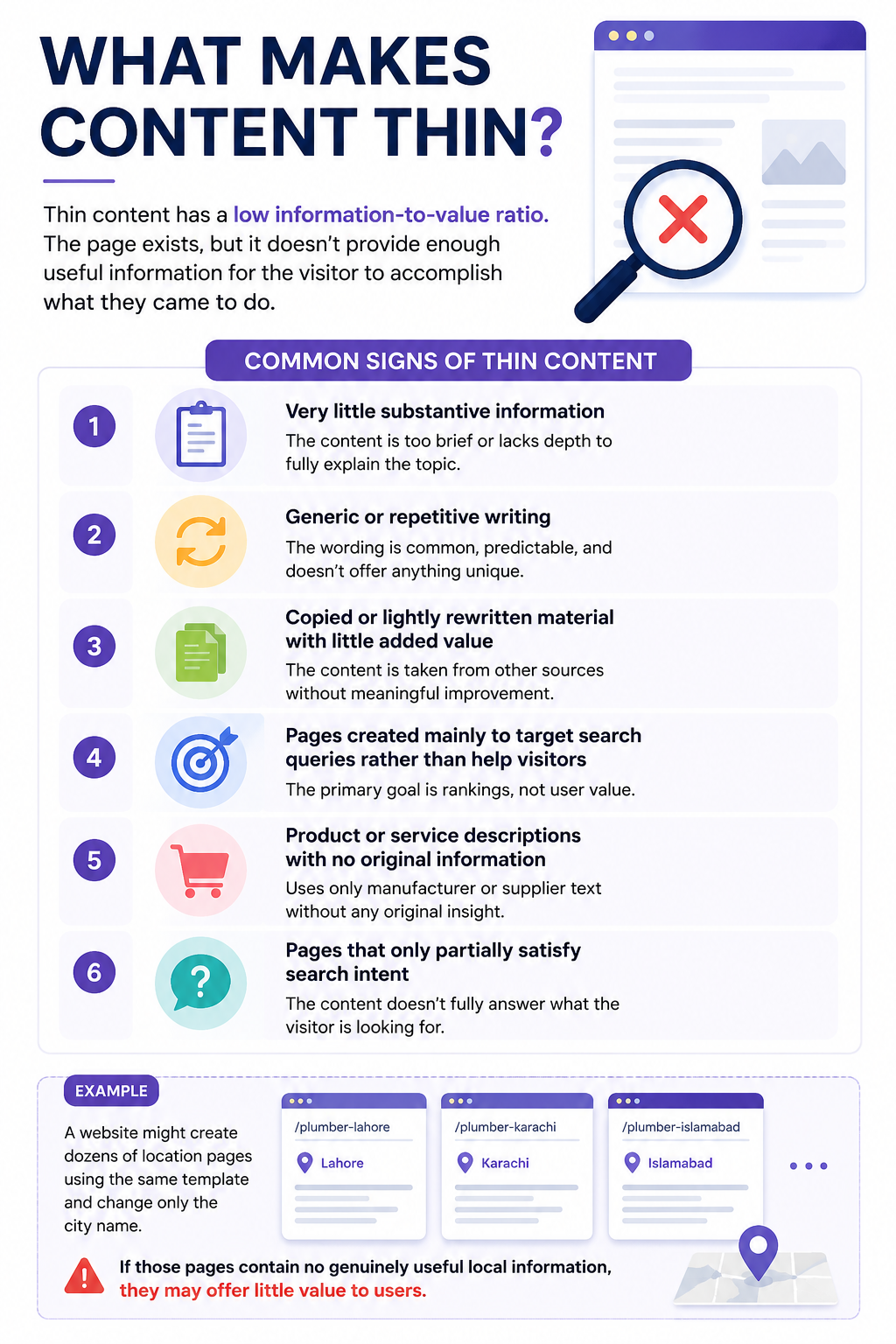
Thin content generally has a low information-to-value ratio. The page exists, but it doesn't provide enough useful information for the visitor to accomplish what they came to do.
For example, a website might create dozens of location pages using the same template and change only the city name. If those pages contain no genuinely useful local information, they may offer little value to users.
Common confusion
Is Thin Content the Same as Short Content?
No. A 400-word page can be excellent if it completely answers a specific question. A 2,000-word page can be thin if most of its words repeat obvious information without adding useful insight.
Google has explicitly stated that word count is not an indicator of thin content. A substantial topic can be covered in one detailed resource or divided into several focused, interlinked pages. Both approaches can be appropriate when they serve users well.
"Does this page provide enough useful information for its intended purpose?"
This makes usefulness, relevance, originality, completeness, and search intent more important than an arbitrary word-count target.
Four patterns to watch for
Common Types of Thin Content
01
Low-Value Pages
Some pages contain so little useful information that they do not adequately address the visitor's needs. A page titled "What Is SEO?" with only a one-sentence definition may be too limited if its purpose is to provide a useful introduction.
02
Duplicate or Near-Duplicate Content
Pages that substantially repeat information found elsewhere may provide little additional value. However, thin content and duplicate content are related but not the same thing — a page can be thin without being duplicated.
03
Thin Affiliate Content
Google specifically identifies thin affiliation as a form of spam — when affiliate pages copy product descriptions or reviews without adding original information, reviews, comparisons, testing, or pricing details.
04
Scaled Low-Value Content
Google's spam policy describes scaled content abuse as producing many pages with little or no value for users — manually, automatically, or with generative AI. The issue is the lack of user value, not the production method.
Impact
Why Does Thin Content Matter for SEO?
Thin content matters because Google's ranking systems aim to surface helpful, reliable, people-first information. A page that doesn't adequately meet a user's needs may rank below a stronger resource that provides a more satisfying answer.
Thin content can also create practical site-management problems: large collections of similar or low-value URLs dilute the purpose of individual pages and add unnecessary crawling and indexing complexity. We cover that mechanism in more depth in our crawl budget guide — in short, it's a concern that matters most for very large or complex sites rather than most small ones.
It's also important not to treat thin content as a simple Google penalty. A short page isn't automatically penalized, and deleting every short page isn't an SEO requirement. The right decision depends on the page's purpose, quality, usefulness, and role within the site.
How it happens
Common Causes of Thin Content
Thin content often happens unintentionally. Common causes include:
Programmatic Page Creation
Templates can generate large numbers of pages with very little unique information between them. This is especially risky when each page exists mainly to target a slightly different keyword or location.
Over-Segmentation
Site owners sometimes divide a useful topic into many extremely narrow pages, which leaves each page unable to provide a complete answer on its own. Breaking a large topic into focused articles isn't inherently thin content — each article just needs enough value to stand on its own.
Rushed Content Production
Pages published before proper research or development often contain generic statements, missing information, or unfinished sections.
Redesigns and Content Changes
Website redesigns, migrations, or template changes can sometimes leave placeholder copy, incomplete pages, or old URLs with very little useful content.
Content audit
How to Identify Thin Content
A useful content audit should look beyond word count. Instead, evaluate each page against its intended purpose and search intent. Ask:
- Does the page clearly answer the question behind the search?
- Does it provide enough information for the topic?
- Does it contain useful, original, or meaningfully added information?
- Is it substantially different from similar pages on the site?
- Would a visitor learn something useful from it?
- Does the page leave the reader needing to search again for a basic answer?
- Was the page created primarily for people or primarily to attract search traffic?
- Could several similar pages be combined without losing useful information?
If several answers are no, the page is a strong candidate for review and improvement.
Remediation
How to Fix Thin Content
The goal isn't to add words simply to make a page longer — it's to increase its usefulness.
1
Improve the Page
Add information that users genuinely need — clearer explanations, examples, original research, comparisons, practical details, or answers to closely related questions.
2
Improve Search Intent Satisfaction
Make sure the page matches what the searcher actually wants. A page can contain plenty of information and still be thin in practical terms if it answers the wrong question.
3
Add Original Value
If the page relies heavily on information available elsewhere, add meaningful value rather than simply rewriting the same material — original analysis, experience, evidence, examples, or useful comparisons.
4
Remove Repetition and Filler
Don't expand a page with unnecessary paragraphs. Replace repetition with information that improves understanding, or remove material that serves no useful purpose.
5
Consolidate Similar Pages
If several pages cover essentially the same narrow topic and none provides enough unique value, combining them into a stronger resource may be appropriate. Handle the redirect and canonical strategy carefully when you consolidate — see our canonicalization guide for the mechanics.
6
Remove Pages That Serve No Useful Purpose
If a page has no meaningful purpose, can't reasonably be improved, and provides no value to users, removal may be appropriate. noindex can be relevant in specific situations, but shouldn't be used as a blanket fix for every short or weak page.
At a glance
Thin Content vs. Helpful Short Content
| Thin Content | Helpful Short Content |
|---|---|
| Provides little useful information | Answers a focused question clearly |
| May repeat generic information | Provides relevant and useful information |
| Often fails to satisfy search intent | Satisfies the intended search intent |
| May exist mainly for search visibility | Exists to help the user |
| Can lack originality or added value | Can provide clear, purposeful information |
| May be short or long | Can be short because the topic requires little explanation |
The difference is value, not volume.
Set the record straight
Common Misconceptions About Thin Content
Myth
"Longer Content Always Ranks Better"
Not true. Length isn't a substitute for usefulness. A concise page that fully answers a focused question can be more valuable than a long article filled with repetition.
Myth
"Thin Content Only Means Low Word Count"
No. A page can contain thousands of words and still provide little value if it's vague, repetitive, copied, or poorly aligned with search intent.
Myth
"Every Short Page Should Be Expanded"
No. If a page completely satisfies its purpose, increasing its word count may make it worse rather than better.
Myth
"AI-Generated Content Is Automatically Thin"
No. Google doesn't define content quality simply by how it was produced. The important questions are whether the content is useful, original, reliable, and created primarily to help people. That said, generating large numbers of low-value pages with AI or other automation can still fall under Google's scaled content abuse policy.
Save this
Quick Thin Content Checklist
Use this checklist when reviewing an existing page:
- Does it fully satisfy the searcher's intent?
- Does it provide enough information to accomplish the page's purpose?
- Does it offer original or meaningfully added value?
- Is it substantially different from similar pages on the site?
- Would the reader learn something useful from it?
- Is any of the content repetitive or added only to increase length?
- Could similar pages be consolidated without losing useful information?
- Was the page created primarily to help people rather than to capture search traffic?
If a page fails several of these checks, review whether it should be improved, consolidated, or removed.
Final takeaway
Thin content is content that provides insufficient value for its intended purpose — not simply content that is short.
The best way to address thin content is to evaluate each page from the user's perspective. Identify what the visitor needs, determine what's missing, remove unnecessary repetition, and add meaningful information where it improves the resource.
For SEO, the goal isn't to make every page longer — it's to make every important page useful, relevant, original, purposeful, and satisfying.
That approach aligns with Google's current emphasis on helpful, reliable, people-first content and provides a stronger foundation for sustainable search visibility.
Keep exploring the Learning Center
Not sure which of your pages are thin?
We'll run a free audit and show you exactly which pages need improving, consolidating, or removing — and why.
Get a Free Audit →